
Preview
Hüseyin Akbulut, MSc (2026). Katie Ledecky and the Distance-Swimming Aerobic Dominance of an Elite Long-Distance Freestyler. Sporeus. Retrieved, October 10, 2026. https://sporeus.com/en/science/katie-ledecky-distance-swimming-aerobic-dominance/
The Athlete in One Paragraph
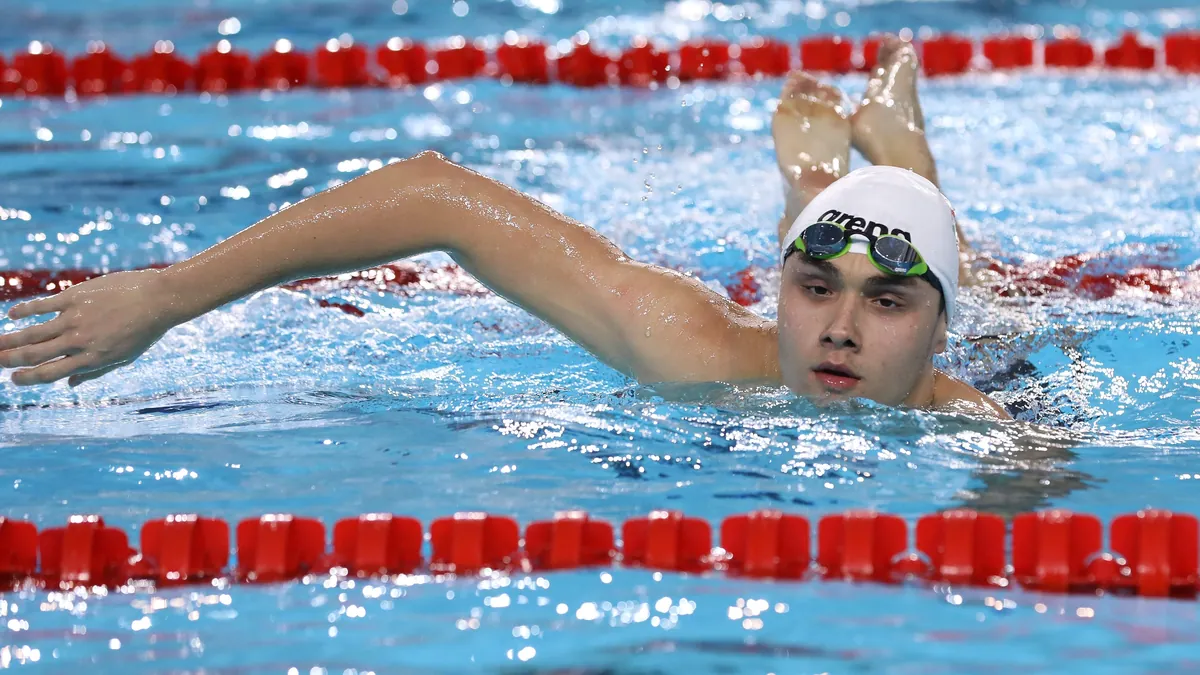
Kathleen Genevieve Ledecky (b. 1997-03-17, Washington, D.C., USA) is the defining female distance freestyler of her generation, multiple-time Olympic champion across the 200, 400, 800 and 1500 metres freestyle and the long-standing world-record holder in the 1500 metres. Listed at 1.83 m and roughly 70 kg, she carries the long-levered, low-density physique that distance swimming rewards — long arms for stroke-length leverage, a horizontal body position that minimises wave drag, and a relatively low body-mass-to-surface-area ratio that keeps drag-cost-per-stroke favourable across thousands of cycles. The interesting case for sport science is not whether Ledecky’s VO₂max is large in isolation; it is how high a sustained fraction of that ceiling she can hold across fifteen-and-a-half minutes of continuous propulsion in water — a medium that demands stroke economy and body-position control where running demands gait economy. The variable underneath that pattern is distance-swimming aerobic dominance — the same Joyner–Coyle endurance trio expressed through stroke mechanics rather than ground reaction force.
Table of Contents
The Physiology — what distance-swimming aerobic dominance actually is
Endurance performance in any locomotor mode is described by the same three-factor model Joyner and Coyle articulated for running: a maximal aerobic ceiling (VO₂max), the fraction of that ceiling that can be sustained without runaway lactate accumulation, and the metabolic cost of moving at a given submaximal velocity [1]. In running, that third term is running economy; in swimming, it is stroke economy — the oxygen cost per metre swum at a given velocity, governed by stroke length, stroke rate, body alignment, and the drag coefficient produced by the swimmer’s posture in the water [1, 2].
Saunders and colleagues catalogued the determinants of running economy — tendon stiffness, neuromuscular efficiency, body-mass distribution, accumulated training history — and the same logic translates almost intact to the pool, with two substitutions: instead of vertical oscillation the swimmer minimises lateral hip-yaw and body-line deviation, and instead of Achilles spring the swimmer relies on the elastic recoil of the trunk-and-shoulder kinetic chain [2]. The economy variable in swimming is harder to measure because the medium itself fights back — drag rises with the square of velocity — but the underlying biology is the same: cheaper submaximal locomotion frees a larger fraction of aerobic capacity for actual propulsion.
Faude and colleagues clarified that “the” lactate threshold is less important than the underlying steady-state biology — the velocity at which production and clearance balance, the velocity that can be held to exhaustion for around an hour [3]. In a 1500-metre freestyle that lasts roughly fifteen-and-a-half minutes the demand sits well above the maximal-lactate-steady-state pace, but the swimmer’s ability to clear and re-oxidise lactate during the early laps determines how much margin remains in the closing 600 metres.
Helgerud and colleagues showed that targeted high-intensity aerobic intervals raise lactate threshold and submaximal sustainable velocity in trained athletes — a finding that has been replicated in swim-specific protocols and underpins the modern distance-swim block of long aerobic sets at threshold pace [4]. Stølen and colleagues, in the canonical physiology-of-soccer review, summarised what aerobic dominance buys the athlete in any sport: faster recovery between high-intensity bouts, higher sustainable velocity at submaximal effort, and a larger reserve at the back end of long efforts [5]. Distance swimming is the cleanest expression of that reserve, because there are no tactical pauses — no walks, no resets, no defensive halves of the field — only continuous propulsion against water that punishes any drift in body position.
The Case — Ledecky as distance-swimming aerobic-dominance lens
Ledecky’s record across the 800 and 1500 metres freestyle is the cleanest applied case study of the distance-swim aerobic phenotype. Her finishing margins in the 1500 metres have repeatedly extended into double-digit seconds against the rest of the global field; her split-pace consistency across the 30 lengths of a long-course final is unusually flat, with the late-race fade — the difference between the 600-metre and final-300-metre splits — small enough that it implies a sustainable fraction held very near her personal aerobic ceiling for the full duration [1, 3].
Her anthropometry is consistent with the profile. At 1.83 m she carries the stroke-length leverage that distance swimming rewards; at roughly 70 kg her mass-specific oxygen demand at submaximal pace stays competitive even in the closing minutes when stroke rate inevitably drifts upward. The Saunders determinants of locomotor economy — neuromuscular efficiency, accumulated training history, and the postural control that keeps body-line drag minimised — read like a description of her career trajectory in the event [2].
The strategic expression of the underlying physiology is the front-loaded but flat-pace tactic that has become her signature. A swimmer with high aerobic dominance does not need to surge mid-race; surges cost glycogen and oxygen disproportionately, and the body that holds a high steady fraction of VO₂max already operates with a small remaining margin for above-threshold spikes [3, 4]. The visually demoralising lead Ledecky often opens by 600 metres is not a tactical decision against the field — it is the only economical way to spend an aerobic budget that is already nearly fully committed [5].
(Performance data: World Aquatics)
What This Means for the Reader
For the developing swimmer or any endurance athlete, the takeaway is that distance performance in the water is a “fraction” problem, not a “ceiling” problem. Many recreational and age-group swimmers chase short, high-intensity sets while their sustainable-pace fraction sits well below their physiological potential; the higher-yield block is usually a sustained period of threshold and aerobic-tempo work that pushes the lactate-deflection velocity upward while stroke economy refines itself in the background [3, 4]. The 1500-metre time falls because the fraction rises, not because the ceiling does.
The second implication is body-position discipline. In water, every degree of drift away from horizontal multiplies drag and inflates the oxygen cost per metre; the swimmer who fixes their alignment through structured kick-and-pull drill sets gets the same effect on stroke economy that a runner gets from years of mileage on tendon stiffness [1, 2]. Stroke-economy work is to swimming what running-economy work is to running — slow, unglamorous, and decisive at the margin.
The diagnostic question for the swimmer: at what submaximal pace does my heart rate stop drifting upward and settle into a steady state, and how does that compare with the pace I am attempting to hold in a 1500-metre race?
References
- Joyner MJ, Coyle EF. (2008). Endurance exercise performance: the physiology of champions. The Journal of Physiology, 586(1): 35–44. doi:10.1113/jphysiol.2007.143834
- Saunders PU, Pyne DB, Telford RD, Hawley JA. (2004). Factors affecting running economy in trained distance runners. Sports Medicine, 34(7): 465–485. doi:10.2165/00007256-200434070-00005
- Faude O, Kindermann W, Meyer T. (2009). Lactate threshold concepts: how valid are they? Sports Medicine, 39(6): 469–490. doi:10.2165/00007256-200939060-00003
- Helgerud J, Engen LC, Wisløff U, Hoff J. (2001). Aerobic endurance training improves soccer performance. Medicine & Science in Sports & Exercise, 33(11): 1925–1931. doi:10.1097/00005768-200111000-00019
- Stølen T, Chamari K, Castagna C, Wisløff U. (2005). Physiology of soccer: an update. Sports Medicine, 35(6): 501–536. doi:10.2165/00007256-200535060-00004
Performance data (descriptive only): World Aquatics.

Hüseyin Akbulut is the founder of Sporeus and author of THRESHOLD (EŞİK), a 540-page Turkish-language book on endurance science.
- 540pp THRESHOLD Book
- MSc Sport Sciences
- Marmara University
The Athlete in One Paragraph
Kathleen Genevieve Ledecky (b. 1997-03-17, Washington, D.C., USA) is the defining female distance freestyler of her generation, multiple-time Olympic champion across the 200, 400, 800 and 1500 metres freestyle and the long-standing world-record holder in the 1500 metres. Listed at 1.83 m and roughly 70…
The Physiology — what distance-swimming aerobic dominance actually is
Endurance performance in any locomotor mode is described by the same three-factor model Joyner and Coyle articulated for running: a maximal aerobic ceiling (VO₂max), the fraction of that ceiling that can be sustained without runaway lactate accumulation, and the metabolic cost of moving at a…
The Case — Ledecky as distance-swimming aerobic-dominance lens
Ledecky's record across the 800 and 1500 metres freestyle is the cleanest applied case study of the distance-swim aerobic phenotype. Her finishing margins in the 1500 metres have repeatedly extended into double-digit seconds against the rest of the global field; her split-pace consistency across the…
What This Means for the Reader
For the developing swimmer or any endurance athlete, the takeaway is that distance performance in the water is a "fraction" problem, not a "ceiling" problem. Many recreational and age-group swimmers chase short, high-intensity sets while their sustainable-pace fraction sits well below their physiological potential; the…