
Preview
Hüseyin Akbulut, MSc (2026). Kelvin Kiptum and the Marathon Economy and Late-stage Decline of an Elite Long-distance Runner. Sporeus. Retrieved, September 17, 2026. https://sporeus.com/en/science/kelvin-kiptum-marathon-economy-late-stage-decline/
The Athlete in One Paragraph
Kelvin Kiptum (1999-12-02 — 2024-02-11, Kenya) was a Kenyan long-distance runner whose marathon career was tragically cut short in February 2024, but whose legacy in the discipline is already permanent. Listed at 1.80 m and roughly 60 kg — slightly taller and heavier than the canonical East-African marathon archetype — he set the marathon world record at 2:00:35 in Chicago in October 2023, the first sub-2:01 performance in a competitive city marathon. The interesting case for sport science is the late-race profile that defined his short career: across each of his major marathons, the second half was run at or near the pace of the first, and the closing 10 km did not collapse the way it does for most elites. The variable underneath that pattern is running economy — the oxygen cost per unit submaximal velocity — and how it interacts with glycogen depletion to determine what is left in the final third of a marathon.
Table of Contents
The Physiology — what marathon late-stage decline actually is
The marathon is, metabolically, an exercise in budget management. The athlete starts with a finite supply of stored carbohydrate (muscle and liver glycogen), an effectively unlimited supply of fat, and a fixed running economy that determines how rapidly each unit of distance draws on the substrate budget. Saunders and colleagues identified the determinants of running economy in trained runners: stride mechanics, tendon stiffness, neuromuscular efficiency, body-mass distribution, and accumulated training history [1]. The economic athlete spends fewer ml O₂ per kilometre, which in marathon energetics translates directly into fewer grams of carbohydrate per kilometre at any given fractional utilisation.
Joyner and Coyle’s framework for endurance performance describes the three multiplicative factors — VO₂max, lactate threshold, and running economy — that combine to determine sustainable race pace [2]. In the marathon the constraint is fractional utilisation; the elite male marathoner holds 80–88% of VO₂max for the full duration, and the discriminator within that elite band is largely economy. The athlete who runs the same pace at lower oxygen cost arrives at 30 km with more glycogen remaining and a smaller late-race fade.
Faude and colleagues catalogued the lactate-threshold concepts that determine when above-threshold running becomes self-limiting [3]. In the marathon, the athlete who runs the first half slightly above personal threshold pays for it disproportionately in the second half — lactate clears poorly when glycogen is depleted, and the apparent “wall” at 30–35 km is the operational expression of substrate exhaustion combined with neuromuscular fatigue. Billat’s earlier work formalised the diagnostic value of submaximal lactate measurement for predicting the velocity sustainable across long-duration efforts [4]; the marathon is precisely the discipline where holding just below the deflection point pays the largest dividend.
Stølen and colleagues’ physiology-of-soccer review, while not marathon-specific, articulates the same broader principle: aerobic recovery and substrate management determine late-effort performance more than any single peak variable [5]. The legacy of marathon sport science, applied to the longest race on the running programme, points repeatedly at economy as the discriminator at the elite frontier.
The Case — Kiptum as marathon late-stage lens
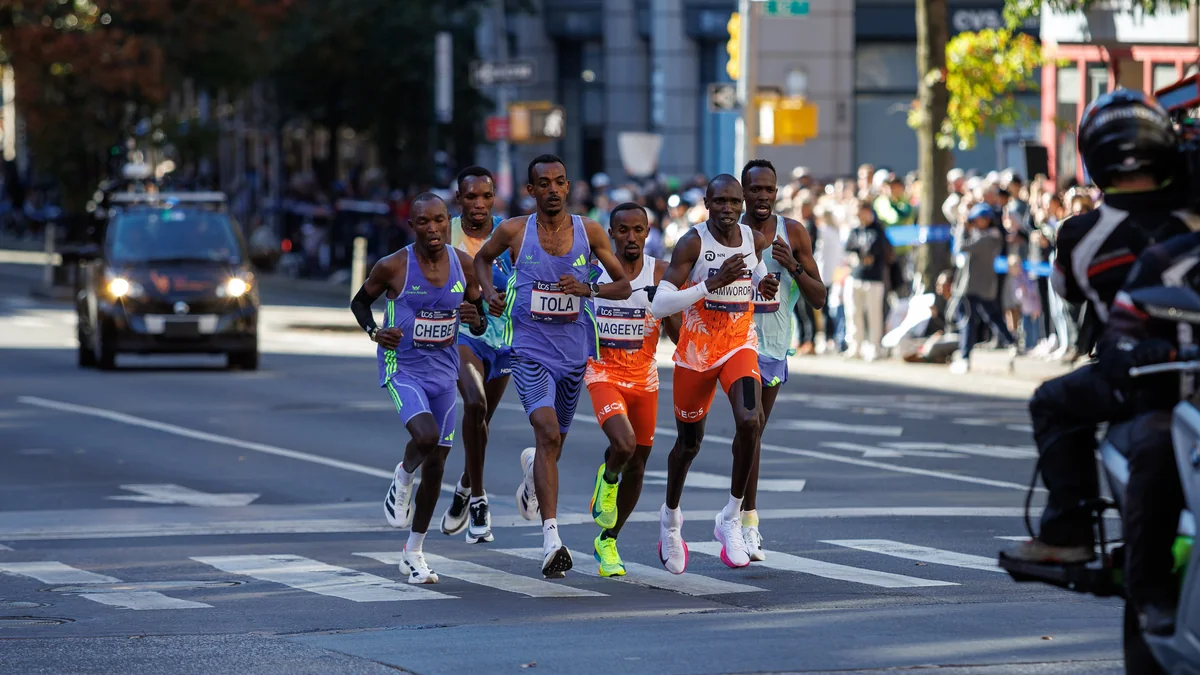
Kiptum’s racing pattern across his short marathon career — a small handful of major-distance performances — was distinctive precisely because the late-race fade was unusually small. In Chicago in October 2023 his second-half split was effectively the same pace as his first, finishing at 2:00:35; the canonical elite-marathon pattern of a 90-second slower second half did not appear. The physiology underneath this is consistent with the multiplicative product of high VO₂max, high fractional utilisation, and exceptional running economy expressed simultaneously at the personal limit [1, 2].
His anthropometry was notable. At 1.80 m and ~60 kg, he was taller than most East-African marathon contemporaries; longer levers and a slightly higher absolute body mass have theoretical implications for mass-specific oxygen cost, but his race results suggest that economy compensated for any anthropometric overhead — and may even have benefited from longer Achilles moment-arms in the late race when small efficiency advantages compound across the closing kilometres [1, 3]. The training context — the well-documented Kenyan high-altitude marathon culture — supplied the long accumulated stimulus that Saunders identifies as one of the slowest-developing but highest-yield economy variables.
The pacing discipline was the operational tell. A marathoner who carries genuine economy advantage into the late stage does not need to surge or to rebuild the lead in the final 10 km; the economy-and-fraction product means that holding the early pace is itself the winning strategy [2, 4]. Kiptum’s even-split races were not stylistic conservatism but the only economical way to allocate a substrate budget that was already nearly fully committed.
(Performance data: World Athletics)
The legacy framing matters. Kiptum’s career was cut short before its peak years; the marathon performances we have are a partial record of what an extraordinary athlete had begun to express. The discipline retains the world record he set; the science he illustrated about late-marathon economy is preserved by the racing patterns themselves.
What This Means for the Reader
For the developing marathoner, the takeaway is that the late-race fade is not a separate problem from the early-race pace; the two are the same problem, expressed in two halves. An athlete who pushes the first half above personal lactate threshold accelerates substrate depletion, and the wall arrives sooner — not because the legs run out, but because the carbohydrate budget runs out [3, 4]. Even-split or negative-split pacing is the only allocation that respects the underlying threshold biology.
The second implication is that running economy is the lever most elites already at high VO₂max should focus on. The mechanics — stride efficiency, tendon stiffness, body composition, neuromuscular refinement — develop slowly across years of consistent submaximal volume; the gain is small per month but compounds permanently [1, 5]. Late-race performance is the most sensitive output of accumulated economy work.
The diagnostic question for the athlete: how much do my last 10 km splits slow relative to the first 10 km, and what does that delta tell me about the gap between my early pace and my sustainable threshold?
References
- Saunders PU, Pyne DB, Telford RD, Hawley JA. (2004). Factors affecting running economy in trained distance runners. Sports Medicine, 34(7): 465–485. doi:10.2165/00007256-200434070-00005
- Joyner MJ, Coyle EF. (2008). Endurance exercise performance: the physiology of champions. The Journal of Physiology, 586(1): 35–44. doi:10.1113/jphysiol.2007.143834
- Faude O, Kindermann W, Meyer T. (2009). Lactate threshold concepts: how valid are they? Sports Medicine, 39(6): 469–490. doi:10.2165/00007256-200939060-00003
- Billat LV. (1996). Use of blood lactate measurements for prediction of exercise performance. Sports Medicine, 22(3): 157–175. doi:10.2165/00007256-199622030-00003
- Stølen T, Chamari K, Castagna C, Wisløff U. (2005). Physiology of soccer: an update. Sports Medicine, 35(6): 501–536. doi:10.2165/00007256-200535060-00004
Performance data (descriptive only): World Athletics.
The Athlete in One Paragraph
Kelvin Kiptum (1999-12-02 — 2024-02-11, Kenya) was a Kenyan long-distance runner whose marathon career was tragically cut short in February 2024, but whose legacy in the discipline is already permanent. Listed at 1.80 m and roughly 60 kg — slightly taller and heavier than the…
The Physiology — what marathon late-stage decline actually is
The marathon is, metabolically, an exercise in budget management. The athlete starts with a finite supply of stored carbohydrate (muscle and liver glycogen), an effectively unlimited supply of fat, and a fixed running economy that determines how rapidly each unit of distance draws on the…
The Case — Kiptum as marathon late-stage lens
Kiptum's racing pattern across his short marathon career — a small handful of major-distance performances — was distinctive precisely because the late-race fade was unusually small. In Chicago in October 2023 his second-half split was effectively the same pace as his first, finishing at 2:00:35;…
What This Means for the Reader
For the developing marathoner, the takeaway is that the late-race fade is not a separate problem from the early-race pace; the two are the same problem, expressed in two halves. An athlete who pushes the first half above personal lactate threshold accelerates substrate depletion, and…