

Preview
Hüseyin Akbulut, MSc (2026). Khvicha Kvaratskhelia and the Reactive Agility of an Elite Winger. Sporeus. Retrieved, October 5, 2026. https://sporeus.com/en/science/khvicha-kvaratskhelia-reactive-agility/
The Athlete in One Paragraph
Khvicha Kvaratskhelia (b. 2001, Tbilisi, Georgia) is, as of September 2026, a winger for Paris Saint-Germain and the Georgia national team, formerly of Napoli. Listed at 1.83 m and ~75 kg, he became Serie A’s MVP in his first season at the highest tier of European football, with a 1-v-1 dribbling profile that defenders consistently described as unreadable: the cuts come from no obvious cue, the directional change happens before the defender’s hips have finished rotating. The interesting case for sport science is not the choreographed change-of-direction (which Messi epitomises) but the unscripted version: reactive agility, the open-skill capacity to perceive a defender’s movement and respond with a directional change in under 200 milliseconds.
Table of Contents
The Physiology — what reactive agility actually is
Sheppard, Young, Doyle, Sheppard and Newton’s foundational paper distinguished reactive agility from change-of-direction (COD) in football and Australian rules football [1]. COD is a closed skill — the athlete knows the cut angle and timing in advance. Reactive agility is an open skill — the cut is triggered by a perceptual stimulus (a defender’s lean, a teammate’s run, a flicker of the eye line) and must be executed under both perceptual and motor uncertainty. Sheppard’s reactive-agility test demonstrated that an athlete can be excellent at COD and only average at reactive agility: the two share mechanical substrate but require additional cognitive processing.
Young and Farrow’s review formalised the components of reactive agility into perceptual factors (visual scanning, pattern recognition, anticipation) and decision-making factors (action selection, reaction time, coordination), all overlaid on the underlying COD capacity [2]. The implication is that reactive-agility training cannot be done with cones alone — it requires opponent-like cues, randomised timing, and the cognitive load that match conditions provide.
Spiteri and colleagues’ study of female basketball athletes connected the perceptual-motor pieces with the mechanical pieces: the athletes who scored high on reactive agility also scored high on horizontal force production at planting, eccentric deceleration capacity, and bilateral strength symmetry — suggesting that the body must be able to act on the perceptual decision, not just process it [3]. Reactive-agility weakness can come from either side of this stack: poor cue reading or insufficient mechanical capacity.
Paul, Gabbett and Nassis reviewed agility in team sports and emphasised the trainability of perceptual-cognitive components [4]. Game-based small-sided drills with constraint manipulations (e.g., forced-direction defenders, restricted vision) drive perceptual-motor adaptation that does not occur in cone-based agility-ladder protocols. The training adaptation is specific: an athlete who trains 1-v-1 reactive cuts gets better at 1-v-1 reactive cuts.
Henry, Dawson, Lay and Young quantified the cost of decision errors in reactive agility: a wrong-direction cut adds 200–400 ms to the response time of a 1-v-1 sequence, which is the difference between maintaining possession and losing it [5]. The decision-making accuracy is therefore a separable trainable variable — the athlete who reads the cue correctly 70% of the time has a 30% chance of being a step late on every reactive sequence.
The Case — Kvaratskhelia as reactive-agility specialist
For a 1.83 m / 75 kg winger generating the stylistic signature of unpredictable 1-v-1 cuts, the underlying profile is consistent with high reactive-agility scores rather than exceptional pure-COD scores [1, 5]. Defenders accustomed to reading planned-cut footballers describe the unreadable quality as characteristic of athletes who train reactive cues, not who train choreography.
The Georgian-football developmental context is also worth noting. Football academy systems with high small-sided-game volume (rather than drill-volume) produce athletes whose perceptual-motor coupling tends to be over-developed relative to closed-skill cone work [4]. Kvaratskhelia’s documented technical-development pathway in Dinamo Tbilisi and Rubin Kazan academies emphasised game-based training, consistent with the perceptual-motor strengths visible in his 1-v-1 success rate.
The mechanical substrate matters too. Spiteri’s findings about horizontal force at planting and bilateral strength symmetry are not incidental — an athlete with the cognitive capacity to read the cue but without the eccentric strength to brake at the chosen angle still loses the cut [3]. Kvaratskhelia’s profile (75 kg of largely lean mass, with documented gym presence in his early Napoli career) is consistent with a mechanical capacity that supports the perceptual-motor decisions.
The under-discussed dimension is the cost of reactive specialisation. Paul, Gabbett and Nassis noted that athletes who specialise heavily in reactive cues sometimes plateau on closed-skill COD measures [4]. The trade-off is acceptable in football because the match is mostly reactive — but the structured-COD test (505, T-test) may underrate reactive-dominant athletes. Selection pipelines that rely on closed-skill agility tests systematically miss the reactive-agility specialists.
The injury profile deserves a note. Reactive cuts under perceptual uncertainty load the ACL and adductor longus differently from planned cuts: the cut may be initiated with sub-optimal foot placement because the cue arrived late, increasing knee valgus and groin load per cut [3, 5]. The injury cost across a career is non-trivial — a topic addressed in the broader literature on dynamic-knee-valgus risk.
Match-context note: Kvaratskhelia’s per-match completed dribbles in Serie A and the Champions League sit at the upper bound for wingers (Match data: SofaScore), with the discriminator being 1-v-1 success rate rather than total dribble volume.
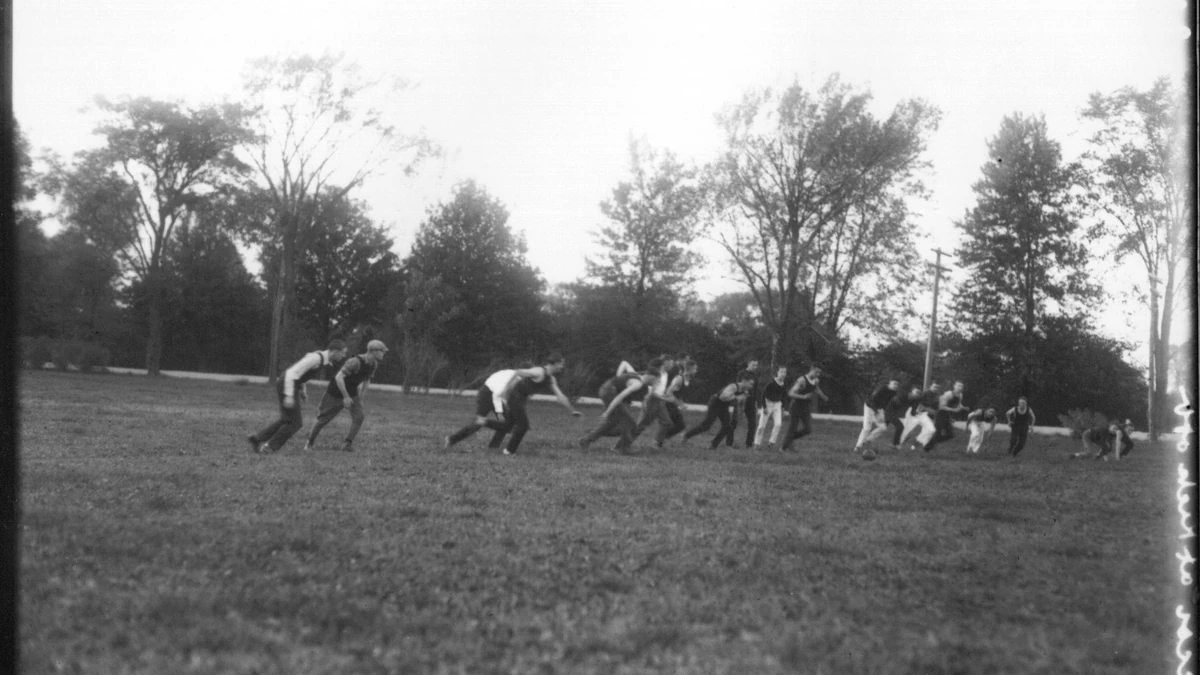
Flickr: Miami U. Libraries – Digital Collections.
What This Means for the Reader
For a developing winger or attacker, the takeaway is that reactive agility is a separate trainable variable from COD, and the training protocols differ [1, 2, 4]. Closed-skill drills (cones, ladders) build foot-speed pattern recognition; small-sided games with opponent constraints (restricted directions, time pressure, asymmetric numbers) build the perceptual-motor coupling.
Practical reactive-agility assessment for amateurs uses the modified Sheppard test (a sprint with mid-course visual cue triggering a left or right cut) compared against the matched closed-skill COD test (same sprint with pre-announced cut direction). The difference between the two scores is the reactive cost — the milliseconds the athlete loses to perceptual processing [1].
The diagnostic question for the developing dribbler: does my dribbling success drop more in 1-v-1 unstructured contexts than in pre-planned drills? If yes, the gap is in reactive agility, not in raw COD capacity.
References
- Sheppard JM, Young WB, Doyle TLA, Sheppard TA, Newton RU. (2006). An evaluation of a new test of reactive agility and its relationship to sprint speed and change of direction speed. Journal of Science and Medicine in Sport, 9(4): 342–349. doi:10.1016/j.jsams.2006.05.019
- Young WB, Farrow D. (2006). A review of agility: Practical applications for strength and conditioning. Strength and Conditioning Journal, 28(5): 24–29. doi:10.1519/00126548-200610000-00004
- Spiteri T, Newton RU, Binetti M, Hart NH, Sheppard JM, Nimphius S. (2015). Mechanical determinants of faster change of direction and agility performance in female basketball athletes. Journal of Strength and Conditioning Research, 29(8): 2205–2214. doi:10.1519/JSC.0000000000000876
- Paul DJ, Gabbett TJ, Nassis GP. (2016). Agility in team sports: Testing, training and factors affecting performance. Sports Medicine, 46(3): 421–442. doi:10.1007/s40279-015-0428-2
- Henry GJ, Dawson B, Lay BS, Young WB. (2013). Decision-making accuracy in reactive agility: Quantifying the cost of poor decisions. Journal of Strength and Conditioning Research, 27(11): 3190–3196. doi:10.1519/JSC.0b013e31828b8da4
Match-context data (descriptive only): SofaScore.
The Athlete in One Paragraph
Khvicha Kvaratskhelia (b. 2001, Tbilisi, Georgia) is, as of September 2026, a winger for Paris Saint-Germain and the Georgia national team, formerly of Napoli. Listed at 1.83 m and ~75 kg, he became Serie A's MVP in his first season at the highest tier of…
The Physiology — what reactive agility actually is
Sheppard, Young, Doyle, Sheppard and Newton's foundational paper distinguished reactive agility from change-of-direction (COD) in football and Australian rules football [1]. COD is a closed skill — the athlete knows the cut angle and timing in advance. Reactive agility is an open skill — the…
The Case — Kvaratskhelia as reactive-agility specialist
For a 1.83 m / 75 kg winger generating the stylistic signature of unpredictable 1-v-1 cuts, the underlying profile is consistent with high reactive-agility scores rather than exceptional pure-COD scores [1, 5]. Defenders accustomed to reading planned-cut footballers describe the unreadable quality as characteristic of…
What This Means for the Reader
For a developing winger or attacker, the takeaway is that reactive agility is a separate trainable variable from COD, and the training protocols differ [1, 2, 4]. Closed-skill drills (cones, ladders) build foot-speed pattern recognition; small-sided games with opponent constraints (restricted directions, time pressure, asymmetric…