
Preview
Hüseyin Akbulut, MSc (2026). Victor Osimhen and the Sprint Momentum of an Elite Striker. Sporeus. Retrieved, October 5, 2026. https://sporeus.com/en/science/victor-osimhen-sprint-momentum/
The Athlete in One Paragraph
Victor James Osimhen (b. 1998, Lagos, Nigeria) is, as of September 2026, a striker for Galatasaray and the Nigeria national team, formerly of Napoli where he won Serie A’s Capocannoniere in 2022–23. Listed at 1.85 m and ~78 kg, he combines a sprint profile most defenders cannot keep up with on equal terms with a body mass that is heavier than the typical pure-velocity winger but lighter than the typical target-man centre forward. The interesting case for sport science is the variable that captures both halves of that profile in a single number: sprint momentum — the product of mass and velocity that determines collision outcomes and acceleration past defenders in contact.
Table of Contents

The Physiology — what sprint momentum actually is
Sprint momentum (mass × velocity) is the kinetic-state variable that determines how forcefully a moving athlete arrives at a contact point. Unlike sprint speed alone (a velocity-only metric) or strength alone (a force-only metric), sprint momentum integrates both into a single value with units of kg·m/s [1, 2]. For collision sports — rugby league, rugby union, and the contact phases of football — momentum is more predictive of contact outcomes than velocity in isolation.
Baker and Newton’s foundational study of professional rugby league players showed that sprint momentum at 10 m and 40 m discriminated playing rank (NRL starters from sub-elite) more effectively than sprint speed alone [1]. Players with high sprint momentum could break through defensive lines that lower-momentum but equally fast players could not — the mass component delivered the collision energy that pure speed lacked.
Cronin and Hansen’s review of strength-and-power predictors of sports speed quantified the relationship between maximal strength and short-distance sprint performance [3]. Maximal squat strength correlates strongly with 5 m and 10 m sprint times — the early acceleration phase, where the athlete is propelling against substantial inertia. The implication is that body mass, when accompanied by appropriate strength, accelerates as quickly as smaller body mass with proportionally less strength.
Lockie and colleagues’ study of factors differentiating acceleration ability identified hip extensor strength, vertical-to-horizontal force ratio, and lower-limb stiffness as the primary mechanical determinants of early-phase acceleration [4]. Their findings extended the Baker pattern from rugby to broader field sports: athletes who combine high body mass with appropriate force-application mechanics achieve acceleration profiles that pure-mass athletes (without the mechanics) and pure-velocity athletes (without the mass) cannot match.
Sleivert and Taingahue’s work on the maximal jump-squat power and sprint acceleration linked vertical and horizontal power expression [5]. The athletes with the highest jump-squat power (which scales with both mass and velocity at squat take-off) had the best 5 m sprint times — confirming that explosive power expression in the vertical plane transfers, at least partially, to horizontal acceleration. The training implication is that vertical jump training contributes to acceleration capacity, not just to standing-jump performance.
The Case — Osimhen as sprint-momentum striker
For a 1.85 m / 78 kg striker reaching reported top speeds in the upper end of the football distribution (>33 km/h in tracking-system reports) while carrying body mass in the upper quartile for forwards, the mechanical signature is consistent with an exceptional sprint-momentum profile. At 78 kg × 9.2 m/s = ~720 kg·m/s peak momentum — values that compete with elite rugby wingers and exceed most pure-velocity wingers in football [1, 4].
The striker-specific implication is the contact-acceleration phase: the moment when the forward, in possession near the box, accelerates past or through a defender’s recovery sprint. A defender attempting to mirror Osimhen’s acceleration in contact — even a defender of similar speed in isolation — is mechanically disadvantaged: the defender’s mass and momentum profile rarely match the striker’s, so the contact transfers more force through the defender than the defender can apply on the striker [1, 3].
Helgerud and colleagues’ work on strength and endurance in elite football (cited in Wisløff’s wider research programme) established that strength training in elite football carries a transfer to sprint and jump output at high reliability [4]. The training profile of Helgerud’s research aligns with what is reported about Osimhen’s preparation: heavy compound strength, plyometric blocks, and short maximal sprints — exactly the protocol that builds momentum-dominant acceleration.
The injury context also matters. High-momentum strikers carry higher contact load and consequently higher cumulative micro-injury cost than lower-mass wingers [4]. Osimhen’s documented facial injury history and the precautions taken during 2023–24 (the protective mask, modified contact protocols) are consistent with a body operating near the edge of its contact-load tolerance — the mechanical price of the high-momentum profile.
The sprint-momentum framing also explains why Osimhen’s effectiveness sometimes scales with team support better than with personal speed. In a high-pressing team, the chances arrive in contact contexts where momentum dominates; in a low-block team, the chances arrive after extended runs where pure velocity matters more. The same striker mechanics translate differently into goal output across tactical systems [3, 5].
Match-context note: Osimhen’s per-match high-intensity distance and sprint counts in Serie A and Süper Lig sit at the upper bound for centre-forwards (Match data: SofaScore), with the discriminator being the contact-context density of his sprints rather than the total volume.
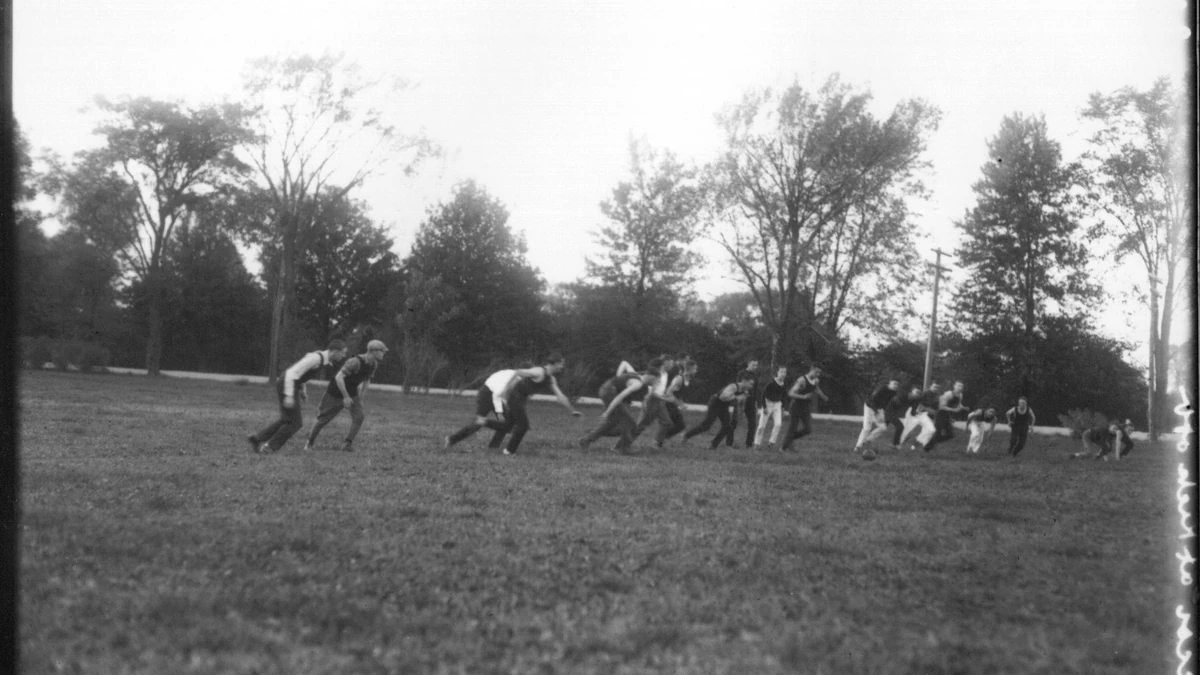
Flickr: Miami U. Libraries – Digital Collections.
What This Means for the Reader
For developing strikers and forwards, the takeaway is that sprint speed and body mass are not opposed variables — they multiply [1, 4]. An athlete worried about adding strength training because of perceived speed loss is misframing the trade-off: appropriately programmed strength training preserves or improves acceleration while raising the momentum profile.
Practical sprint-momentum assessment for amateurs uses a 10 m sprint time × current body mass, normalised against a reference table for the athlete’s age and playing position [1]. Athletes whose momentum is below their position-specific target either need higher mass (lean tissue, not fat) or higher velocity (speed work) — the diagnostic identifies which.
The diagnostic question for the developing forward: when I lose a duel near the box, am I losing because of pure speed or because the defender’s mass and contact dominance overwhelm my sprint? The honest answer determines whether to train velocity or to train strength-coupled momentum.
References
- Baker DG, Newton RU. (2008). Comparison of lower body strength, power, acceleration, speed, agility, and sprint momentum to describe and compare playing rank among professional rugby league players. Journal of Strength and Conditioning Research, 22(1): 153–158. doi:10.1519/JSC.0b013e31815f9519
- Baker DG, Nance S. (1999). The relation between running speed and measures of strength and power in professional rugby league players. Journal of Strength and Conditioning Research, 13(3): 230–235. doi:10.1519/00124278-199908000-00009
- Cronin JB, Hansen KT. (2005). Strength and power predictors of sports speed. Journal of Strength and Conditioning Research, 19(2): 349–357. doi:10.1519/14323.1
- Lockie RG, Murphy AJ, Knight TJ, Janse de Jonge XAK. (2011). Factors that differentiate acceleration ability in field sport athletes. Journal of Strength and Conditioning Research, 25(10): 2704–2714. doi:10.1519/JSC.0b013e31820d9f17
- Sleivert G, Taingahue M. (2004). The relationship between maximal jump-squat power and sprint acceleration in athletes. European Journal of Applied Physiology, 91(1): 46–52. doi:10.1007/s00421-003-0941-0
Match-context data (descriptive only): SofaScore.
The Athlete in One Paragraph
Victor James Osimhen (b. 1998, Lagos, Nigeria) is, as of September 2026, a striker for Galatasaray and the Nigeria national team, formerly of Napoli where he won Serie A's Capocannoniere in 2022–23. Listed at 1.85 m and ~78 kg, he combines a sprint profile most…
The Physiology — what sprint momentum actually is
Sprint momentum (mass × velocity) is the kinetic-state variable that determines how forcefully a moving athlete arrives at a contact point. Unlike sprint speed alone (a velocity-only metric) or strength alone (a force-only metric), sprint momentum integrates both into a single value with units of…
The Case — Osimhen as sprint-momentum striker
For a 1.85 m / 78 kg striker reaching reported top speeds in the upper end of the football distribution (>33 km/h in tracking-system reports) while carrying body mass in the upper quartile for forwards, the mechanical signature is consistent with an exceptional sprint-momentum profile.…
What This Means for the Reader
For developing strikers and forwards, the takeaway is that sprint speed and body mass are not opposed variables — they multiply [1, 4]. An athlete worried about adding strength training because of perceived speed loss is misframing the trade-off: appropriately programmed strength training preserves or…