Preview
Hüseyin Akbulut, MSc (2026). Mike Maignan and the Diving Explosive Lateral Power of an Elite Goalkeeper. Sporeus. Retrieved, September 13, 2026. https://sporeus.com/en/science/mike-maignan-diving-explosive-lateral-power/
The Athlete in One Paragraph
Mike Maignan (b. 1995-07-03, Cayenne, French Guiana) is the goalkeeper for AC Milan and the France national team. Listed at 1.91 m and ~86 kg, he is one of the most physically explosive first-choice goalkeepers in European football, a category defined less by foot speed across the goal line than by the capacity to launch the body sideways from a near-stationary stance and reach a corner that the geometry of the goal frame says should be unreachable. The interesting question for sport science is not how high he jumps in a vertical test but how fast he produces force horizontally, against gravity, in the 200–500 millisecond window between perceptual cue and ball-line crossing. The variable underneath that pattern is diving explosive lateral power — the rate-of-force-development demand of a single-leg horizontal launch coupled to a perceptual trigger.
Table of Contents
The Physiology — what diving explosive lateral power actually measures
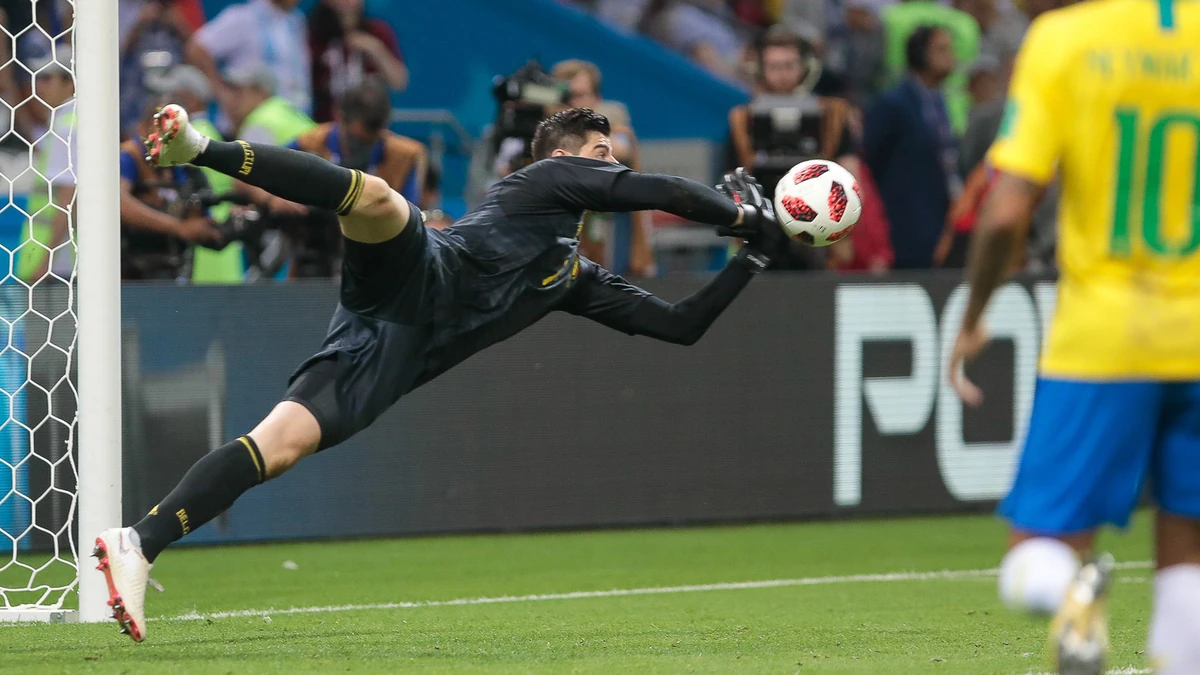
The lateral dive is a single-effort ballistic movement compressed into a very small time window. The cue resolves; the central nervous system selects a directional commitment; the planted leg loads through a brief countermovement; the hip extensors, knee extensors, plantar flexors and trunk rotators fire in sequence to drive the centre of mass horizontally; the contralateral leg sweeps to clear the floor. The total budget between shot release and the goalkeeper’s hand reaching the ball line on a corner-bound strike is, depending on shot velocity and distance, in the range of 300–500 ms — barely longer than the simple visual reaction time of an untrained adult. Anything more than the most rehearsed cue–response coupling arrives late, and any deficit in the force-production envelope of the planted leg produces an early but short dive.
Wisløff, Castagna, Helgerud, Jones and Hoff established the strength-power-jump correlation that anchors this domain. Their data on elite footballers showed that maximal squat strength correlates with vertical-jump height and short-sprint performance, indicating that the lower-body force-production envelope predicts ballistic output across both vertical and horizontal axes [1]. For a goalkeeper, the implication is that the lateral dive is not a separate quality from the vertical jump but a related expression of the same underlying force-velocity profile, redirected horizontally through the foot-plant angle.
Cormie, McGuigan and Newton’s review of maximal neuromuscular power refined the picture. Power output — the product of force and velocity — is governed by a force-velocity curve in which strength sets the high-force end and movement-specific ballistic training shifts the curve toward higher velocities at sub-maximal loads, with the time-to-peak-force dimension (rate of force development) being the variable most relevant to actions completed in under 300 ms [2]. The lateral dive sits squarely in the rate-of-force-development region; high maximal strength without high RFD produces a slow, laboured launch that arrives after the ball.
Markovic and Mikulic’s review of plyometric adaptations connected the training side to the output side. Their synthesis showed that lower-extremity plyometric work produces measurable improvements in jump height, sprint mechanics and rate-of-force-development variables, with the largest gains appearing when the plyometric stimulus is matched to the movement pattern of the target action [3]. For a goalkeeper, this argues for plyometric exposures that include lateral and unilateral patterns — single-leg lateral bounds, lateral hops with arrest, depth jumps to lateral receive — rather than only bilateral vertical jumps.
The perceptual-trigger side cannot be separated from the mechanical side. Sheppard, Young, Doyle, Sheppard and Newton’s reactive-agility test data showed that the reactive component of agility — locomotor speed coupled to a perceptual cue — discriminates higher performers more cleanly than the closed-skill change-of-direction component, and that the cue-coupled latency is itself a trainable variable [4]. For a goalkeeper, the dive is always cue-coupled; mechanical capacity without perceptual-trigger fidelity produces a powerful but late or wrong-side dive.
Young and Farrow’s practical synthesis closed the loop. Their argument that agility training should expose the athlete to representative cue-coupled demands — live shooters, video stimuli, scenario drills with unpredictable timing — rather than to closed-skill repetition implies that the diving-power profile of a goalkeeper is the product of a mechanical layer (force, RFD, plyometric quality) and a perceptual layer (cue use, decision latency), with each capping the other [5]. Diving explosive lateral power, in this framing, is a system measurement, not a single test.
The Case — Maignan as horizontal-launch prototype
For a 1.91 m / 86 kg goalkeeper operating in a possession-dominant Serie A and Champions League system, the perceptual demand is uneven and asymmetric: long stretches of low involvement punctuated by point-blank reactions in which the cue resolves under 300 ms and the body must launch sideways from a near-stationary stance [4, 5]. The case for diving explosive lateral power as the defining variable is that the saves which separate first-choice goalkeepers from elite goalkeepers are disproportionately the ones at the geometric edge of the goal — the corner-bound strikes where a fractional difference in horizontal launch force translates into a fingertip on the ball rather than a fingertip on air.
The mechanical envelope is necessary. Wisløff and colleagues’ strength-jump correlation indicates that the lower-body force needed to produce a powerful lateral launch responds to maximal-strength training and predicts ballistic output across axes [1]. Cormie and colleagues’ force-velocity framework adds the RFD dimension: a goalkeeper with high maximal strength but poor rate of force development produces a slow launch from a strong base, which is not what the 300-ms decision window rewards [2]. The training that develops the relevant profile is the combination — maximal-strength work to lift the high-force end of the curve, and ballistic plyometric work to shift the curve toward higher velocities and shorter time-to-peak-force [2, 3].
The perceptual integration is structural. Sheppard and colleagues’ reactive-agility data and Young and Farrow’s practical synthesis converge on the same point: the dive is a coupled system, and a deficit in either layer caps the other [4, 5]. A perceptually elite but mechanically average goalkeeper reads the shot but cannot reach the corner; a mechanically elite but perceptually average goalkeeper launches early and arrives at the wrong side. The goalkeeper at the upper end of the position has both layers in place and trains them as a coupled system.
Match-context note: Maignan’s high-difficulty save share and post-shot-expected-goals overperformance in Serie A and Champions League play sit in the upper band for first-choice goalkeepers (Match data: SofaScore), with the discriminator being the consistency of those numbers against high-velocity corner-bound strikes rather than raw save volume against low-difficulty central shots that any first-team goalkeeper would handle.
The plyometric-quality dimension completes the picture. Markovic and Mikulic’s finding that pattern-matched plyometric exposure produces the largest gains in rate-of-force-development variables implies that the goalkeeper-specific dive needs goalkeeper-specific plyometric work — lateral bounds, single-leg horizontal hops, lateral depth-drops with immediate horizontal redirection — rather than only the bilateral vertical jumps that traditional strength-and-conditioning programmes prioritise [3]. The mechanical profile is buildable; what makes it deployable is the perceptual layer that triggers it on time.
What This Means for the Reader
For a developing goalkeeper, the takeaway is that diving explosive lateral power is not a single trait but a system — maximal strength, rate of force development, pattern-specific plyometric quality, and the perceptual trigger that fires the launch on time — and it is trained from the mechanical layer up and the perceptual layer down, in parallel rather than in sequence. Three measurements diagnose the limiting variable: a maximal squat or trap-bar deadlift relative to body mass for the high-force end of the curve, a single-leg lateral hop test for pattern-specific RFD, and a video-based reactive-agility test for cue-coupled latency [1, 2, 4].
The training prescription targets the diagnostic finding: athletes with adequate strength but slow lateral hops need ballistic and pattern-matched plyometric work rather than more squats; athletes with slow reactive-agility times need open-skill exposures rather than more cone drills; athletes with deficits in both need both, prioritised by which one ceilings the competitive expression of the other [2, 3, 5]. The single diagnostic question for the developing goalkeeper: when a corner-bound strike beats me, did my legs not produce enough force, or did my decision arrive too late to deploy the force I had?
References
- Wisløff U, Castagna C, Helgerud J, Jones R, Hoff J. (2004). Strong correlation of maximal squat strength with sprint performance and vertical jump height in elite soccer players. British Journal of Sports Medicine, 38(3): 285–288. doi:10.1136/bjsm.2002.002071
- Cormie P, McGuigan MR, Newton RU. (2011). Developing maximal neuromuscular power: Part 1 — biological basis of maximal power production. Sports Medicine, 41(1): 17–38. doi:10.2165/11537690-000000000-00000
- Markovic G, Mikulic P. (2010). Neuro-musculoskeletal and performance adaptations to lower-extremity plyometric training. Sports Medicine, 40(10): 859–895. doi:10.2165/11318370-000000000-00000
- Sheppard JM, Young WB, Doyle TLA, Sheppard TA, Newton RU. (2006). An evaluation of a new test of reactive agility and its relationship to sprint speed and change of direction speed. Journal of Science and Medicine in Sport, 9(4): 342–349. doi:10.1016/j.jsams.2006.05.019
- Young WB, Farrow D. (2006). A review of agility: practical applications for strength and conditioning. Strength and Conditioning Journal, 28(5): 24–29. doi:10.1519/00126548-200610000-00004
Match-context data (descriptive only): SofaScore.
The Athlete in One Paragraph
Mike Maignan (b. 1995-07-03, Cayenne, French Guiana) is the goalkeeper for AC Milan and the France national team. Listed at 1.91 m and ~86 kg, he is one of the most physically explosive first-choice goalkeepers in European football, a category defined less by foot speed…
The Physiology — what diving explosive lateral power actually measures
The lateral dive is a single-effort ballistic movement compressed into a very small time window. The cue resolves; the central nervous system selects a directional commitment; the planted leg loads through a brief countermovement; the hip extensors, knee extensors, plantar flexors and trunk rotators fire…
The Case — Maignan as horizontal-launch prototype
For a 1.91 m / 86 kg goalkeeper operating in a possession-dominant Serie A and Champions League system, the perceptual demand is uneven and asymmetric: long stretches of low involvement punctuated by point-blank reactions in which the cue resolves under 300 ms and the body…
What This Means for the Reader
For a developing goalkeeper, the takeaway is that diving explosive lateral power is not a single trait but a system — maximal strength, rate of force development, pattern-specific plyometric quality, and the perceptual trigger that fires the launch on time — and it is trained…