Preview
Hüseyin Akbulut, MSc (2026). Marc-Andre ter Stegen and the Sweeper-Keeper Positioning Demand of an Elite Goalkeeper. Sporeus. Retrieved, October 25, 2026. https://sporeus.com/en/science/marc-andre-ter-stegen-sweeper-keeper-positioning/
The Athlete in One Paragraph
Marc-André ter Stegen (b. 1992-04-30, Mönchengladbach, Germany) is the goalkeeper for FC Barcelona and the Germany national team. Listed at 1.87 m and ~85 kg, he is one of the defining proactive goalkeepers of his generation, the kind whose effective playing area extends well beyond the six-yard box and whose decision-making clock starts long before a shot is on frame. The interesting question for sport science is not how he saves the close-range strike but how he prevents the close-range strike from materialising in the first place, a function of where he stands, when he advances, when he holds, and how quickly he reads the geometry between defensive line, ball carrier, and far-post space. The variable underneath that pattern is sweeper-keeper positioning, a hybrid demand of perceptual-cognitive anticipation, decision-cost economy, and the sprint-recovery capacity to act on the read.
Table of Contents
The Physiology: what sweeper-keeper positioning actually measures
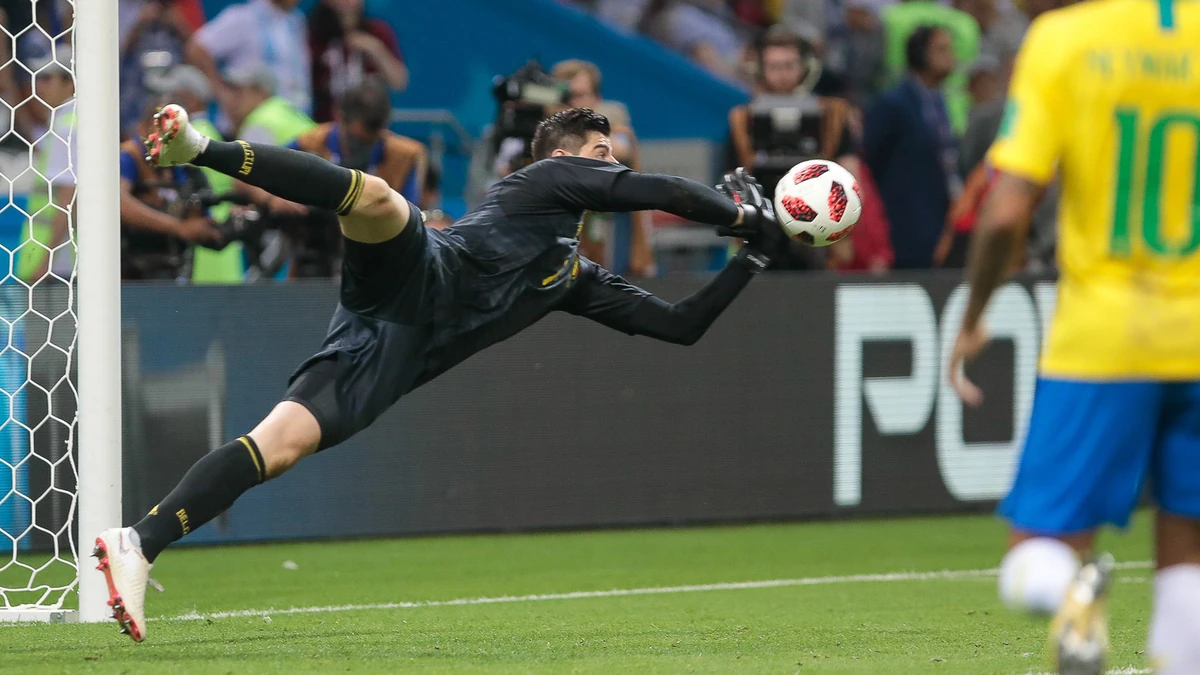
Sweeper-keeper play is not a single skill but a pipeline that runs from cue to commitment to locomotion to recovery, all of it executed against a moving high defensive line where the cost of a wrong call is a one-on-one against an attacker through on goal. The clock starts when the ball-carrier crosses a notional pressure line; the goalkeeper’s perceptual system extracts trajectory of pass, body shape of the runner, and the depth of the back four; the central nervous system either commits to advance or holds; the resulting movement, a 10–25 metre sprint to a dead ball or a 5-metre micro-adjustment to a different angle, is a high-intensity action layered on top of the otherwise low-density goalkeeping baseline.
Sheppard and Young’s agility framework organises the conceptual layer. Their distinction between closed-skill change-of-direction speed and open-skill agility, the open-skill side coupled to a perceptual cue rather than a pre-planned route, is, for a goalkeeper, the operative one [1]. Every advance off the line is open-skill: the cue is the through-ball trajectory and the runner’s stride, not a cone, and the locomotor pattern is selected only after the cue resolves. Closed-skill repetition without cue-coupling produces fast goalkeepers who arrive at the wrong place.
Henry, Dawson, Lay and Young extended the framework into the decision-cost dimension. Their reactive-agility data showed that the correctness of the directional choice, not just the speed of the response, discriminates higher performers, and that decision latency under cue-coupled conditions is itself a trainable variable that responds to perceptual exposure rather than to additional running [2]. For a sweeper-keeper, a fractionally late but correct read, hold the line, do not advance, let the centre-back recover, outperforms a fast but wrong commitment that leaves the goal unguarded.
Paul, Gabbett and Nassis synthesised the perceptual-cognitive and physical sides into a single agility construct in team sports. Elite agility, they argued, is the product of perceptual-cognitive expertise (anticipatory cue use, pattern recognition, scan frequency) and physical capability (acceleration, deceleration, change-of-direction strength), with the perceptual side dominating in the most time-pressured situations and the physical side dominating in the least [3]. The sweeper-keeper sits squarely in the high-time-pressure region; the perceptual layer sets the ceiling.
The metabolic substrate is the layer beneath the cognitive one. Stølen, Chamari, Castagna and Wisløff’s physiology-of-soccer review notes that goalkeepers cover less total distance than outfield players but produce a meaningful share of their high-intensity output in short, irregular bursts, the kind of profile in which aerobic recovery between bursts is what determines whether the next advance is a sharp sprint or a laboured jog [4]. Bangsbo, Mohr and Krustrup’s match-running decomposition shows that even players with low overall distance accumulate measurable high-intensity work and depend on aerobic recovery between bouts to maintain output across the match [5]. Sweeper-keeper positioning is therefore not a single trait but an ordered system: cue, decision, action, recovery.
The Case: Ter Stegen as proactive area-extender
For a 1.87 m / 85 kg goalkeeper operating behind a possession-dominant high-line system, the running profile is consistent with low total distance, but with a high share of that distance accumulated in short anticipatory advances and recovery jogs back into position [4, 5]. The case is not that he sprints faster than every other goalkeeper, at first-choice level, raw foot speed differences are small, but that the anticipatory component of his cue use compresses the effective decision window so that the advance begins early enough to reach the dead ball before the runner arrives [1, 2].
The decision-cost layer is what makes the case distinctive at the position. Henry and colleagues’ finding that correctness of the directional choice discriminates elite reactive performers maps directly onto sweeper-keeper play: the goalkeeper who advances early and arrives at the right ball is in a different category from the one who advances early and is chipped, and the gap between the two is largely a perceptual-training gap rather than a locomotor one [2]. Anticipatory cue use, built on film exposure, scenario drills, and repeated representative pressure, is what allows the early commitment to be a correct one.
The integration is structural. Paul, Gabbett and Nassis’s argument that elite agility is the product of perceptual and physical capability rather than the sum implies that a deficit in either layer caps the other [3]. A perceptually elite but mechanically average goalkeeper reads the through-ball but cannot reach it; a mechanically elite but perceptually average goalkeeper sprints early and arrives at empty space. The goalkeeper at the upper end of the position has both layers in place and trains them as a coupled system rather than as separate qualities.
Match-context note: Ter Stegen’s defensive-action volume outside the penalty area in La Liga and Champions League play sits in the upper band for first-choice goalkeepers (Match data: SofaScore), with the discriminator being the consistency of those numbers across high-line possession matches and against quick-transition opposition rather than any single eye-catching intervention.
The metabolic envelope completes the picture. A goalkeeper whose tactical role demands repeated 15–25 metre advances and recovery jogs across 90 minutes against high-tempo opposition needs the aerobic recovery capacity that allows the next sprint to be as sharp as the first, not a slower, later, half-effort version [4, 5]. The recovery profile is what separates the goalkeeper who maintains the proactive line into the 80th minute from the one who concedes the same ball in the 80th minute that he intercepted in the 30th.
What This Means for the Reader
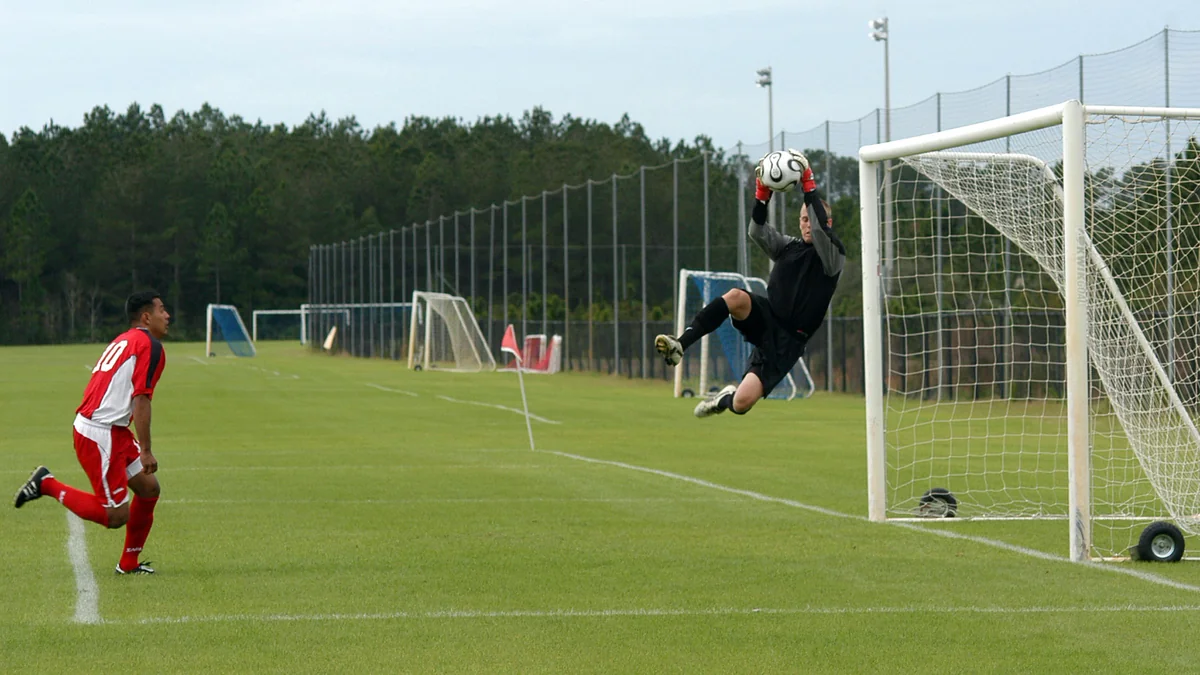
For a developing goalkeeper, the takeaway is that sweeper-keeper positioning is a system rather than a trait, and it is trained from the perceptual layer down rather than from the legs up. Three measurements diagnose the limiting variable: a video-based reactive-agility test for cue-coupled latency and decision correctness, a 20–40 metre acceleration test for sprint-action capacity, and a repeated-effort protocol for the recovery between advances that lets the next advance retain its sharpness [1, 2, 4].
The training prescription targets the diagnostic finding: athletes with fast acceleration but slow reactive-agility times need open-skill work, drills with live runners, video stimuli, unpredictable cue timing, rather than more cone-pattern repetition; athletes with both slow need both, with perceptual exposure prioritised because it ceilings everything else [2, 3]. The single diagnostic question for the developing sweeper-keeper: when the through-ball beats me, did my legs arrive late, or did my decision arrive late?
References
- Sheppard JM, Young WB. (2006). Agility literature review: classifications, training and testing. Journal of Sports Sciences, 24(9): 919–932. doi:10.1080/02640410500457109
- Henry GJ, Dawson B, Lay BS, Young WB. (2013). Decision-making accuracy in reactive agility: quantifying the cost of poor decisions. Journal of Strength and Conditioning Research, 27(11): 3190–3196. doi:10.1519/JSC.0b013e31828b8da4
- Paul DJ, Gabbett TJ, Nassis GP. (2016). Agility in team sports: testing, training and factors affecting performance. Sports Medicine, 46(3): 421–442. doi:10.1007/s40279-015-0428-2
- Stølen T, Chamari K, Castagna C, Wisløff U. (2005). Physiology of soccer: an update. Sports Medicine, 35(6): 501–536. doi:10.2165/00007256-200535060-00004
- Bangsbo J, Mohr M, Krustrup P. (2006). Physical and metabolic demands of training and match-play in the elite football player. Journal of Sports Sciences, 24(7): 665–674. doi:10.1080/02640410500482529
Match-context data (descriptive only): SofaScore.
Hüseyin Akbulut is the founder of Sporeus and author of THRESHOLD (EŞİK), a 540-page Turkish-language book on endurance science.
- 540pp THRESHOLD Book
- MSc Sport Sciences
- Marmara University
The Athlete in One Paragraph
Marc-André ter Stegen (b. 1992-04-30, Mönchengladbach, Germany) is the goalkeeper for FC Barcelona and the Germany national team. Listed at 1.87 m and ~85 kg, he is one of the defining proactive goalkeepers of his generation, the kind whose effective playing area extends well beyond…
The Physiology: what sweeper-keeper positioning actually measures
Sweeper-keeper play is not a single skill but a pipeline that runs from cue to commitment to locomotion to recovery, all of it executed against a moving high defensive line where the cost of a wrong call is a one-on-one against an attacker through on…
The Case: Ter Stegen as proactive area-extender
For a 1.87 m / 85 kg goalkeeper operating behind a possession-dominant high-line system, the running profile is consistent with low total distance, but with a high share of that distance accumulated in short anticipatory advances and recovery jogs back into position [4, 5]. The…
What This Means for the Reader
For a developing goalkeeper, the takeaway is that sweeper-keeper positioning is a system rather than a trait, and it is trained from the perceptual layer down rather than from the legs up. Three measurements diagnose the limiting variable: a video-based reactive-agility test for cue-coupled latency…