Preview
Hüseyin Akbulut, MSc (2026). Miltiadis Tentoglou and the Horizontal Jump Takeoff Mechanics of an Elite Long Jumper. Sporeus. Retrieved, September 26, 2026. https://sporeus.com/en/science/miltiadis-tentoglou-horizontal-jump-takeoff-mechanics/
The Athlete in One Paragraph
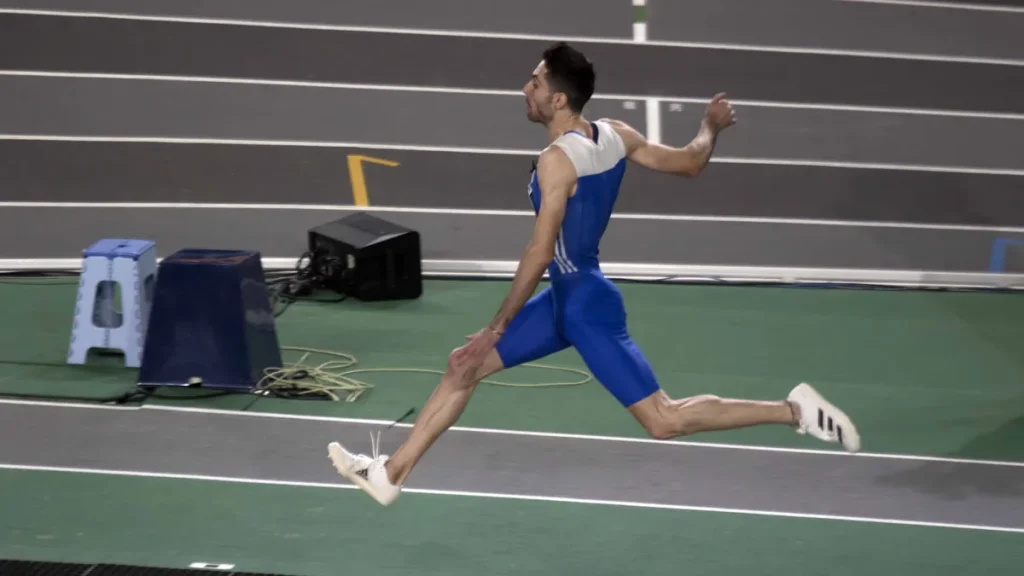
Miltiadis Tentoglou (b. 1998-03-18, Grevena, Greece) is the back-to-back Olympic long jump champion (Tokyo 2020 and Paris 2024) and a multiple world indoor and European outdoor titlist representing Greece. Listed at 1.83 m and approximately 71 kg, he sits in the lighter, more sprint-oriented end of the global long-jump distribution — the body type for which the takeoff phase, rather than raw approach speed alone, becomes the decisive lever. A long jumper is, mechanically, a sprinter who must convert the horizontal kinetic energy of the runway into a controlled vertical impulse without losing too much of the forward velocity that the runway just bought; that conversion happens inside roughly 100–120 milliseconds at the takeoff board. The variable underneath is the takeoff mechanics — foot-plant angle, ankle stiffness, hip-extension power and the stretch-shortening cycle that strings them together — and Tentoglou’s profile is among the cleanest contemporary cases for examining how a 1.83 m jumper extracts a 8 m+ result from a body mass under 75 kg.
Table of Contents

The Physiology — what takeoff mechanics actually convert
The horizontal jump is a constrained energy-conversion task. The athlete arrives at the board with as much horizontal velocity as the runway has produced, and the takeoff phase must redirect a portion of that velocity upward without bleeding excessive kinetic energy into the brake. Komi’s classical model of the stretch-shortening cycle (SSC) describes this exact mechanism: a rapid eccentric loading of the lower-limb extensors stores elastic energy in the tendons and the series-elastic component of the muscle, and the immediate concentric reversal returns that energy as additional propulsive force [1]. Long-jump takeoff is a textbook SSC task, executed at extreme velocity with minimal contact time.
Wisløff, Castagna, Helgerud, Jones and Hoff anchored the strength-side input to ballistic performance: maximal squat strength correlates strongly with sprint and vertical jump performance in elite athletes, because the takeoff impulse depends on the magnitude of force applied per unit time and that magnitude is bounded by the athlete’s maximal force-production capacity [2]. Bobbert, Gerritsen, Litjens and Van Soest decomposed the vertical-jump countermovement specifically and showed that countermovement jump height exceeds squat jump height because the stretch phase pre-tensions the muscle and recruits a higher fraction of available motor units before the concentric phase begins [3] — a finding that translates directly to the long-jump takeoff, where the eccentric pre-load of the plant leg is what permits the concentric extension to produce a peak vertical impulse far above what a static start could generate.
Markovic and Mikulic synthesised the broader plyometric-training literature and confirmed that the neuromuscular adaptations that improve SSC performance — tendon stiffness, motor-unit synchronisation, intermuscular coordination and reflex contribution — are trainable in adult athletes through targeted, progressive plyometric exposure rather than through generic strength work alone [4]. Aragón-Vargas and Gross detailed the kinesiological factors that govern vertical-jump performance specifically — joint-angle configurations at takeoff, segmental coordination, force-velocity profile of the extensors — and showed that small variations in foot-plant angle and knee-flexion at touchdown produce disproportionately large variations in vertical impulse [5].
The Case — Tentoglou’s takeoff signature
For a 1.83 m, 71 kg long jumper, the structural problem at the board is to maximise vertical impulse without sacrificing the horizontal velocity the runway has already accumulated. The plant leg arrives at the board essentially extended, the foot strikes ahead of the centre of mass and the ankle, knee and hip absorb the impact in a brief eccentric load before reversing into a concentric extension whose timing is governed almost entirely by the SSC reflex window described by Komi [1]. The lighter the athlete, the more critical the elastic-tendon contribution becomes, because there is less raw mass-times-velocity to convert and the percentage of takeoff impulse that comes from stored elastic energy rises [1, 3, 4].
The geometry of the takeoff is itself a constraint. The classical kinesiological work [5] and the broader vertical-jump literature [3] both show that excessive knee flexion at touchdown collapses the elastic-tendon contribution — the muscle ends up taking the load that the tendon should have stored — while insufficient knee flexion leaves stored energy on the table and produces a flatter trajectory. The ankle is, in many ways, the more sensitive joint: ankle stiffness at touchdown determines how much of the eccentric load is absorbed elastically versus muscularly, and a high-stiffness ankle is the structural marker that distinguishes athletes who convert efficiently from those who do not [1, 4].
Hip-extension power, the third element of the chain, contributes the late-stage vertical impulse that lifts the centre of mass above the board height and projects the body into the flight phase [2, 5]. The takeoff is therefore a sequence — ankle stiffness, knee SSC, hip extension — that must fire in the correct order within roughly 100–120 ms; out-of-sequence firing collapses the impulse regardless of how strong any single segment is.
(Performance data: World Athletics)
What This Means for the Reader
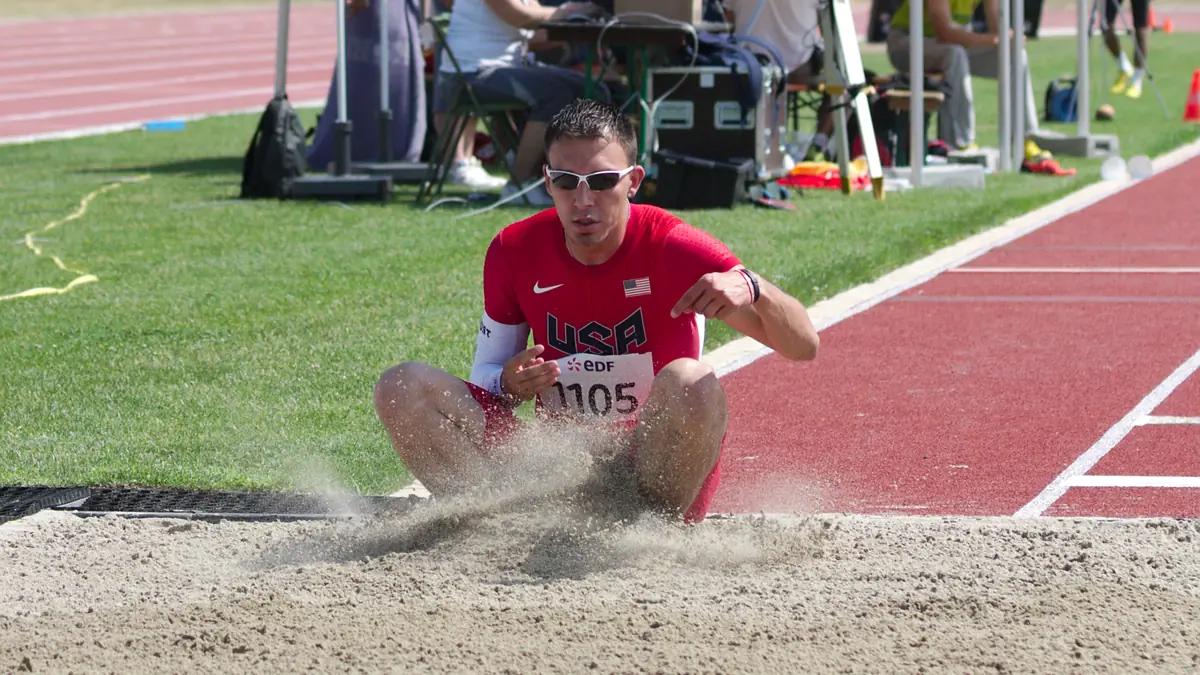
For a developing jumper, the diagnostic question is not whether the athlete is strong, but whether the athlete is elastic — whether the SSC contribution at the takeoff is recovering a high fraction of the eccentric-loading energy or losing it to muscular damping [1, 3, 4]. A simple in-the-gym diagnostic compares squat jump height (no countermovement) with countermovement jump height: the difference is the SSC contribution, and a low difference flags an elastic-deficit profile that no amount of additional heavy strength work will fix [3]. Plyometric exposure — progressively, starting from low-intensity drop and bound work and progressing to higher contact-velocity tasks — is the trainable lever for the SSC side; maximal-strength work [2] is the trainable lever for the F-side that bounds the absolute magnitude of the impulse. The mistake most commonly made with horizontal-jump prospects is to over-emphasise approach speed at the expense of the takeoff phase: a faster runway buys nothing if the takeoff mechanics cannot convert the velocity it produced [4, 5].
References
- Komi PV. (2000). Stretch-shortening cycle: a powerful model to study normal and fatigued muscle. Journal of Biomechanics, 33(10): 1197–1206. doi:10.1016/s0021-9290(00)00064-6
- Wisløff U, Castagna C, Helgerud J, Jones R, Hoff J. (2004). Strong correlation of maximal squat strength with sprint performance and vertical jump height in elite soccer players. British Journal of Sports Medicine, 38(3): 285–288. doi:10.1136/bjsm.2002.002071
- Bobbert MF, Gerritsen KGM, Litjens MCA, Van Soest AJ. (1996). Why is countermovement jump height greater than squat jump height? Medicine and Science in Sports and Exercise, 28(11): 1402–1412. doi:10.1097/00005768-199611000-00009
- Markovic G, Mikulic P. (2010). Neuro-musculoskeletal and performance adaptations to lower-extremity plyometric training. Sports Medicine, 40(10): 859–895. doi:10.2165/11318370-000000000-00000
- Aragón-Vargas LF, Gross MM. (1997). Kinesiological factors in vertical jump performance: differences among individuals. Journal of Applied Biomechanics, 13(1): 24–44. doi:10.1123/jab.13.1.24
Performance data (descriptive only): World Athletics.
The Athlete in One Paragraph
Miltiadis Tentoglou (b. 1998-03-18, Grevena, Greece) is the back-to-back Olympic long jump champion (Tokyo 2020 and Paris 2024) and a multiple world indoor and European outdoor titlist representing Greece. Listed at 1.83 m and approximately 71 kg, he sits in the lighter, more sprint-oriented end…
The Physiology — what takeoff mechanics actually convert
The horizontal jump is a constrained energy-conversion task. The athlete arrives at the board with as much horizontal velocity as the runway has produced, and the takeoff phase must redirect a portion of that velocity upward without bleeding excessive kinetic energy into the brake. Komi's…
The Case — Tentoglou's takeoff signature
For a 1.83 m, 71 kg long jumper, the structural problem at the board is to maximise vertical impulse without sacrificing the horizontal velocity the runway has already accumulated. The plant leg arrives at the board essentially extended, the foot strikes ahead of the centre…
What This Means for the Reader
For a developing jumper, the diagnostic question is not whether the athlete is strong, but whether the athlete is elastic — whether the SSC contribution at the takeoff is recovering a high fraction of the eccentric-loading energy or losing it to muscular damping [1, 3,…