
Preview
Hüseyin Akbulut, MSc (2026). Mollie O’Callaghan and the Sprint-Swim Stroke Power Output of an Elite Female Freestyle Sprinter. Sporeus. Retrieved, September 23, 2026. https://sporeus.com/en/science/mollie-ocallaghan-sprint-swim-stroke-power-output/
The Athlete in One Paragraph
Mollie O’Callaghan (b. 2004-04-02, Brisbane, Australia) is the defining female freestyle sprinter of her generation, Olympic champion in the 200 metres freestyle at Paris 2024 and a multiple-time world-record holder in the same event. Listed at 1.78 m and roughly 64 kg, she carries the long-levered, lean-mass profile that female sprint freestyle rewards — stroke-length leverage in the upper body, hip-drive capacity in the trunk, and a lean mass-to-frontal-area ratio that keeps drag-cost-per-stroke favourable at the cycle frequencies a sub-1:53 200 metres demands. The interesting case for sport science is not whether her isolated stroke peak force is the largest in the women’s field; it is how the product of peak force per stroke and stroke rate — the swim-power output sustained across roughly two minutes of near-maximal effort — defines elite female sprint freestyle. The variable underneath that pattern is sprint-swim stroke power output — the swimming-specific expression of strength-to-velocity coupling in repeated propulsive cycles.
Table of Contents
The Physiology — what sprint-swim stroke power output actually is
In land-based sport, maximal speed is generated by the application of force to the ground; Wisløff and colleagues showed in their canonical paper that maximal squat strength correlates strongly with sprint speed and vertical jump in elite athletes, because the foot-to-ground impulse is the rate-limiting step [1]. In sprint swimming the substrate is different — there is no rigid surface to push against — but the underlying logic translates: the swimmer applies force to a relatively yielding fluid through an aquadynamic hand-and-forearm shape, and the propulsive impulse per stroke multiplied by the number of strokes per second determines the velocity that can be sustained.
The peak force per stroke is partly a function of upper-body and trunk maximal strength, and partly a function of the technical ability to apply that force in the high-pressure window of the underwater pull. The peak force is wasted if applied at the wrong moment or against the wrong hand-and-forearm shape, in the same way that a strong vertical-jumper who fails to coordinate the arm-swing under-utilises their leg power. Wisløff’s force-to-speed relationship still holds; only the application surface changes [1].
Stroke rate, the second multiplier, is constrained by the swimmer’s ability to recover the stroke against drag and reset the catch with sufficient dwell time for force application. Buchheit and Laursen’s framework for repeated-high-intensity work clarified that aerobic capacity buys the recovery currency between bursts and therefore enables higher sustained output across an event whose duration sits in the aerobic-anaerobic transition zone [2]. A 200-metre freestyle, lasting roughly two minutes, is precisely such an event: the swimmer is operating above their lactate threshold for most of the race, and the aerobic system pays the bill for the back-end stroke-rate maintenance.
Joyner and Coyle’s three-factor framework — VO₂max, sustainable fraction, and economy — applies to the 200-metre freestyle even though it is a sprint relative to the 1500 metres; the aerobic ceiling and the sustainable fraction still constrain the back-end pace, while stroke economy determines how much of each stroke’s force translates into forward velocity rather than turbulence and lateral drift [3]. Stølen and colleagues summarised the same picture for any sport: the larger the aerobic engine, the cheaper the late-event high-intensity output [4]. Faude and colleagues’ clarification of the lactate-threshold concept underlines that the 200-metre swimmer who can clear the lactate produced in the opening 50 metres before the closing 50 metres preserves more of their stroke-power output where the race is decided [5].
The Case — O’Callaghan as sprint-swim power lens
O’Callaghan’s record across the 200-metre freestyle in the long-course pool is the cleanest applied demonstration of the sprint-swim power signature in women’s swimming. Her sub-1:53 200-metre and her ability to hold high stroke rates in the closing 50 metres — where most of the women’s field decelerates as lactate accumulates and stroke-rate collapses — are consistent with a power profile that combines high peak force per stroke with a large enough aerobic recovery system to keep the cycle frequency from falling [1, 2].
Her anthropometry is consistent with the female-sprint profile rather than a marathon-swim or pure-50-metre profile. At 1.78 m she carries the stroke-length leverage that 200-metre freestyle rewards; at roughly 64 kg her lean mass-to-frontal-area ratio keeps drag manageable at the cycle frequencies the event demands. Female sprint-swim physiology must respect the same Wisløff-type force-to-velocity logic as male sprint swimming, but with a smaller absolute force pool and a correspondingly stronger emphasis on technical force-application and stroke economy to convert what force there is into propulsion [1, 3].
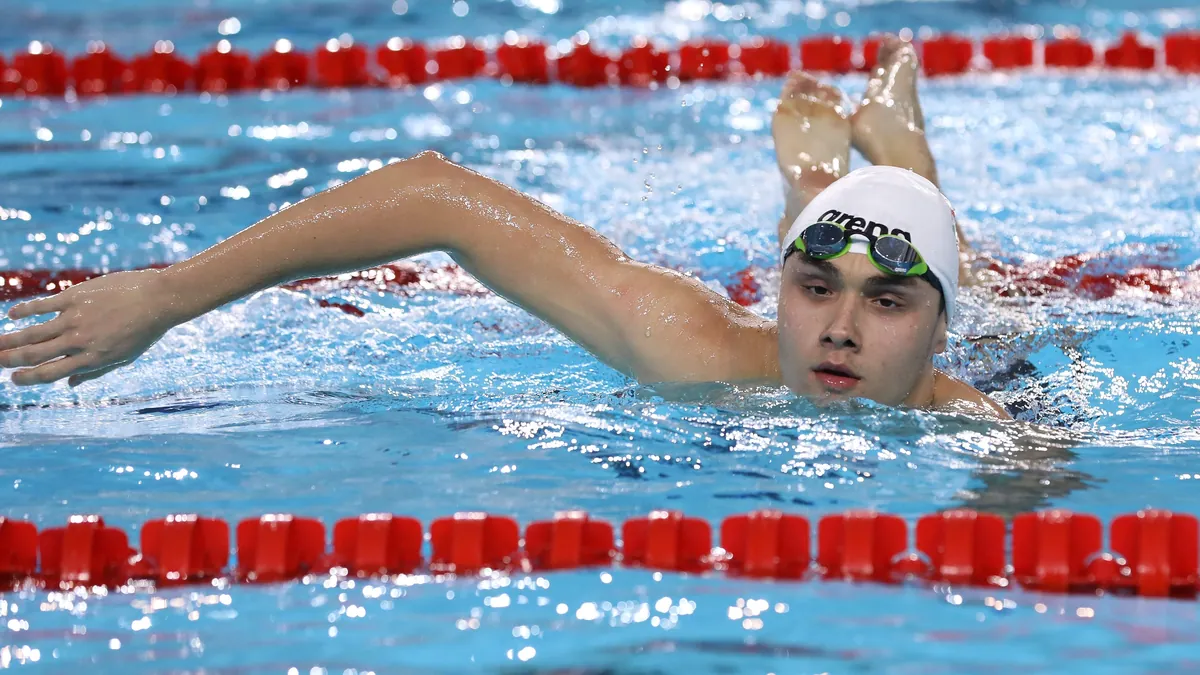
The strategic expression of the underlying physiology is the controlled but high-rate stroke pattern O’Callaghan has produced in her major-final swims — a rate that does not collapse in the third 50, a peak-force-per-stroke that does not erode despite the rising lactate, and a closing 50 in which stroke length is preserved by the postural control that lean trunk mass enables [4, 5]. The visual of late-race rate maintenance is not stylistic; it is what a sprint-swim stroke-power profile looks like when the aerobic recovery system has been built large enough to support it.
(Performance data: World Aquatics)
What This Means for the Reader
For the developing female sprint-freestyle swimmer or any age-group swimmer working on the 100–200 metre band, the takeaway is that stroke power is a product, not a single variable. Many junior swimmers chase peak stroke force in dryland strength work without addressing the technical force-application window in the water, and stroke rate without addressing the aerobic recovery system that maintains it; the higher-yield block is usually a programme that develops both multipliers in parallel — strength and force-application together, stroke rate and aerobic threshold together [1, 2]. The 200-metre time falls because the product rises, not because either factor is maxed out alone.
The second implication is event-specific aerobic discipline. The 200-metre freestyle is metabolically a hybrid event; under-training the aerobic recovery system produces fast 50s and collapsing 200s, while over-training the aerobic system at the expense of peak power produces a sustainable but underwhelming profile [3, 5]. The sprint-freestyle plan is, in effect, a balance problem between strength-power inputs and aerobic-recovery inputs, and the elite female programme reflects that balance across the macrocycle.
The diagnostic question for the swimmer: in a 200-metre freestyle, how much does my third 50 stroke rate drop relative to my first 50, and how does that gap compare with my dryland strength-power profile and my aerobic threshold work?
References
- Wisløff U, Castagna C, Helgerud J, Jones R, Hoff J. (2004). Strong correlation of maximal squat strength with sprint performance and vertical jump height in elite soccer players. British Journal of Sports Medicine, 38(3): 285–288. doi:10.1136/bjsm.2002.002071
- Buchheit M, Laursen PB. (2013). High-intensity interval training, solutions to the programming puzzle. Sports Medicine, 43(5): 313–338. doi:10.1007/s40279-013-0029-x
- Joyner MJ, Coyle EF. (2008). Endurance exercise performance: the physiology of champions. The Journal of Physiology, 586(1): 35–44. doi:10.1113/jphysiol.2007.143834
- Stølen T, Chamari K, Castagna C, Wisløff U. (2005). Physiology of soccer: an update. Sports Medicine, 35(6): 501–536. doi:10.2165/00007256-200535060-00004
- Faude O, Kindermann W, Meyer T. (2009). Lactate threshold concepts: how valid are they? Sports Medicine, 39(6): 469–490. doi:10.2165/00007256-200939060-00003
Performance data (descriptive only): World Aquatics.
The Athlete in One Paragraph
Mollie O'Callaghan (b. 2004-04-02, Brisbane, Australia) is the defining female freestyle sprinter of her generation, Olympic champion in the 200 metres freestyle at Paris 2024 and a multiple-time world-record holder in the same event. Listed at 1.78 m and roughly 64 kg, she carries the…
The Physiology — what sprint-swim stroke power output actually is
In land-based sport, maximal speed is generated by the application of force to the ground; Wisløff and colleagues showed in their canonical paper that maximal squat strength correlates strongly with sprint speed and vertical jump in elite athletes, because the foot-to-ground impulse is the rate-limiting…
The Case — O'Callaghan as sprint-swim power lens
O'Callaghan's record across the 200-metre freestyle in the long-course pool is the cleanest applied demonstration of the sprint-swim power signature in women's swimming. Her sub-1:53 200-metre and her ability to hold high stroke rates in the closing 50 metres — where most of the women's…
What This Means for the Reader
For the developing female sprint-freestyle swimmer or any age-group swimmer working on the 100–200 metre band, the takeaway is that stroke power is a product, not a single variable. Many junior swimmers chase peak stroke force in dryland strength work without addressing the technical force-application…