Preview
Hüseyin Akbulut, MSc (2026). Anthony Edwards and the Explosive Guard Vertical Pop of an Elite Shooting Guard. Sporeus. Retrieved, October 18, 2026. https://sporeus.com/en/science/anthony-edwards-explosive-guard-vertical-pop/
The Athlete in One Paragraph
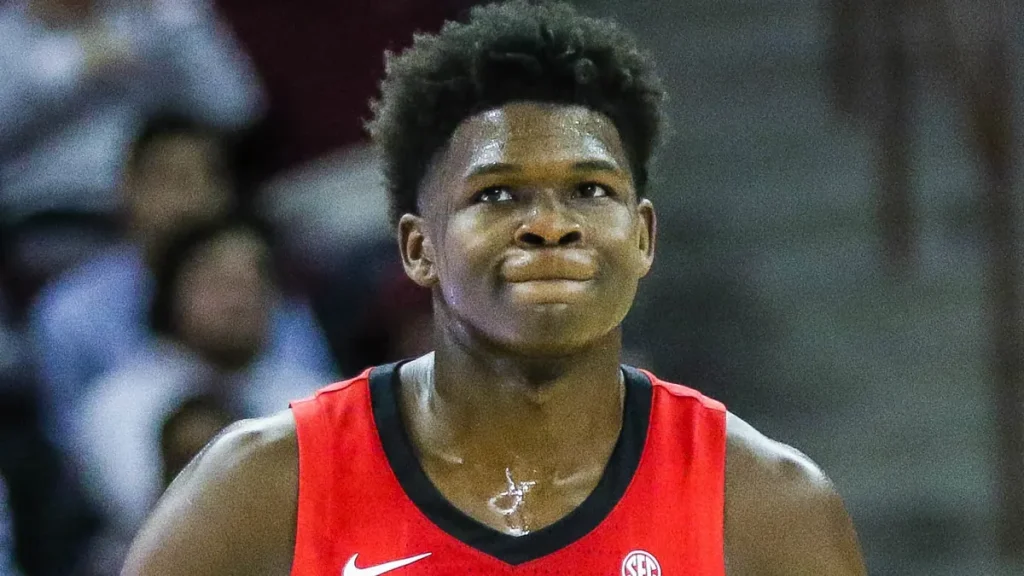
Anthony DeVante Edwards (b. 2001-08-05, Atlanta, Georgia, United States) is, as of September 2026, a shooting guard for the Minnesota Timberwolves and a member of the United States national team programme. Listed at 1.93 m and ~102 kg, he carries the anthropometry of a heavy guard — heavier by ten to fifteen kilos than most backcourt athletes — who nevertheless converts that mass into the league’s most-replayed dunk catalogue, with a vertical-pop signature that puts him visually among the highest air-time guards in modern basketball. The interesting case for sport science is not any single highlight but the underlying neuromuscular machinery that allows a 102 kg guard to compress a counter-movement and return a vertical impulse on the order asked of athletes 15 kg lighter. The variable underneath that story is explosive guard vertical pop — how countermovement-jump biomechanics, reactive strength index, and the strength base that underwrites both interact when the body is heavier than the prototype the jumping literature usually describes.
Table of Contents

The Physiology — what vertical pop actually is
Vertical jump performance in team-sport athletes is governed by the interaction of maximal lower-body strength, the rate of force development, and the efficiency of the stretch-shortening cycle that returns elastic energy through tendon and active musculature [1, 2]. Wisløff and colleagues, working with elite footballers, demonstrated a strong correlation between maximal squat strength and both vertical jump height and sprint performance, with the relationship mediated by relative strength — force expressed against body mass — rather than by absolute force alone [1]. Cormie and colleagues’ framework on developing maximal neuromuscular power generalises the principle: peak power is the product of maximal force capacity and the velocity at which that capacity can be expressed, and chronic adaptation depends on training that loads both ends of the force-velocity curve [2].
Komi’s foundational work on the stretch-shortening cycle adds the elastic-energy layer. A countermovement jump out-performs a static squat jump because the eccentric pre-stretch loads tendinous structures and primes the contractile machinery, returning energy on the concentric phase that a pure concentric action cannot access [3]. The reactive strength index — flight time divided by ground-contact time in a drop jump — captures how efficiently this cycle is exploited, and at the elite level it discriminates between athletes who use the rebound and athletes who absorb it [3]. Markovic’s meta-analysis of plyometric training shows that the reactive component is trainable: well-programmed plyometrics produce small-to-moderate gains in vertical jump height across athletic populations, with the magnitude of the response shaped by baseline status, programme volume, and the integration of strength training [4].
For a heavier athlete the calculus shifts. Wisløff’s relative-strength point bites harder because the same absolute squat returns less per kilogram, and the impulse-momentum requirement to lift a heavier body to the same take-off velocity scales with mass [1]. Stølen and colleagues’ update on football physiology, used here for general sport-physiology framing, reminds us that athletic-action profiles are role-specific: a guard who finishes above the rim is asking for guard-level air time at heavyweight body mass, and the protective margin against orthopaedic cost lives in the strength base [5]. The implication is direct: heavy-guard vertical pop is built on a relative-strength foundation that is not optional.
The takeaway is that the visible “pop” is an integral — strength reserve plus stretch-shortening efficiency plus repeatable countermovement mechanics — and the body-mass tax on a heavy guard is paid in the strength base before it is paid in the plyometric drill.
The Case — Edwards as a heavy-guard vertical-pop case study
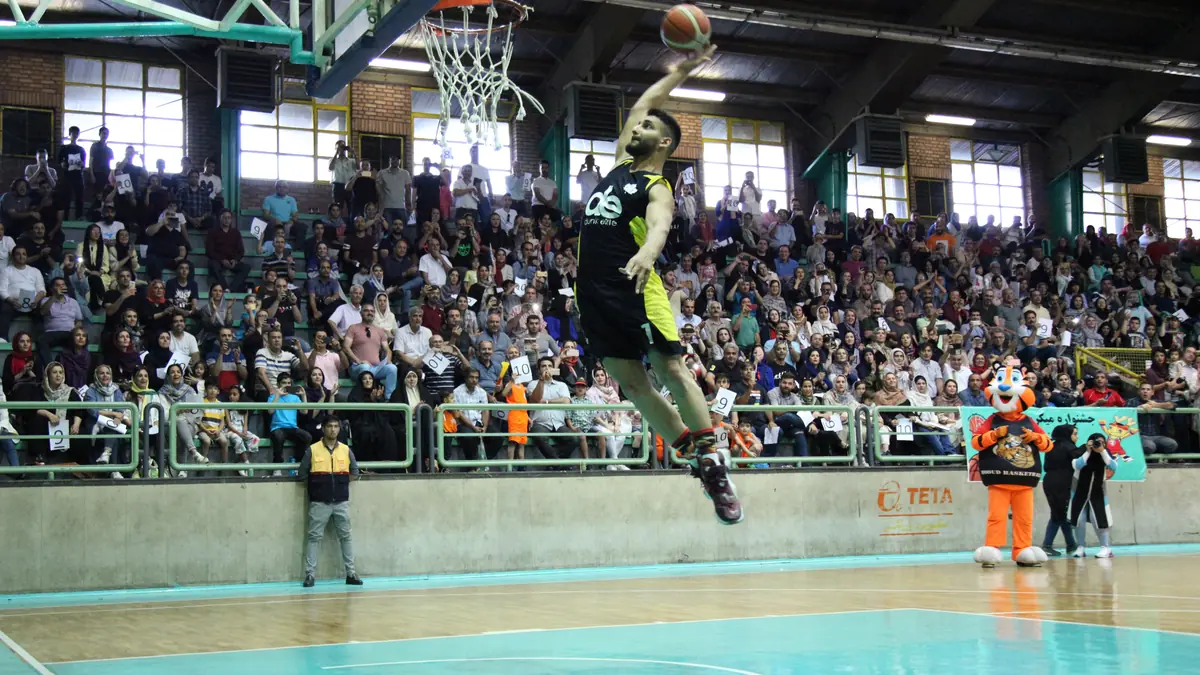
For a 1.93 m / ~102 kg guard, the highlight-reel countermovement jump is, in the language of the literature, a demonstration that the relative-strength foundation has been built well enough that the body-mass tax does not collapse the take-off [1, 2]. The visible signature — a deep counter-movement, a fast reversal, and a high vertical impulse onto the rim — is the neuromuscular trio of strength, rate of force development, and stretch-shortening efficiency expressed at heavyweight body mass [1, 2, 3].
Edwards’s role compounds the demand. A scoring guard who catches lobs in transition, attacks closeouts vertically, and finishes through contact at the rim accumulates a high volume of countermovement actions across a season; the metabolic and orthopaedic cost is real, and the strength base that allows the actions to remain explosive late in games is the same base that protects the joints from the eccentric landings that follow each one [2, 4]. Cormie and colleagues’ principle — that peak power adaptations require continuous training across the force-velocity curve — applies directly: a heavy guard who lets the strength base drift will see the visible pop drift with it [2].
A second feature is reactive expression. The reactive strength index — short ground-contact time, long flight time — is what separates the athlete who rebounds the second jump from the athlete who lands and re-organises before the next take-off [3, 4]. For a heavy athlete this is the more difficult trainable variable, because every extra kilogram lengthens the ground-contact phase and dilutes the elastic return; the literature is consistent in framing reactive work as a layer that sits on top of strength, not as a substitute for it [3, 4, 5].
Match-context note: across recent seasons, Edwards’s per-game finishing volume around the rim has placed him among the most-replayed dunk profiles in the league at his body mass (Match data: NBA.com / Basketball-Reference). The discriminator across seasons is not raw single-trial vertical but the repeatability of the pop deep into a high-volume scoring role.
What This Means for the Reader
For heavier guard-sized athletes — basketball shooting guards, volleyball outsides, the heavier wing positions across team sports — the lesson is that the visible vertical is built on the strength base before it is built on the plyometric drill [1, 2, 4]. Train relative strength against body mass; integrate countermovement and drop-jump work as expression, not as the foundation; expect that body-mass increases without proportional strength gains will quietly erode the pop.
Practical assessment: track three indicators — relative back-squat strength against body mass, a countermovement jump on a contact mat or accelerometer, and a drop-jump reactive strength index from a standardised box height [1, 2, 3, 4]. A relative squat below 1.7× body mass in a heavy guard is a development priority before chasing reactive-plyometric volume that the body cannot yet underwrite [1, 2].
The diagnostic question for the heavy-guard jumper: am I gaining mass faster than I am gaining the strength to launch it?
References
- Wisløff U, Castagna C, Helgerud J, Jones R, Hoff J. (2004). Strong correlation of maximal squat strength with sprint performance and vertical jump height in elite soccer players. British Journal of Sports Medicine, 38(3): 285–288. doi:10.1136/bjsm.2002.002071
- Cormie P, McGuigan MR, Newton RU. (2011). Developing maximal neuromuscular power: Part 1 — biological basis of maximal power production. Sports Medicine, 41(1): 17–38. doi:10.2165/11537690-000000000-00000
- Komi PV. (2000). Stretch-shortening cycle: a powerful model to study normal and fatigued muscle. Journal of Biomechanics, 33(10): 1197–1206. doi:10.1016/s0021-9290(00)00064-6
- Markovic G. (2007). Does plyometric training improve vertical jump height? A meta-analytical review. British Journal of Sports Medicine, 41(6): 349–355. doi:10.1136/bjsm.2007.035113
- Stølen T, Chamari K, Castagna C, Wisløff U. (2005). Physiology of soccer: an update. Sports Medicine, 35(6): 501–536. doi:10.2165/00007256-200535060-00004
Match-context data (descriptive only): NBA.com / Basketball-Reference.

Hüseyin Akbulut is the founder of Sporeus and author of THRESHOLD (EŞİK), a 540-page Turkish-language book on endurance science.
- 540pp THRESHOLD Book
- MSc Sport Sciences
- Marmara University
The Athlete in One Paragraph
Anthony DeVante Edwards (b. 2001-08-05, Atlanta, Georgia, United States) is, as of September 2026, a shooting guard for the Minnesota Timberwolves and a member of the United States national team programme. Listed at 1.93 m and ~102 kg, he carries the anthropometry of a heavy…
The Physiology — what vertical pop actually is
Vertical jump performance in team-sport athletes is governed by the interaction of maximal lower-body strength, the rate of force development, and the efficiency of the stretch-shortening cycle that returns elastic energy through tendon and active musculature [1, 2]. Wisløff and colleagues, working with elite footballers,…
The Case — Edwards as a heavy-guard vertical-pop case study
For a 1.93 m / ~102 kg guard, the highlight-reel countermovement jump is, in the language of the literature, a demonstration that the relative-strength foundation has been built well enough that the body-mass tax does not collapse the take-off [1, 2]. The visible signature —…
What This Means for the Reader
For heavier guard-sized athletes — basketball shooting guards, volleyball outsides, the heavier wing positions across team sports — the lesson is that the visible vertical is built on the strength base before it is built on the plyometric drill [1, 2, 4]. Train relative strength…