
Preview
Hüseyin Akbulut, MSc (2026). Sarah Sjöström and the Butterfly Stroke Mechanical Efficiency of an Elite Sprint Swimmer. Sporeus. Retrieved, October 2, 2026. https://sporeus.com/en/science/sarah-sjostrom-butterfly-stroke-mechanical-efficiency/
The Athlete in One Paragraph
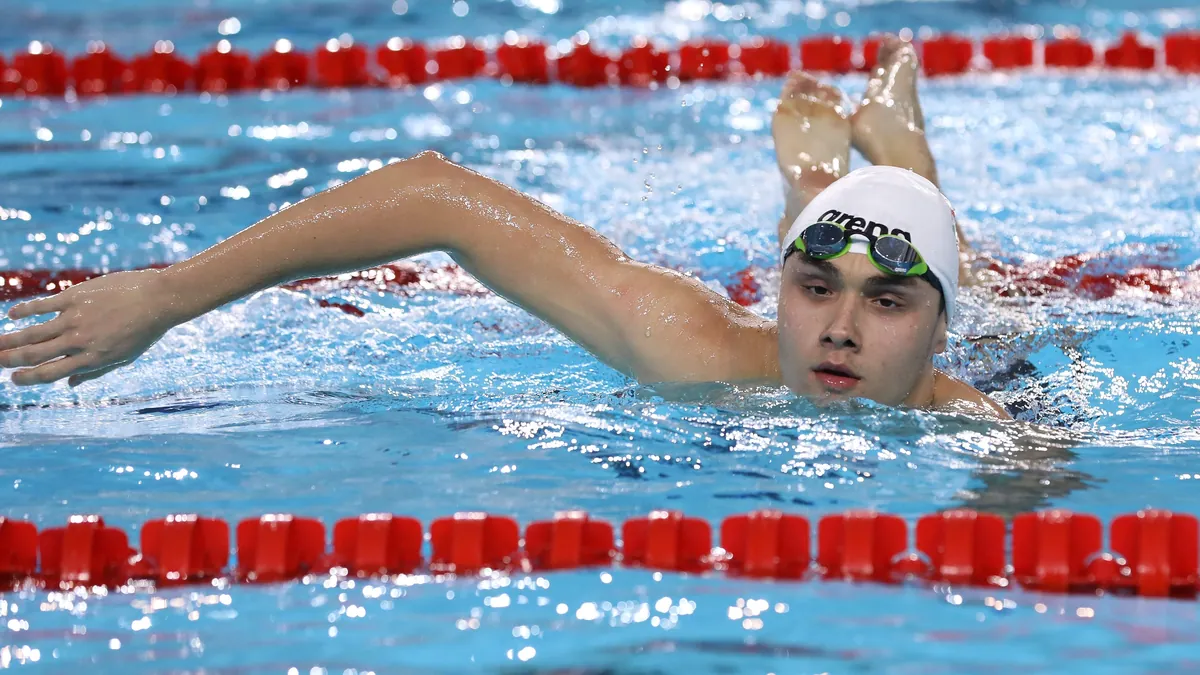
Sarah Sjöström (b. 1993-08-17, Södertälje, Sweden) is the defining women’s butterfly and sprint-freestyle swimmer of the 2010s and 2020s, Olympic 100-metre butterfly champion in 2016, multiple-time long-course world-record holder across 50 and 100 butterfly and 50 and 100 freestyle, and the rare athlete whose sprint-stroke output remains world-class across more than a decade. Listed at 1.82 m and roughly 67 kg, she carries the long-levered, lean-mass physique that butterfly rewards — stroke-length leverage in the upper body, trunk-and-hip range for the body-undulation pattern that defines the stroke, and a lean mass-to-frontal-area ratio that keeps drag manageable across the high cycle frequencies butterfly demands. The interesting case for sport science is not whether her isolated peak pull force is the largest in the women’s field; it is how the mechanical efficiency of her butterfly — the conversion ratio between metabolic energy expended and forward velocity produced — has allowed her to sustain sub-25 50-metre butterfly times across a decade in the most mechanically expensive of the four strokes. The variable underneath that pattern is butterfly stroke mechanical efficiency — the body-undulation and arm-pull coordination that converts metabolic cost into forward propulsion against a stroke whose energetic baseline is the highest in swimming.
Table of Contents
The Physiology — what butterfly stroke mechanical efficiency actually is
Among the four competitive strokes, butterfly is consistently the most metabolically expensive at any given velocity, because the simultaneous-arm-recovery pattern requires the entire upper body to lift partially out of the water on every cycle and the dolphin-kick body-undulation pattern produces a propulsive impulse only on a fraction of the cycle. Joyner and Coyle’s three-factor framework for endurance performance — VO₂max, sustainable fraction, and economy — applies to sprint butterfly even though the event is metabolically a sprint, because the economy term dominates: a small advantage in oxygen-cost-per-metre at high velocity translates into a measurably faster sustainable pace, and across the field the differences in raw aerobic ceiling are smaller than the differences in stroke-mechanics economy [1].
Saunders and colleagues catalogued the determinants of locomotor economy — neuromuscular efficiency, accumulated training history, body-mass distribution, and the elastic-energy storage that produces “free” propulsion through tendon recoil [2]. Translated to butterfly, these determinants read as the lat-and-trunk elastic chain that produces the second underwater pull phase, the postural control that keeps the body-undulation amplitude inside its drag-minimising range, and the timing precision that allows the kick and pull to combine constructively rather than destructively across each cycle.
Wisløff and colleagues’ canonical strength-to-velocity finding establishes that maximal force capacity correlates strongly with velocity output in elite athletes [3]. In butterfly the application surface is fluid rather than ground, but the underlying logic still holds: the swimmer who can apply higher peak force during the high-pressure underwater pull window, against a hand-and-forearm shape that does not slip, produces a higher per-cycle propulsive impulse. Buchheit and Laursen’s framework for repeated-high-intensity work clarifies that even in the 100-metre sprint the aerobic recovery system pays a non-trivial part of the bill — and certainly does so across heats, semis, and finals on the same day [4]. Stølen and colleagues summarised the same picture for any sport: aerobic dominance is the recovery currency that purchases late-event high-intensity capacity [5].
Mechanical efficiency in butterfly, then, is the product of three things: the elastic-storage stroke-economy variables that Saunders described; the peak-force capacity that Wisløff anchored; and the aerobic recovery system that supports repeated maximal efforts across a competition cycle. Each of the three is necessary; none of the three alone is sufficient.
The Case — Sjöström as butterfly mechanical-efficiency lens
Sjöström’s record across the women’s 50 and 100 butterfly is the cleanest applied demonstration of butterfly mechanical efficiency in a long career rather than a single-Games peak. Her ability to sustain sub-25 50-metre butterfly times over a decade — into a phase of career when most sprint specialists drift outwards by tenths — is consistent with a stroke-mechanics signature that has been refined across years of accumulated technical training, and an aerobic recovery system that has supported the high-intensity work without the late-career compromises that reduced peak force production typically forces [1, 4].
Her anthropometry is consistent with the butterfly profile rather than a long-distance or pure-breaststroke profile. At 1.82 m she carries the stroke-length leverage that butterfly rewards; at roughly 67 kg her lean mass-to-frontal-area ratio keeps drag manageable at the high cycle frequencies sprint butterfly demands. The Saunders-style determinants of locomotor economy translate to butterfly through the trunk-and-shoulder elastic chain that produces the second pull-phase impulse, and through the postural control that keeps body-undulation amplitude inside its drag-minimising range across each cycle [2].
The strategic expression of the underlying physiology is the unusually well-preserved stroke-mechanics signature Sjöström has produced across competition cycles — a peak force per stroke that has not eroded sharply with age, a stroke rate that does not over-shoot into mechanical waste, and a closing 25 metres in which body-undulation amplitude is preserved by the postural control that lean trunk mass enables [3, 5]. The visual of a butterfly stroke that still looks mechanically clean a decade after the first major medal is not stylistic; it is what mechanical efficiency looks like when the stroke-economy variables have been protected by training and the aerobic-recovery system has been kept large enough to support repeated maximal efforts.
(Performance data: World Aquatics)
What This Means for the Reader
For the developing butterfly swimmer or any age-group swimmer working on the most mechanically demanding stroke, the takeaway is that butterfly performance is bought primarily through stroke-mechanics economy, not raw peak force. Many junior swimmers chase peak pull strength while the body-undulation amplitude drifts outside the drag-minimising range and stroke timing decouples between kick and pull; the higher-yield block is usually a sustained period of technical work that protects the elastic-storage stroke-economy variables Saunders described, supported by the aerobic-recovery work that lets the high-intensity sets be repeated cleanly [1, 2]. The 50-metre butterfly time falls because the stroke costs less metabolic energy per metre, not because the swimmer becomes raw-strength-stronger.
The second implication is career-longevity discipline. The athletes who sustain sprint-stroke output across a decade are the ones whose stroke-mechanics signature does not drift, and who do not over-train peak-force work at the expense of the recovery system that supports it [3, 4]. The butterfly swimmer’s training plan is, in effect, a balance problem between technical-economy inputs, peak-force inputs, and aerobic-recovery inputs, and the elite long-career programme reflects that balance.
The diagnostic question for the swimmer: in a 50-metre butterfly time trial, does my stroke length collapse before my stroke rate does, and what does that tell me about whether my technical-economy work or my aerobic-recovery work is the limiting block?
References
- Joyner MJ, Coyle EF. (2008). Endurance exercise performance: the physiology of champions. The Journal of Physiology, 586(1): 35–44. doi:10.1113/jphysiol.2007.143834
- Saunders PU, Pyne DB, Telford RD, Hawley JA. (2004). Factors affecting running economy in trained distance runners. Sports Medicine, 34(7): 465–485. doi:10.2165/00007256-200434070-00005
- Wisløff U, Castagna C, Helgerud J, Jones R, Hoff J. (2004). Strong correlation of maximal squat strength with sprint performance and vertical jump height in elite soccer players. British Journal of Sports Medicine, 38(3): 285–288. doi:10.1136/bjsm.2002.002071
- Buchheit M, Laursen PB. (2013). High-intensity interval training, solutions to the programming puzzle. Sports Medicine, 43(5): 313–338. doi:10.1007/s40279-013-0029-x
- Stølen T, Chamari K, Castagna C, Wisløff U. (2005). Physiology of soccer: an update. Sports Medicine, 35(6): 501–536. doi:10.2165/00007256-200535060-00004
Performance data (descriptive only): World Aquatics.
The Athlete in One Paragraph
Sarah Sjöström (b. 1993-08-17, Södertälje, Sweden) is the defining women's butterfly and sprint-freestyle swimmer of the 2010s and 2020s, Olympic 100-metre butterfly champion in 2016, multiple-time long-course world-record holder across 50 and 100 butterfly and 50 and 100 freestyle, and the rare athlete whose sprint-stroke…
The Physiology — what butterfly stroke mechanical efficiency actually is
Among the four competitive strokes, butterfly is consistently the most metabolically expensive at any given velocity, because the simultaneous-arm-recovery pattern requires the entire upper body to lift partially out of the water on every cycle and the dolphin-kick body-undulation pattern produces a propulsive impulse only…
The Case — Sjöström as butterfly mechanical-efficiency lens
Sjöström's record across the women's 50 and 100 butterfly is the cleanest applied demonstration of butterfly mechanical efficiency in a long career rather than a single-Games peak. Her ability to sustain sub-25 50-metre butterfly times over a decade — into a phase of career when…
What This Means for the Reader
For the developing butterfly swimmer or any age-group swimmer working on the most mechanically demanding stroke, the takeaway is that butterfly performance is bought primarily through stroke-mechanics economy, not raw peak force. Many junior swimmers chase peak pull strength while the body-undulation amplitude drifts outside…