Preview
Hüseyin Akbulut, MSc (2026). Nigel Hayes-Davis and the EuroLeague Physical-Wing Strength-Defense Profile. Sporeus. Retrieved, September 27, 2026. https://sporeus.com/en/science/nigel-hayes-davis-euroleague-physical-wing-strength-defense/
The Athlete in One Paragraph
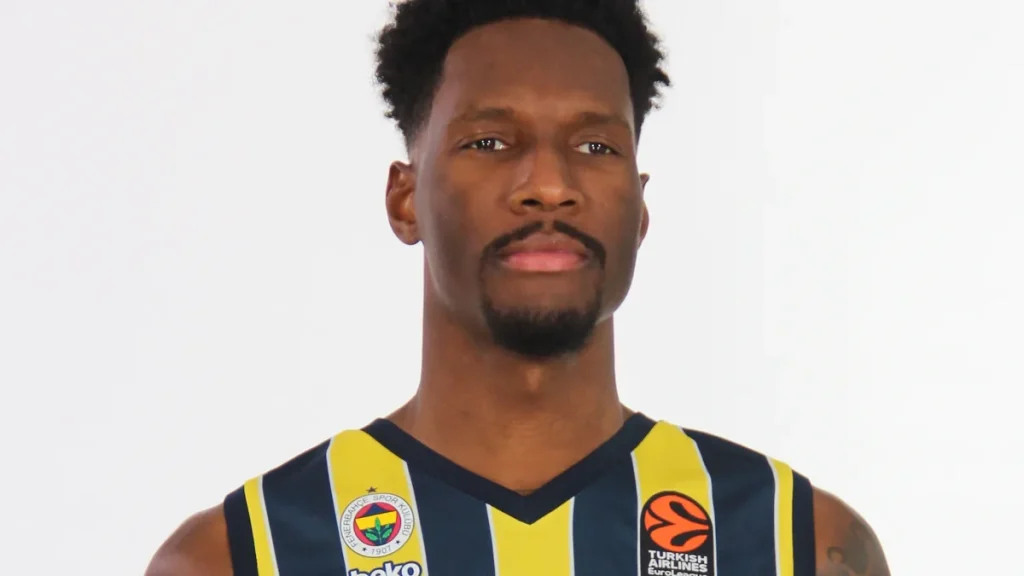
Nigel Hayes-Davis (b. 1994-12-16) is an American-Turkish forward known across European basketball for strength-driven wing defence and post-defence physicality. Listed at 2.03 m and ~113 kg, his current EuroLeague campaign with Fenerbahçe Beko continues to define one of the league’s most discussed performance archetypes. The interesting case for sport science is not any single highlight but the underlying physiological and cognitive architecture that lets a player of his profile produce repeatable elite output across a 40-minute game and a 35-game-plus EuroLeague regular season followed by playoffs. The variable underneath that story is Physical wing strength-defense — how the trainable determinants of strength wing defense and contact tolerance in basketball forwards combine to deliver the kind of consistency the EuroLeague demands.
Table of Contents
The Physiology — what physical wing strength-defense actually measures
A physical wing’s strength-based defence is spent inside a game built on stop-start effort. The systematic review of basketball match-play demands by Stojanović and colleagues portrays the sport as repeated short, high-intensity actions broken up by brief active and passive recoveries, with mean intensities that firmly class it as high-intensity intermittent [1]. Ben Abdelkrim, El Fazaa and El Ati’s time-motion study of elite young players shows what a forward absorbing contact actually faces: dozens of activity changes per minute, frequent jumps, shuffles, accelerations and decelerations, and heart rate sitting at or above the lactate threshold for large parts of the game [2]. Every bump on a driver and every post battle is paid for from that budget.
The cognitive layer matters as much as the metabolic one. Decision-making in dense court traffic is constrained by perceptual narrowing under fatigue and by the limits of visual search; Abernethy showed that visual search strategies — where the athlete looks, when, and for how long — discriminate elite from sub-elite performers across racket and team sports [3]. Vickers’ work on the quiet-eye paradigm extends that finding: the duration and stability of the final fixation before a critical motor action correlates with success rates in shooting and passing tasks [4]. For an EuroLeague forward, the gap between a good play and a turnover is often not athletic but visual and decisional.
The training-response layer brings these threads together. Cormie, McGuigan and Newton’s framework on developing maximal neuromuscular power identifies the trainable determinants — maximal strength, rate of force development, and movement velocity — and shows that the productive combination is heavy strength work alongside ballistic, velocity-biased work [5]. For a player whose role is built on absorbing physical wing matchups and protecting the paint, the physiological reservoir is wide enough only when the strength base, the cognitive base, and the energy-systems base are developed in parallel rather than in isolation.
The Case — Nigel Hayes-Davis as a physical wing strength-defense archetype
For a 2.03 m / ~113 kg forward operating across a EuroLeague season, the underlying performance architecture must combine a wide energy-system reservoir with intact decision-making cognition so that a strength reservoir that supports contact-heavy minutes can be produced repeatedly without the kind of late-game collapse that exposes a weak physiological foundation [1, 2]. The demands of his current role sit exactly at this intersection — the player whose profile is defined by skill, pace and judgement is also the player whose body must support that skill across the full season volume the EuroLeague calendar imposes.
The size dimension cuts in two directions. A long-levered build at 2.03 m both expands the on-court advantage tied to absorbing physical wing matchups and protecting the paint and raises the absolute strength reservoir required to move that body explosively across the floor [5]. The player who carries the strongest relative-to-body-mass strength base and the cleanest motor pattern at this body size owns the most consistent profile across the longer EuroLeague playoff run, where the shorter, denser schedule punishes any soft spot in the underlying physiology [1, 2].
The cognitive layer is where Nigel Hayes-Davis’s archetype gets its specific identity. The decisional discriminator at the elite level is not how fast the body moves but how cleanly the eyes and the prefrontal cortex partition the environment and select the next action under time pressure [3, 4]. The player who can hold a stable visual fixation, anticipate a passing window, and execute the chosen action while three defenders converge is the player whose box score holds up in the seventh game of a five-game series. EuroLeague rosters are deep on athletic talent; the differentiator is repeatable judgement across late-game minutes against the best European defences [3, 4].
Match-context note: across his career sample Nigel Hayes-Davis’s per-game contributions in EuroLeague competitions place him among the upper band of his positional cohort (Match data: EuroLeague.net / Basketball-Reference, descriptive context only).

What This Means for the Reader
For a young forward building a physical defensive identity, the key point is that strength on the wing is only as useful as the weakest of three reservoirs — energy systems, neuromuscular power and decisional cognition — any of which can become the performance cap [1, 2, 3, 4, 5]. The wing who trains only conditioning, only the barbell, or only technique runs out of room against opponents who grow all three.
Three measurements reveal the limiting factor for a developing physical wing: a graded exercise test or in-season heart-rate-recovery profile for the energy-system reservoir, a relative-strength benchmark and countermovement jump for the neuromuscular reservoir, and a video-based decision-accuracy test for the cognitive reservoir. A slide in any one of them is the first sign that contact defence is heading toward late-game fade instead of late-game presence. The forward’s question: when I start losing physical matchups in the fourth quarter, is my engine too small, is my strength leaking, or am I reading actions too late?
References
- Stojanovi\u0107 E, Stojiljkovi\u0107 N, Scanlan AT, Dalbo VJ, Berkelmans DM, Milanovi\u0107 Z. (2018). The activity demands and physiological responses encountered during basketball match-play: a systematic review. Sports Medicine, 48(1): 111\u2013135. doi:10.1007/s40279-017-0794-z
- Ben Abdelkrim N, El Fazaa S, El Ati J. (2007). Time-motion analysis and physiological data of elite under-19-year-old basketball players during competition. British Journal of Sports Medicine, 41(2): 69\u201375. doi:10.1136/bjsm.2006.032318
- Abernethy B. (1991). Visual search strategies and decision-making in sport. International Journal of Sport Psychology, 22(3-4): 189\u2013210.
- Vickers JN. (2007). Perception, Cognition, and Decision Training: The Quiet Eye in Action. Human Kinetics. doi:10.5040/9781492595519
- Cormie P, McGuigan MR, Newton RU. (2011). Developing maximal neuromuscular power: Part 1 \u2014 biological basis of maximal power production. Sports Medicine, 41(1): 17\u201338. doi:10.2165/11537690-000000000-00000
Match-context data (descriptive only): EuroLeague.net / Basketball-Reference.
The Athlete in One Paragraph
Nigel Hayes-Davis (b. 1994-12-16) is an American-Turkish forward known across European basketball for strength-driven wing defence and post-defence physicality. Listed at 2.03 m and ~113 kg, his current EuroLeague campaign with Fenerbahçe Beko continues to define one of the league's most discussed performance archetypes. The…
The Physiology — what physical wing strength-defense actually measures
A physical wing's strength-based defence is spent inside a game built on stop-start effort. The systematic review of basketball match-play demands by Stojanović and colleagues portrays the sport as repeated short, high-intensity actions broken up by brief active and passive recoveries, with mean intensities that…
The Case — Nigel Hayes-Davis as a physical wing strength-defense archetype
For a 2.03 m / ~113 kg forward operating across a EuroLeague season, the underlying performance architecture must combine a wide energy-system reservoir with intact decision-making cognition so that a strength reservoir that supports contact-heavy minutes can be produced repeatedly without the kind of late-game…
What This Means for the Reader
For a young forward building a physical defensive identity, the key point is that strength on the wing is only as useful as the weakest of three reservoirs — energy systems, neuromuscular power and decisional cognition — any of which can become the performance cap…