
Preview
Hüseyin Akbulut, MSc (2026). Florian Wirtz and the ACL Recovery and Return to Elite Form of an Attacking Midfielder. Sporeus. Retrieved, October 5, 2026. https://sporeus.com/en/science/florian-wirtz-acl-recovery-return-to-elite-form/
The Athlete in One Paragraph
Florian Richard Wirtz (b. 2003-05-03, Pulheim, Germany) is, as of September 2026, the attacking midfielder of Liverpool (formerly Bayer Leverkusen) and the Germany national team — listed at 1.76 m and ~72 kg, lean and average-tall for the role, and the creative spine of the Leverkusen side that won the 2023–24 Bundesliga. The interesting case for sport science is not whether Wirtz is technically gifted; the body of work answers that question. The interesting case is what happened across 2022 — a non-contact anterior cruciate ligament rupture in March 2022, surgical reconstruction, and a return to the pitch and to elite creative output across the months and seasons that followed. The variable underneath the trajectory is ACL recovery and the return-to-elite-form curve — the eccentric-strength, neuromuscular-control and decision-making timeline that separates clinical clearance from genuine match performance.
Table of Contents
The Physiology — what ACL recovery actually demands
The anterior cruciate ligament is the principal anterior-translation and rotational restraint at the knee, and a non-contact rupture in elite football typically occurs during deceleration, planting and cutting — the same task profile that defines the attacking midfielder’s working day [1]. Surgical reconstruction restores the mechanical restraint, but it does not restore neuromuscular control, eccentric quadriceps capacity, or the perceptual-cognitive coupling between cue recognition and cut execution. The clinical milestone — return to training, return to play — is necessary but not sufficient for return to elite form.
Spiteri and colleagues’ work on the mechanical determinants of change-of-direction performance is foundational here: faster, more efficient cuts are produced by athletes with greater eccentric strength, higher horizontal force production at planting, and bilateral strength symmetry below clinically meaningful asymmetry thresholds [1]. Post-ACL athletes consistently present with persistent quadriceps weakness on the operated limb, often beyond the typical six- to nine-month return-to-play window; the mechanical asymmetry persists after the clinical clearance, and the cutting performance remains compromised until the asymmetry resolves.
Wisløff and colleagues established the underlying linkage: maximal squat strength is strongly correlated with sprint performance and vertical jump height in elite footballers, and the same lower-limb-strength substrate underwrites the eccentric-deceleration capacity required for cutting and planting [2]. The post-ACL athlete who returns to play with a 15–20% bilateral strength deficit is, mechanically, returning at a different operating point from the one they left. The deficit is not a vague risk; it is a measurable mechanical limitation on the actions that define their role.
Bangsbo, Mohr and Krustrup’s match-running decomposition framed the per-match demand the recovering athlete is being asked to absorb — total distance ~10–12 km per match, ~8–12% at high intensity, dominated by short bursts of acceleration, deceleration and direction change [3]. The high-intensity segments are precisely the segments that load the reconstructed knee; the recovery curve is therefore not just from rest to low-intensity activity but from rest to the specific loading pattern of the match.
Stølen, Chamari, Castagna and Wisløff’s physiology-of-soccer review made the broader point that football is not a single physiological challenge but an integrated one — aerobic substrate, repeated-sprint capacity, lower-limb strength, eccentric-deceleration capacity, and perceptual-cognitive function must all be available simultaneously for elite performance [4]. The ACL-reconstructed athlete is rebuilding several of these layers concurrently, with different recovery timelines for each, which is why the form-recovery curve typically lags the clinical-recovery curve by months in elite football.
The Case — Wirtz’s form-recovery curve
For a 1.76 m / 72 kg attacking midfielder whose role is built on tight-space deceleration, reception under pressure, and rapid direction change rather than maximum-velocity sprint volume, the post-ACL recovery profile is structurally specific [3, 4]. The role demands persistent eccentric loading at the knee — every reception under pressure, every small-space turn, every sharp change of plant foot — which means that the role-specific stress is overlaid directly on the most vulnerable mechanical substrate.
The return-to-play decision is not the return-to-form decision. Spiteri’s mechanical-determinant framework predicts that an athlete with persistent inter-limb strength asymmetry will execute cuts at a different angle-velocity trade-off than the pre-injury baseline — slower into the plant, less aggressive at the angle, with more closed-skill and less reactive output [1]. The clinical clearance is the threshold for re-exposure; the form threshold is reached when the asymmetry is back inside acceptable limits and the eccentric-deceleration profile matches the role demand.
The Wisløff lower-limb-strength linkage matters here. The reconstruction restores the ligament; the rehabilitation programme must restore the maximal-strength substrate that underwrites the cutting and decelerating actions [2]. Bangsbo’s match decomposition supplies the per-match volume the rebuilt substrate must tolerate, and Stølen’s integrated review supplies the cross-system load the rebuilt substrate must carry simultaneously with aerobic and perceptual demands [3, 4]. The form-recovery curve is therefore a multi-system curve, not a single-tendon one.
Bangsbo’s framework also explains the role-specific signature of the post-ACL form-recovery period. The recovering attacking midfielder typically returns to total-distance volume before they return to high-intensity-distance volume; they return to high-intensity-distance volume before they return to peak per-match deceleration count; and they return to peak per-match deceleration count before they return to pre-injury reactive-cut volume [3]. The cascade is observable in match data and is the operational signature of a complete rather than a partial return.
The performance signature in Wirtz’s post-injury seasons — a Bundesliga title, sustained creative output, regular international call-ups — is the empirical answer to whether the recovery curve completed. The mechanism behind that answer is a multi-month, multi-system rebuild in which clinical clearance was the start of the form-recovery process rather than the end of it [1, 2, 4].
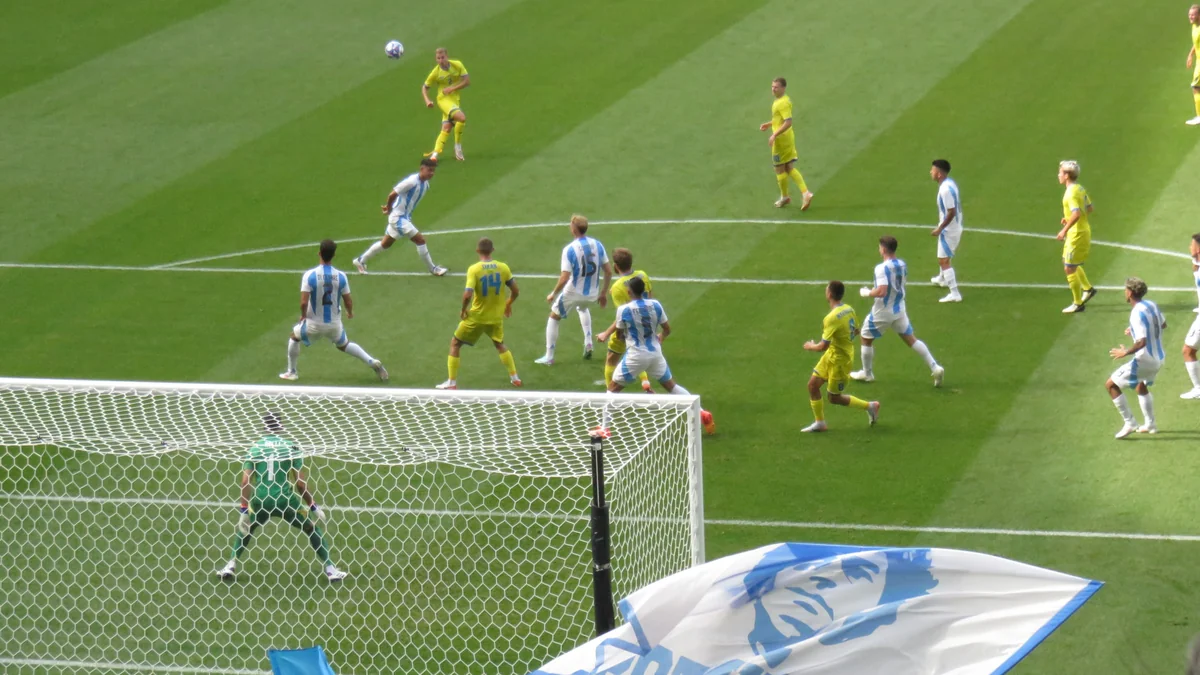
Match-context note: Wirtz’s per-match key passes, progressive carries and minutes load across his post-injury Bundesliga and international seasons sit at the upper band for attacking midfielders (Match data: SofaScore), with the discriminator being the consistency across late-stage match phases rather than any single peak performance.
Flickr: Miami U. Libraries – Digital Collections.
What This Means for the Reader
For amateur and developing footballers recovering from ACL reconstruction, the takeaway is that the clinical clearance and the form-recovery clearance are two different events, separated by months. The transferable diagnostic uses three measurements: a bilateral isokinetic or single-leg-jump asymmetry test (operated vs non-operated limb, expressed as a percentage), an eccentric-deceleration test (e.g., a structured plant-and-cut at standardised approach velocity), and a reactive small-sided drill that requires cue recognition and asymmetric cutting under uncertainty [1, 2].
The training prescription targets the diagnostic finding. Persistent inter-limb strength asymmetry is treated with structured eccentric and bilateral strength work; persistent reactive-cut hesitation is treated with constraint-led small-sided games that re-expose the athlete to perceptual-motor uncertainty in a graded way [1, 4]. The most common error in amateur ACL return-to-play is treating the clinical clearance as the end of the rehabilitation programme; the elite literature treats it as the start of the form-recovery programme.
The diagnostic question for the recovering footballer: am I cleared to play, or am I cleared to perform? If the asymmetry is unresolved and the reactive cuts feel different from the pre-injury baseline, the answer is the first, and the second is still a programme away.
References
- Spiteri T, Newton RU, Binetti M, Hart NH, Sheppard JM, Nimphius S. (2015). Mechanical determinants of faster change of direction and agility performance in female basketball athletes. Journal of Strength and Conditioning Research, 29(8): 2205–2214. doi:10.1519/JSC.0000000000000876
- Wisløff U, Castagna C, Helgerud J, Jones R, Hoff J. (2004). Strong correlation of maximal squat strength with sprint performance and vertical jump height in elite soccer players. British Journal of Sports Medicine, 38(3): 285–288. doi:10.1136/bjsm.2002.002071
- Bangsbo J, Mohr M, Krustrup P. (2006). Physical and metabolic demands of training and match-play in the elite football player. Journal of Sports Sciences, 24(7): 665–674. doi:10.1080/02640410500482529
- Stølen T, Chamari K, Castagna C, Wisløff U. (2005). Physiology of soccer: an update. Sports Medicine, 35(6): 501–536. doi:10.2165/00007256-200535060-00004
- Bourne MN, Timmins RG, Opar DA, Pizzari T, Ruddy JD, Sims C, Williams MD, Shield AJ. (2018). An evidence-based framework for strengthening exercises to prevent hamstring injury. British Journal of Sports Medicine, 52(7): 469–477. doi:10.1136/bjsports-2016-097068
Match-context data (descriptive only): SofaScore.
The Athlete in One Paragraph
Florian Richard Wirtz (b. 2003-05-03, Pulheim, Germany) is, as of September 2026, the attacking midfielder of Liverpool (formerly Bayer Leverkusen) and the Germany national team — listed at 1.76 m and ~72 kg, lean and average-tall for the role, and the creative spine of the…
The Physiology — what ACL recovery actually demands
The anterior cruciate ligament is the principal anterior-translation and rotational restraint at the knee, and a non-contact rupture in elite football typically occurs during deceleration, planting and cutting — the same task profile that defines the attacking midfielder's working day [1]. Surgical reconstruction restores the…
The Case — Wirtz's form-recovery curve
For a 1.76 m / 72 kg attacking midfielder whose role is built on tight-space deceleration, reception under pressure, and rapid direction change rather than maximum-velocity sprint volume, the post-ACL recovery profile is structurally specific [3, 4]. The role demands persistent eccentric loading at the…
What This Means for the Reader
For amateur and developing footballers recovering from ACL reconstruction, the takeaway is that the clinical clearance and the form-recovery clearance are two different events, separated by months. The transferable diagnostic uses three measurements: a bilateral isokinetic or single-leg-jump asymmetry test (operated vs non-operated limb, expressed…