Preview
Hüseyin Akbulut, MSc (2026). Thyroid Hormone: How Its Release Is Triggered and Switched Off. Sporeus. Retrieved, November 17, 2026. https://sporeus.com/en/science/thyroid-hormone-release-and-inhibition/
Continuing the series on how hormones are synthesised, how they are released and how that release is brought to a halt, the subject here is thyroid hormone.
Table of Contents
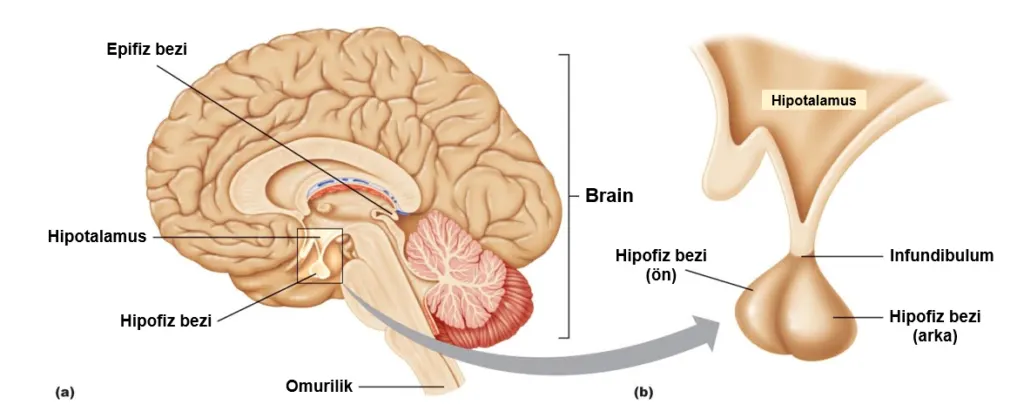
Start with the hypothalamus.
As we know, neurosecretory neurons handle the synthesis and release of hormones, and what they release travels to the anterior pituitary.
In the case of thyroid hormone, neurosecretory neurons first synthesise and release thyrotropin-releasing hormone, which we can shorten to TRH.
Once a neurosecretory neuron has made TRH, the hormone travels down the axon to the axon terminal. Release happens at the terminal, and TRH enters the hypophyseal portal system.
That portal system is, in simple terms, a bridge between the hypothalamus and the anterior pituitary, and TRH crosses by it.
Arriving at the anterior pituitary, TRH binds to receptors on the endocrine cells there. The result is the synthesis and release of thyroid-stimulating hormone (TSH).
Once those endocrine cells have made and released TSH, it enters the systemic circulation.
From there we know where it is going: to the thyroid gland, to bind the receptors waiting for it. And that binding is what brings about the release of thyroid hormone.
T3 and T4
The first thing to know about thyroid hormone is that it comes in two forms, T3 and T4.
Both are synthesised and secreted by the thyroid gland.
They are usually mentioned together, but the differences are worth knowing.
T3 is triiodothyronine, so called because it carries three iodine atoms.
T4 is thyroxine, carrying four.
T4 is produced in much the larger quantity but is the weaker of the two. T3 is secreted in far smaller amounts yet is roughly three to four times more potent.
In practice the two work as a pair, because T4 is converted into T3 in the peripheral tissues by deiodinase enzymes, and it is T3 that acts on the target tissues.
What Thyroid Hormone Does
Picture thyroid hormone circulating, and keep in mind the long list of jobs it has a hand in.
To begin with, it increases the number of mitochondria in the cell.
It also targets a range of tissues, and one of its tasks in each of them is to set the rate of cellular respiration. So it is indirectly in charge of metabolic rate — according, of course, to what the body needs.
It raises the activity of the sodium-potassium ATPase pump, which increases ATP hydrolysis, and that in turn lifts basal metabolic rate.
More chemical reactions across the body means more heat. Producing that heat costs ATP, which means drawing on the body’s stores.
So the energy mobilised under thyroid hormone is spent as fast as it is released: the hormone raises turnover rather than building anything up.
Thyroid Hormone in Liver and Skeletal Muscle
Liver and skeletal muscle are among the main targets once thyroid hormone enters the circulation.
In both, it initiates glycogenolysis, the breakdown of glycogen, and so raises plasma glucose.
It targets adipose tissue as well, and there it drives the breakdown of fat.
That raises the level of fatty acids in the plasma.
Thyroid hormone also targets skeletal muscle for protein breakdown, releasing amino acids into the circulation and raising plasma amino acid levels.
Taken together, the wide reach of thyroid hormone synthesis and release shows how far into growth and development it extends. It also keeps the balance between catabolic and anabolic reactions.
As for shutting the process down, that runs on negative feedback.
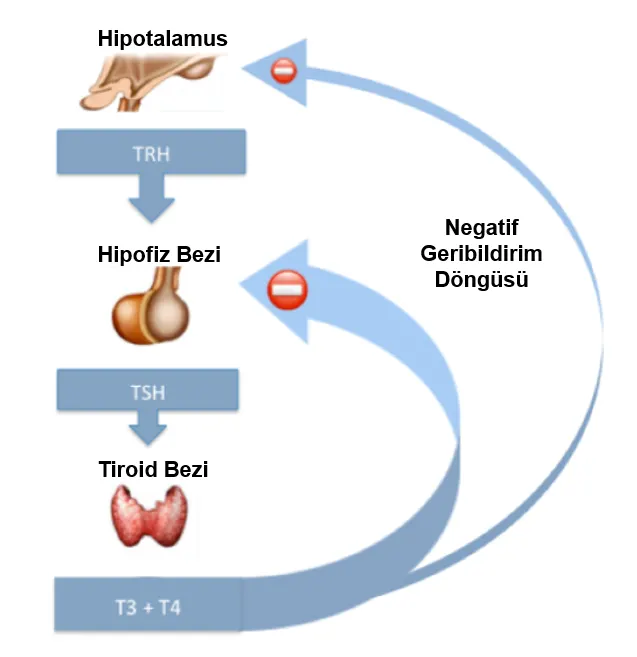
Picture circulating thyroid hormone again, and recall that it has a suppressive effect at the anterior pituitary. There it damps down the release of TSH, so the signal reaching the thyroid gland weakens.
It exerts the same effect on the hypothalamus. Binding to receptors there, it inhibits the synthesis and release of TRH. With that, the loop is closed.
You may also like: Cortisol: How Its Release Is Triggered and Switched Off
References
- Mullur, R., Liu, Y.Y. & Brent, G.A. (2014). Thyroid hormone regulation of metabolism. Physiological Reviews, 94(2), 355–382. https://doi.org/10.1152/physrev.00030.2013
- Brent, G.A. (2012). Mechanisms of thyroid hormone action. Journal of Clinical Investigation, 122(9), 3035–3043. https://doi.org/10.1172/JCI60047

Hüseyin Akbulut is the founder of Sporeus and author of THRESHOLD (EŞİK), a 540-page Turkish-language book on endurance science.
- 540pp THRESHOLD Book
- MSc Sport Sciences
- Marmara University
T3 and T4
The first thing to know about thyroid hormone is that it comes in two forms, T3 and T4.
What Thyroid Hormone Does
Picture thyroid hormone circulating, and keep in mind the long list of jobs it has a hand in.
Thyroid Hormone in Liver and Skeletal Muscle
Liver and skeletal muscle are among the main targets once thyroid hormone enters the circulation.