Preview
Hüseyin Akbulut, MSc (2026). How Exercise Affects the Brain: Pain Perception and Responses. Sporeus. Retrieved, November 17, 2026. https://sporeus.com/en/science/exercise-brain-pain-perception/
The effects of exercise on the brain, from its structure to its functions, have been studied extensively.
Table of Contents
As an athlete you have probably thought, more than once, about stopping a session or giving up on a goal, whether in training or in the days before a race. That is entirely normal. The cause may be the pain in your legs, doubt in your mind or deep fatigue.
Overcoming that feeling turns out to be one of the factors that decides an athlete’s performance.
If you keep pushing at that point, it may make you stronger (we grow stronger or weaker according to the stresses we are exposed to), or it may force you to take a break from training.
Let’s look at the effects of exercise on the brain through the lens of pain.
Overcoming Pain
The pain we experience during exercise should be seen as part of the exercise experience itself. It can take many forms:
- pain linked to glycogen depletion
- joint pain from repeated loading
- everything from blisters to stomach cramps
In a race between two athletes of equal physical ability, the one with the higher pain tolerance will have the advantage, and the best way to build that tolerance is exercise itself.
When trained and untrained people are compared, their pain thresholds may be similar. The trained athlete stands out because they have also developed the ability to endure pain for longer.
Because the cellular structures involved are the same, the way you sense pain does not change. But as you are exposed to the stresses of exercise, your brain becomes accustomed to those pain signals and can build tolerance to them.
Endurance athletes can reduce the sensation of pain by directing their attention elsewhere. Many studies report that listening to music during exercise shifts attention and has positive effects on performance. For elite athletes, however, these effects are not yet clear.
How the Brain Responds to Physical Load
Research continues into how the brain decides whether it can or cannot tolerate a given intensity, and whether that decision is controlled consciously or subconsciously.
There does, however, seem to be agreement that in either case training shapes and regulates the brain’s responses. One theory is worth thinking about here.
The Central Governor Model
In this theory, a “governor” in the central nervous system, operating below the level of consciousness, creates sensations of fatigue and discomfort in order to limit the stress placed on the body. (For a deeper look, see The Central Governor: Is Fatigue a Decision?)
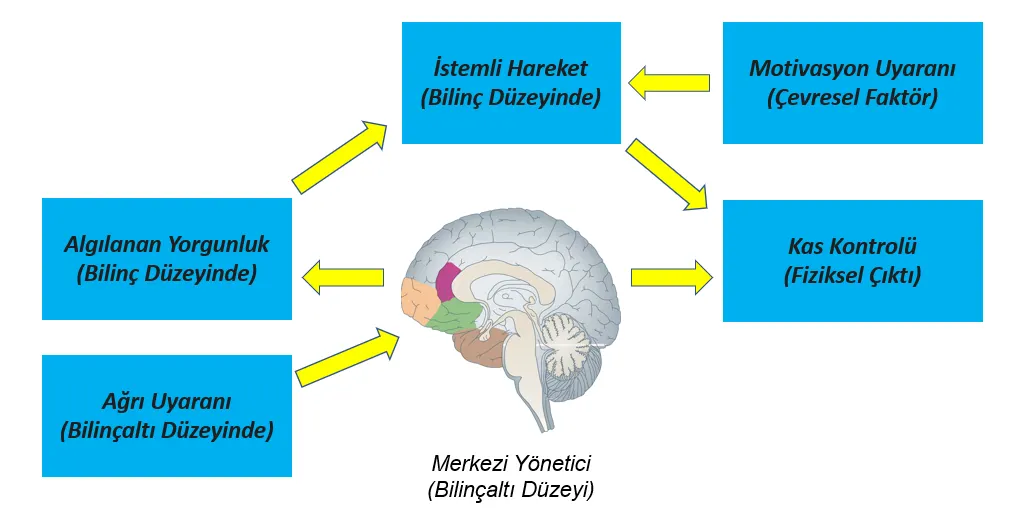
Perceived fatigue (conscious level)
At the conscious level, the brain evaluates pain-related signals. For that to happen, however, the feeling of fatigue is first generated by the subconscious centre.
Voluntary response (conscious level)
At the conscious level, the brain may want to stop the activity because of the perceived effort, or, in response to a motivational cue, it may drive the muscles to work harder.
Pain stimulus (subconscious level)
During exercise, nerve signals travelling from your muscles to the nervous system are registered subconsciously as a pain stimulus and can then be felt consciously.
Motivational stimulus (environmental factor)
Factors such as a crowd cheering the athlete on or the sight of the finish line act as emotional motivation and can trigger conscious responses.
Muscle control (physical output)
According to the theory, the subconscious brain can order exercise to stop before the body’s systems are exposed to a stress they cannot handle. At the conscious level, the decision to stop or carry on may be made differently. Even so, after overload, the autonomic nervous system may at some point force the body to stop, through fainting or collapse.
Good performance depends on many factors working together, and the influence those factors have on one another should not be underestimated.
From the sensation of pain to chronic muscle fatigue, and from the social environment to the athlete’s private life, all of these interacting factors will also shape performance.
You may also like: Muscle Fatigue: Causes, Effects and Exercises (in Turkish) · Pain Tolerance in Endurance Sport: What Science Says
References
- Tesarz J, Schuster AK, Hartmann M, Gerhardt A, Eich W. (2012). Pain perception in athletes compared to normally active controls: a systematic review with meta-analysis. Pain, 153(6): 1253-1262. doi:10.1016/j.pain.2012.03.005
- Noakes TD, St Clair Gibson A, Lambert EV. (2005). From catastrophe to complexity: a novel model of integrative central neural regulation of effort and fatigue during exercise in humans: summary and conclusions. British Journal of Sports Medicine, 39(2): 120-124. doi:10.1136/bjsm.2003.010330
- Karageorghis CI, Priest DL. (2012). Music in the exercise domain: a review and synthesis (Part I). International Review of Sport and Exercise Psychology, 5(1): 44-66. doi:10.1080/1750984X.2011.631026

Hüseyin Akbulut is the founder of Sporeus and author of THRESHOLD (EŞİK), a 540-page Turkish-language book on endurance science.
- 540pp THRESHOLD Book
- MSc Sport Sciences
- Marmara University
Overcoming Pain
The pain we experience during exercise should be seen as part of the exercise experience itself. It can take many forms:
How the Brain Responds to Physical Load
Research continues into how the brain decides whether it can or cannot tolerate a given intensity, and whether that decision is controlled consciously or subconsciously.
The Central Governor Model
In this theory, a "governor" in the central nervous system, operating below the level of consciousness, creates sensations of fatigue and discomfort in order to limit the stress placed on the body. (For a deeper look, see The Central Governor: Is Fatigue a Decision?)