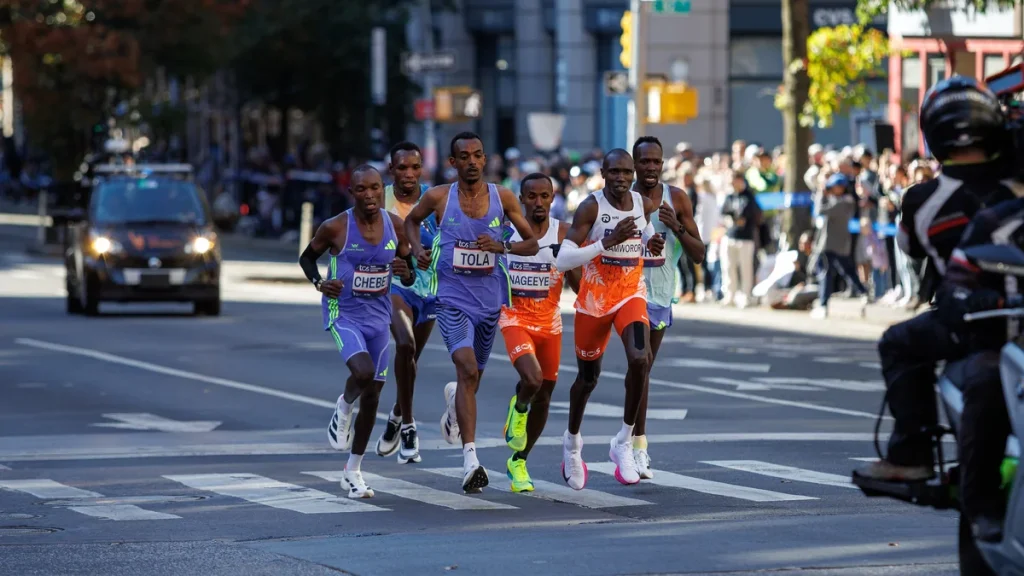
Preview
Hüseyin Akbulut, MSc (2026). The Marathon and the Two-Hour Barrier: What Statistics Predicted. Sporeus. Retrieved, November 19, 2026. https://sporeus.com/en/sport/marathon-two-hour-barrier-statistical-predictions/
Legend has it that the marathon takes its name from a messenger who ran from the plain of Marathon to Athens after the Battle of Marathon. It was first run at the 1896 Athens Olympic Games over a course of about 40 km. Today’s distance of 42.195 km was used at the 1908 London Olympics and became the official standard in 1921.
Table of Contents
But how fast has this long distance been covered, and what is the best time ever run?
What can you do in 99 seconds? Walk 100 metres? What do 99 seconds mean to you?
In 2020, when this article was first written, the marathon world record belonged to the Kenyan athlete Eliud Kipchoge, and for him 99 seconds was the gap to making history by running under two hours in an official marathon. (Update: Kipchoge lowered the record to 2:01:09 in Berlin in 2022, Kelvin Kiptum took it to 2:00:35 in Chicago in 2023, and at the London Marathon on 26 April 2026 Sabastian Sawe ran 1:59:30, the first sub-two-hour marathon in a record-eligible race.)
In official competition, 99 seconds is a far bigger margin than you might think. How close was the barrier, and how likely was it to fall? To find out, let’s look at the analysis by the economist Simon D. Angus, published in Medicine & Science in Sports & Exercise (2019), which modelled every official men’s and women’s marathon world record since 1950.
Breaking the Two-Hour Barrier
According to the model, if an official marathon had been held in 2009, the chance of a sub-two-hour run in it would have been only 0.5%.
Angus took a one-in-ten chance as a reasonable benchmark: by that measure, a sub-two-hour run would become a realistic possibility in an official race held around 2032.
Taking a more generous view, the probability would reach 25% by 2054.
| Chance (%) | Year |
|---|---|
| 25 | 2054 |
| 10 | 2032 |
| 5 | 2024 |
| 2 | 2017 |
| 1 | 2013 |
| 0.5 | 2009 |
The crucial point of this approach is that it is built on the average size of the improvements between previous record runs.
In fact, Eliud Kipchoge turned all these calculations upside down in a special event. The calculations, however, were based on official races held over the years; specially staged events were not included.
Still, it is worth knowing that in 2019, at the age of 34, Kipchoge ran 1:59:40 on a special course in Vienna and went under two hours, although the time does not count as an official marathon result. Seven years later, Sawe’s 1:59:30 in London came far earlier than the model’s one-in-ten benchmark date.
Men’s Marathon Records
The table above shows the probabilities calculated from official results from 2009 onwards. Now let’s look at the marathon world records set since 1950, as listed by World Athletics, which were used in these calculations.
| Date | Athlete (country) | Time |
|---|---|---|
| 14 June 1952 | Jim Peters (United Kingdom) | 2:20:42 |
| 13 June 1953 | Jim Peters (United Kingdom) | 2:18:40 |
| 4 October 1953 | Jim Peters (United Kingdom) | 2:18:35 |
| 26 June 1954 | Jim Peters (United Kingdom) | 2:17:39 |
| 24 August 1958 | Sergei Popov (Soviet Union) | 2:15:17.0 |
| 10 September 1960 | Abebe Bikila (Ethiopia) | 2:15:16.2 |
| 17 February 1963 | Toru Terasawa (Japan) | 2:15:15.8 |
| 15 June 1963 | Buddy Edelen (United States) | 2:14:28 |
| 13 June 1964 | Basil Heatley (United Kingdom) | 2:13:55 |
| 21 October 1964 | Abebe Bikila (Ethiopia) | 2:12:11 |
| 12 June 1965 | Morio Shigematsu (Japan) | 2:12:00 |
| 3 December 1967 | Derek Clayton (Australia) | 2:09:36 |
| 30 May 1969 | Derek Clayton (Australia) | 2:08:34 |
| 6 December 1981 | Rob De Castella (Australia) | 2:08:18 |
| 21 October 1984 | Steve Jones (United Kingdom) | 2:08:05 |
| 20 April 1985 | Carlos Lopes (Portugal) | 2:07:12 |
| 17 April 1988 | Belayneh Dinsamo (Ethiopia) | 2:06:50 |
| 20 September 1998 | Ronaldo da Costa (Brazil) | 2:06:05 |
| 24 October 1999 | Khalid Khannouchi (Morocco) | 2:05:42 |
| 14 April 2002 | Khalid Khannouchi (United States) | 2:05:38 |
| 28 September 2003 | Paul Tergat (Kenya) | 2:04:55 |
| 30 September 2007 | Haile Gebrselassie (Ethiopia) | 2:04:26 |
| 28 September 2008 | Haile Gebrselassie (Ethiopia) | 2:03:59 |
| 25 September 2011 | Patrick Makau (Kenya) | 2:03:38 |
| 29 September 2013 | Wilson Kipsang (Kenya) | 2:03:23 |
| 28 September 2014 | Dennis Kimetto (Kenya) | 2:02:57 |
| 16 September 2018 | Eliud Kipchoge (Kenya) | 2:01:39 |
| 25 September 2022 | Eliud Kipchoge (Kenya) | 2:01:09 |
| 8 October 2023 | Kelvin Kiptum (Kenya) | 2:00:35 |
| 26 April 2026 | Sabastian Sawe (Kenya) | 1:59:30 |
Another important point is that, alongside the two-hour question, the model gives 1:58:05 as the best time a man could achieve in a marathon, using its one-in-ten benchmark.
This time is very close to the result of a 1991 study that estimated the best possible marathon time from physiological factors (1:57:58; see Modeling: optimal marathon performance on the basis of physiological factors).
Women’s Records
When the same calculations are made for women, the gap between the current record and the modelled limit is larger in percentage terms. According to the same model, the best time achievable by a woman in a marathon was estimated at 2:05:31.
When this article was first written, the women’s record belonged to the Kenyan athlete Brigid Kosgei, who ran 2:14:04 at the Chicago Marathon on 13 October 2019, improving the 2:15:25 of Britain’s Paula Radcliffe by 81 seconds after 16 years. (Update: the record was later improved by Tigst Assefa, 2:11:53 in 2023, and by Ruth Chepngetich, 2:09:56 at the 2024 Chicago Marathon.)

While women waited 16 years for a new record, the men’s record was broken seven more times in the same period. Explaining why would mean looking at many areas, from social and environmental factors to training programmes, and the subject quickly becomes very broad. Women’s marathon performance and records deserve an article of their own.
At elite level: a sub-two-hour marathon means an average pace of about 2:50.6 per kilometre, a speed of more than 21 km/h for 42 km. As Joyner and colleagues (2020) summarise, this requires three determinants to be at their highest level together: a high VO₂max, the ability to sustain a very high percentage of that capacity for two hours, and exceptional running economy. Carbon-plated shoes that improve economy, organised pacemaking and higher in-race carbohydrate intake are thought to have contributed to the rapid progress of recent years.
You may also be interested in: Running Technology: GPS, Accelerometers and Foot Pods (in Turkish)
References
- Angus, S.D. (2019). A statistical timetable for the sub-2-hour marathon. Medicine & Science in Sports & Exercise, 51(7), 1460-1466.
- Joyner, M.J., Hunter, S.K., Lucia, A., & Jones, A.M. (2020). Physiology and fast marathons. Journal of Applied Physiology.
- Hoogkamer, W., Kram, R., & Arellano, C.J. (2017). How biomechanical improvements in running economy could break the 2-hour marathon barrier. Sports Medicine.
- Joyner, M.J. (1991). Modeling: optimal marathon performance on the basis of physiological factors. Journal of Applied Physiology.
- Jones, A.M., Kirby, B.S., Clark, I.E., et al. (2021). Physiological demands of running at 2-hour marathon race pace. Journal of Applied Physiology.

Hüseyin Akbulut is the founder of Sporeus and author of THRESHOLD (EŞİK), a 540-page Turkish-language book on endurance science.
- 540pp THRESHOLD Book
- MSc Sport Sciences
- Marmara University
Breaking the Two-Hour Barrier
According to the model, if an official marathon had been held in 2009, the chance of a sub-two-hour run in it would have been only 0.5%.
Men's Marathon Records
The table above shows the probabilities calculated from official results from 2009 onwards. Now let's look at the marathon world records set since 1950, as listed by World Athletics, which were used in these calculations.
Women's Records
When the same calculations are made for women, the gap between the current record and the modelled limit is larger in percentage terms. According to the same model, the best time achievable by a woman in a marathon was estimated at 2:05:31.