Preview
Hüseyin Akbulut, MSc (2026). Eliud Kipchoge and the Marathon Pacing and Fractional Utilisation of an Elite Long-distance Runner. Sporeus. Retrieved, October 20, 2026. https://sporeus.com/en/science/eliud-kipchoge-marathon-pacing-and-fractional-utilisation/
The Athlete in One Paragraph
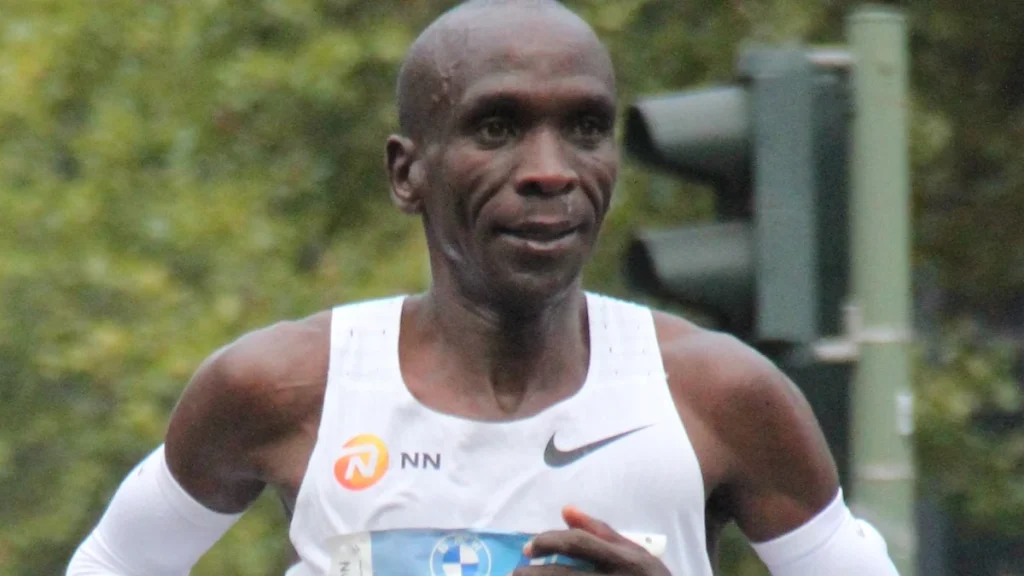
Eliud Kipchoge (b. 1984-11-05, Kapsisiywa, Kenya) is a long-distance runner and the defining marathon figure of his generation, twice Olympic marathon champion (Rio 2016, Tokyo 2020) and former world-record holder with 2:01:09 set in Berlin in September 2022. Listed at 1.67 m and roughly 52 kg, he carries the canonical East-African endurance physique, low body mass, narrow hips, and a long Achilles moment-arm, into a discipline where every kilogram of avoidable mass becomes additional oxygen demand across 42.195 km. The interesting case for sport science is not what Kipchoge’s VO₂max ceiling looks like in isolation; it is how high a fraction of that ceiling he can hold for two hours and one minute, race after race, on courses that are flat enough to expose every metabolic flaw. The variable underneath that pattern is fractional utilisation, the percentage of VO₂max that the marathon pace actually demands.
Table of Contents
The Physiology: what fractional utilisation actually is
Marathon performance is not a one-variable problem. Joyner and Coyle’s framework for endurance performance describes three independent factors, VO₂max, lactate threshold, and running economy, that combine multiplicatively to determine the speed an athlete can sustain in a race [1]. VO₂max sets the absolute ceiling for aerobic ATP turnover; running economy describes the oxygen cost per unit distance at submaximal velocities; and the threshold-based variables describe how high a fraction of the ceiling can be held without an exponential lactate accumulation that ends the effort.
The third factor: the sustainable fraction, is operationalised in two related ways. The first is the lactate threshold itself, the velocity at which blood lactate begins to rise non-linearly above resting baseline; the second is fractional utilisation, the percentage of VO₂max that corresponds to that threshold velocity [2, 3]. In well-trained recreational runners the marathon is typically run at around 75–80% of VO₂max; in elite male marathoners it climbs to 80–85%; in the very best, sustained over a complete race, it sits in the 85–88% range [1, 4]. Each percentage point shifted upward, holding VO₂max and economy constant, translates into measurably faster sustainable pace.
Faude and colleagues catalogued the dozen-plus methods used in the literature to identify “the” lactate threshold and showed that the chosen method matters less than the underlying biology, a non-linear deflection in lactate, the highest steady-state at which production and clearance balance, the velocity that can be held to exhaustion for ~60 minutes [3]. Billat’s earlier work formalised the diagnostic value of these submaximal lactate measurements for predicting endurance performance, and showed that the threshold velocity tracks race-pace performance more tightly than VO₂max in homogeneous elite groups [4]. In other words: among elites, who all have ceilings, what discriminates a 2:01 marathoner from a 2:05 marathoner is mostly the fraction.
That fraction is the consequence of long-term aerobic adaptation. Helgerud and colleagues showed that targeted aerobic interval training can raise lactate threshold and sustainable submaximal velocity in trained athletes [5], and Saunders and colleagues argued that the running-economy contribution to the same equation continues to refine itself across years of consistent training [2]. Elite marathoners, accordingly, are made and the making takes a decade.
The Case: Kipchoge as fractional-utilisation lens
Kipchoge’s marathon record across more than fifteen majors and the controlled INEOS 1:59 Challenge is the cleanest applied demonstration of this principle. His finishing times cluster within a narrow band; his split-pace consistency across the course is unusually flat; and his late-race fade, the difference between halves, is small enough that it implies a sustainable fraction held very near the personal ceiling for the full duration. The physiology that produces this signature is not a single freakish variable but the multiplicative product of all three Joyner–Coyle factors expressed simultaneously near their personal limit [1].
His anthropometry is consistent with the profile. At 1.67 m and ~52 kg, the absolute oxygen cost per stride is low; the relative (mass-specific) oxygen cost, the variable that actually appears in the marathon energy equation, is competitive with anyone in the field. Saunders’ determinants of running economy, stride mechanics, tendon stiffness, neuromuscular efficiency, body-mass distribution, and accumulated training history, read like a description of Kipchoge’s career arc [2].
The pacing strategy itself is the operational expression of the underlying physiology. A marathoner with high fractional utilisation does not need to surge; surges cost glycogen disproportionately, and the body that holds 85%+ of VO₂max steadily is the body that has the smallest remaining margin for above-threshold spikes. Kipchoge’s even-split races are not stylistic, they are the only economical way to spend a substrate budget that is already nearly fully committed [3, 4].
(Performance data: World Athletics)
What This Means for the Reader
For the developing endurance athlete, the takeaway is that the marathon is a “fraction” problem, not just a “ceiling” problem. Many recreational runners chase VO₂max-style intervals while their sustainable-pace fraction sits in the low 70s; the higher-yield block is usually a sustained period of threshold and tempo work that pushes the lactate-deflection velocity upward while economy continues to refine itself in the background [3, 5]. The marathon time falls because the fraction rises, not because the ceiling does.
The second implication is pacing discipline. The athlete who runs the first half too aggressively converts a larger share of the day’s substrate into lactate and glycogen depletion that cannot be reclaimed in the second half [1]. Even-split or negative-split pacing is not stylistic conservatism; it is the only allocation of an aerobic budget that respects the underlying threshold biology.
The diagnostic question for the athlete: at what percentage of my VO₂max does my blood lactate begin to rise non-linearly, and how does that compare with the percentage I am actually attempting to hold on race day?
References
- Joyner MJ, Coyle EF. (2008). Endurance exercise performance: the physiology of champions. The Journal of Physiology, 586(1): 35–44. doi:10.1113/jphysiol.2007.143834
- Saunders PU, Pyne DB, Telford RD, Hawley JA. (2004). Factors affecting running economy in trained distance runners. Sports Medicine, 34(7): 465–485. doi:10.2165/00007256-200434070-00005
- Faude O, Kindermann W, Meyer T. (2009). Lactate threshold concepts: how valid are they? Sports Medicine, 39(6): 469–490. doi:10.2165/00007256-200939060-00003
- Billat LV. (1996). Use of blood lactate measurements for prediction of exercise performance. Sports Medicine, 22(3): 157–175. doi:10.2165/00007256-199622030-00003
- Helgerud J, Engen LC, Wisløff U, Hoff J. (2001). Aerobic endurance training improves soccer performance. Medicine & Science in Sports & Exercise, 33(11): 1925–1931. doi:10.1097/00005768-200111000-00019
Performance data (descriptive only): World Athletics.
Discuss this in the forum: Running a negative split
Hüseyin Akbulut is the founder of Sporeus and author of THRESHOLD (EŞİK), a 540-page Turkish-language book on endurance science.
- 540pp THRESHOLD Book
- MSc Sport Sciences
- Marmara University
The Athlete in One Paragraph
Eliud Kipchoge (b. 1984-11-05, Kapsisiywa, Kenya) is a long-distance runner and the defining marathon figure of his generation, twice Olympic marathon champion (Rio 2016, Tokyo 2020) and former world-record holder with 2:01:09 set in Berlin in September 2022. Listed at 1.67 m and roughly 52…
The Physiology: what fractional utilisation actually is
Marathon performance is not a one-variable problem. Joyner and Coyle's framework for endurance performance describes three independent factors, VO₂max, lactate threshold, and running economy, that combine multiplicatively to determine the speed an athlete can sustain in a race [1]. VO₂max sets the absolute ceiling for…
The Case: Kipchoge as fractional-utilisation lens
Kipchoge's marathon record across more than fifteen majors and the controlled INEOS 1:59 Challenge is the cleanest applied demonstration of this principle. His finishing times cluster within a narrow band; his split-pace consistency across the course is unusually flat; and his late-race fade, the difference…
What This Means for the Reader
For the developing endurance athlete, the takeaway is that the marathon is a "fraction" problem, not just a "ceiling" problem. Many recreational runners chase VO₂max-style intervals while their sustainable-pace fraction sits in the low 70s; the higher-yield block is usually a sustained period of threshold…