Preview
Hüseyin Akbulut, MSc (2026). Running Equipment: Checklists for Shoes, Clothing and Watches. Sporeus. Retrieved, November 19, 2026. https://sporeus.com/en/sport/running-equipment-shoes-clothing-watch-checklists/
If we are going to talk about the essentials of running equipment, it is natural to start with shoes. Before clothing or a watch, the first thing you need is a good pair of running shoes, not tennis shoes or shoes made for another sport.
Table of Contents
Running shoes are designed specifically to support the foot and feel comfortable while running. They have taken their current form through a long evolution, although whether wearing shoes at all is ideal for our feet is a fair question. That debate matters, but in this article we focus only on the basics of choosing shoes, clothing and a watch.
Foot Type and Its Effects
Everyone has a slightly different foot type and running pattern. It makes sense to choose shoes that suit the natural way you move. A good choice can spare you many of the problems runners meet; a poor one can make things worse.
Two factors are usually discussed when describing foot type. The first is pronation, the natural motion that occurs as the foot makes contact with the ground. Picture a neutral pronation pattern: the outside of the foot touches down first, the foot then rolls inwards and levels out, and push-off follows as friction with the ground increases.
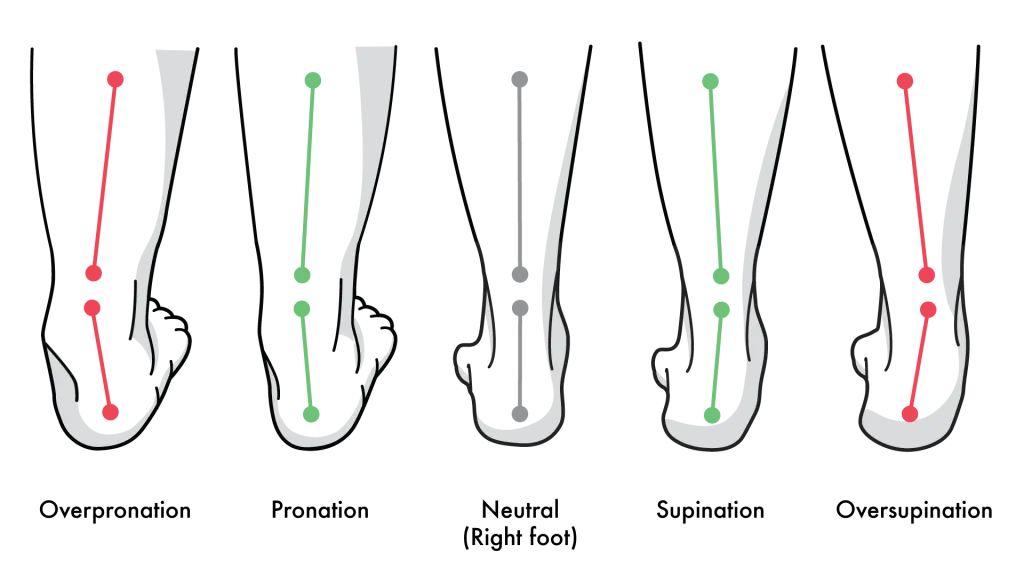
Overpronation describes the foot rolling inwards more than usual on contact, placing extra load on the arch, and it is often said to increase stress on the lower leg muscles.
This deserves a caveat. Such stress is usually seen as negative, and up to a point that view is reasonable, particularly for athletes who have run for many years and whose technique has settled into a stable pattern. Harvard evolutionary biologist Daniel Lieberman, known for his work on barefoot running, has studied how habitually barefoot runners tend to land on the forefoot or midfoot and generate smaller impact transients than shod runners who land on the heel (Lieberman et al., 2010). His book The Story of the Human Body also includes a chapter on the evolution of running. Whether a forefoot strike is more economical is a separate question, and the research has not shown a consistent metabolic advantage. Anyone who wants to change their foot strike should do so gradually, with technique work, and give the calf and Achilles tendon time to adapt to the new loads.
Underpronation, also known as supination, is when the outside of the foot touches down first but the foot does not roll in to a neutral position. It is often said to distribute load poorly, and it has been linked with problems such as medial tibial stress syndrome and stress fractures, though the evidence for foot posture as a cause of injury is mixed.
It can be hard to identify your own walking and running pattern. A biomechanics laboratory or an experienced clinician can help with a gait analysis.
The second factor in foot type is the height of the arch.
Imagine standing on both feet and looking straight ahead. If your arch collapses inwards (overpronation) and there is little or no gap between the arch and the floor, you have a flatter foot. If there is a large gap between the arch and the floor, you have a high arch, which is often associated with supination.
What the evidence says: the long-standing practice of matching shoes to foot posture has weak support. In a one-year cohort of novice runners all wearing the same neutral shoe, those with pronated feet did not have a higher injury risk than those with neutral feet (Nielsen et al., 2014). For most runners, comfort is a sensible first filter, with foot type used to narrow the options rather than to dictate them.
Running Equipment 1: a Checklist for Your Training Shoes
Now that we understand our needs a little better, here are some points to check when buying:
- Ask a specialist, your coach or a knowledgeable shop assistant to assess your arch type and pronation and give you their opinion. This will at least narrow your options.
- Choose the pair that feels most comfortable.
- Consider going at least half a size up. This reduces the pressure on the front of the foot during running, when the foot slides forward slightly on each landing.
- Try several brands to find the best fit. Most running shoe brands make shoes of similar quality; the main difference is how they fit your foot. Some make shoes with wider toe boxes and narrower heels, others design for runners with broader feet.
Running Equipment 2: a Checklist for Your Training Clothing
Choosing the right clothing matters. The right fabrics prevent chafing, wick moisture away and help you feel secure and comfortable. Over a long programme your training clothes count: even if you do not think about them much, they should never get in the way of the comfort you need to focus on training.
There are other points to consider as well:
- Along with your shoes, the right socks help prevent blisters. Cotton socks can rub when wet and lead to blisters.
- Shorts can be any length you find comfortable, but again choose moisture-wicking fabrics to prevent chafing.
- Avoid cotton T-shirts. When you sweat or it rains, cotton becomes heavy, keeps you wet and is uncomfortable on long sessions.
- A rain jacket is important when you run in rain or cold. Running jackets should be breathable and shed water.
- If you live in a cold climate, a hat and gloves are essential. Together with layers that move sweat away from the skin, they help you avoid getting cold towards the end of long sessions.
And what about your wrist?
Running Equipment 3: a Checklist for Your Training Watch
Watches now carry a great deal of technology. They have many more functions than older models and come in so many varieties that choosing has become harder. Which one should you buy?
In the end it depends on how much data you want and what you can actually use. Choose a watch that fits your training goals: having every possible data stream is pointless if you never analyse it.
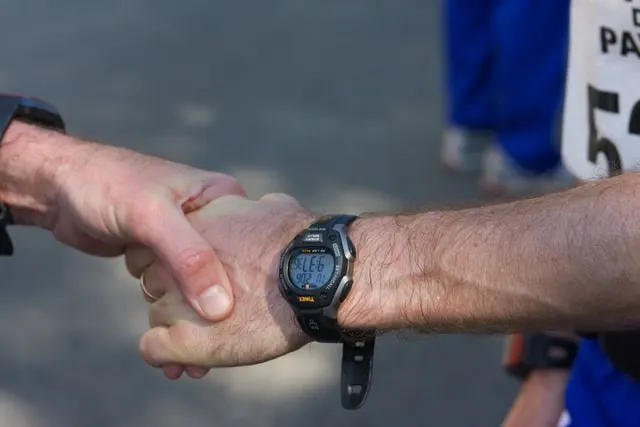
Use these points to decide which features you need:
- If you want to improve your speed, get a watch with good GPS that measures pace and distance.
- If you want to monitor the effort you put into training, get a watch that records reliable heart rate data, ideally with a chest strap.
- If you want to assess your movement pattern or basic biomechanics, get a watch that records data such as cadence and stride length.
- Or, if you just want to run, get a simple watch with a stopwatch. An athlete who knows how to use one can work out a great deal from a stopwatch alone, using previous sessions and tests as reference points.
For more on how GPS, accelerometers and foot pods work, see Running Technology: GPS, Accelerometers and Foot Pods.
You may also be interested in: How Many Calories Does Running Burn?
References
- Lieberman, D. E. (2013). The Story of the Human Body: Evolution, Health, and Disease. Pantheon Books.
- Lieberman, D. E., Venkadesan, M., Werbel, W. A., Daoud, A. I., D’Andrea, S., Davis, I. S., Mang’eni, R. O., & Pitsiladis, Y. (2010). Foot strike patterns and collision forces in habitually barefoot versus shod runners. Nature, 463(7280), 531-535. https://doi.org/10.1038/nature08723
- Nielsen, R. O., Buist, I., Parner, E. T., Nohr, E. A., Sørensen, H., Lind, M., & Rasmussen, S. (2014). Foot pronation is not associated with increased injury risk in novice runners wearing a neutral shoe: a 1-year prospective cohort study. British Journal of Sports Medicine, 48(6), 440-447. https://doi.org/10.1136/bjsports-2013-092202
Related: The Science of the Nike Vaporfly · Barefoot Running: Evolutionary Truth or Modern Myth?

Hüseyin Akbulut is the founder of Sporeus and author of THRESHOLD (EŞİK), a 540-page Turkish-language book on endurance science.
- 540pp THRESHOLD Book
- MSc Sport Sciences
- Marmara University
Foot Type and Its Effects
Everyone has a slightly different foot type and running pattern. It makes sense to choose shoes that suit the natural way you move. A good choice can spare you many of the problems runners meet; a poor one can make things worse.
Running Equipment 1: a Checklist for Your Training Shoes
Now that we understand our needs a little better, here are some points to check when buying:
Running Equipment 2: a Checklist for Your Training Clothing
Choosing the right clothing matters. The right fabrics prevent chafing, wick moisture away and help you feel secure and comfortable. Over a long programme your training clothes count: even if you do not think about them much, they should never get in the way of…
Running Equipment 3: a Checklist for Your Training Watch
Watches now carry a great deal of technology. They have many more functions than older models and come in so many varieties that choosing has become harder. Which one should you buy?