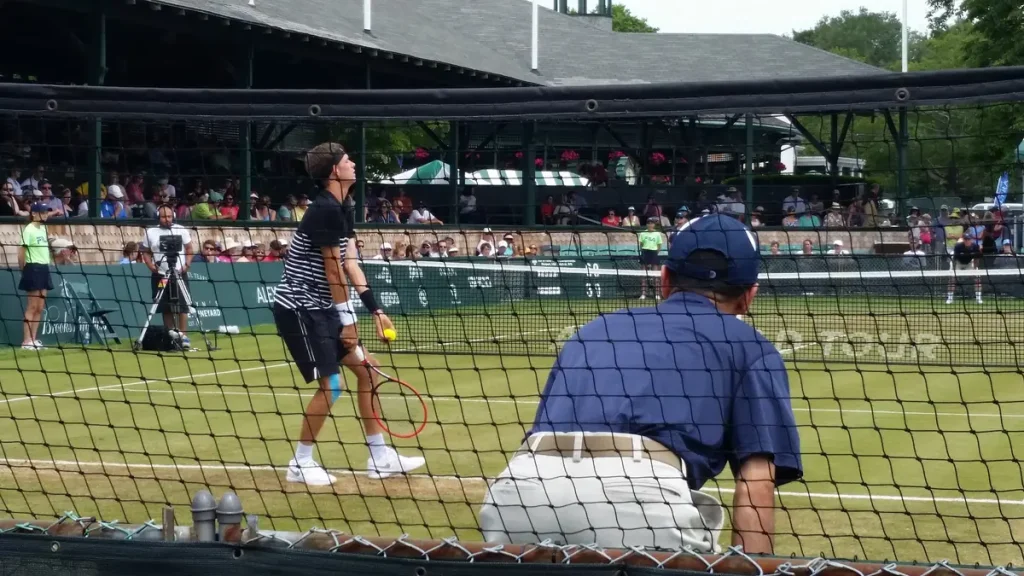
Preview
Emre Köse (2026). Reading the Server: Toss Location, Contact Point, and Shoulder Cues. Sporeus. Retrieved, September 25, 2026. https://sporeus.com/en/tennis/reading-server-toss-shoulder-cues/
A 200 km/h serve travels from the server’s racquet to your service box in roughly 0.4 seconds. Your visual reaction time is 200 milliseconds. Subtract the time it takes your body to actually move once the brain has decided, and you have effectively no time to react after seeing the ball leave the strings. You have to read the serve before it’s hit.
Table of Contents
This is the perceptual reality of returning at high pace. Elite returners don’t just have fast reflexes — they have learned to read the cues that telegraph where a serve is going before contact happens. Toss location, shoulder rotation, body lean, racquet angle — these all leak information about the upcoming serve. Players who can read this information have effectively bought themselves 100-300 milliseconds of extra reaction time. At professional pace, that is the difference between a return and a missed swing.
This article is about what cues actually telegraph the serve, how to read them, and how to train the perceptual skill.
What the Research Shows
Studies of expert returners using eye-tracking technology reveal consistent patterns:
- Expert returners fixate on the server’s tossing hand and shoulder region in the seconds leading up to contact, not on the ball itself (Williams et al., 2002).
- They extract direction-prediction information from these cues with above-chance accuracy 100-200 ms before contact.
- The earlier they can extract direction information, the better their return performance.
- Novice returners fixate primarily on the ball after it leaves the strings, missing the pre-contact cues entirely.
The skill is not in the eyes themselves but in where the eyes look during the windows when useful information is available. Eye-tracking studies make this visible.
The Five Main Cues
Cue 1: Toss location. This is the strongest single predictor. A wide toss to the server’s right (for a right-handed server) tends to produce wide-deuce serves. A toss slightly to the left produces serves down the T. A toss further back produces kick or slice serves. Toss location alone predicts direction with 70-80% accuracy at the pro level.
Cue 2: Shoulder rotation. How much does the server’s shoulder turn during the loading phase? More rotation typically means more pace; less rotation often means more spin. The angle of the shoulders at contact also indicates direction — squared up suggests T or body; turned out suggests wide.
Cue 3: Hip position. Hip rotation through the serve correlates with direction. A server whose hips face the deuce sideline at contact is hitting toward the deuce. Hips facing the ad side mean ad-court target.
Cue 4: Racquet angle at the moment of contact. The orientation of the racquet face — open, closed, neutral — tells you whether the ball will go straight, slice across, or kick high. This is the latest-developing cue but the most direct.
Cue 5: Body lean and weight distribution. A server leaning slightly forward at contact is producing more pace; a server with weight back and trunk arched produces more spin. The lean tells you the energy distribution of the serve.
Elite returners integrate all five cues continuously. The reading is not conscious in real-time — it has been learned to the point of automaticity. But the information sources are observable and trainable.
How Cues Vary by Server
Different servers have different telegraphing patterns. Some servers are very transparent (you can read their serves easily); others have learned to disguise (the cues are subtle or misleading).
Transparent servers typically:
- Vary their toss location significantly by serve target
- Have a consistent body position that gives away direction
- Don’t try to mask their preparation
Disguised servers typically:
- Use a consistent toss location regardless of serve target
- Adjust direction with subtle racquet angle changes rather than body cues
- Have learned to break the predictable relationships
Reading transparent servers is much easier than reading disguised ones. Top professionals work hard to be disguised, but few achieve full disguise. The reading skill is always somewhat useful, even against elite servers.
How to Train Reading
A progression for developing serve-reading skill:
Stage 1: Off-court video study (2-3 weeks). Watch professional serves at half speed. Try to predict the direction before contact. Score your accuracy. Most beginners are at chance level (50/50). Within 2-3 weeks of deliberate practice, you can reach 60-65%.
Stage 2: Practice partner with directional commitment (2-3 weeks). Have a partner serve to specific targets (you can ask for “wide deuce” or “body ad”). They commit to the target before tossing. You return. Over time, you start to see the cues that telegraph the target.
Stage 3: Practice partner with mixed targets (3-4 weeks). Partner serves to varied targets without telling you. You guess before contact, then check after. Track your accuracy. Initial goal: 55%. Then 60%. Then 65%.
Stage 4: Live match-realistic reading (ongoing). Apply the skill in practice matches. Conscious reading at first, becoming automatic over months.
Total development time: 4-6 months for measurable in-match improvement. The skill compounds over years.
What to Look At (and When)
A useful heuristic for amateur returners:
At toss release: Glance at the toss height and direction. Quick check, then back to the server’s shoulders.
During toss flight (0.5-1.0 second window): Watch the server’s shoulders, hips, and body position. This is where the strongest direction cues exist.
At contact (last 0.1 second): Focus on the racquet angle and the direction it’s pointing. Confirm your read.
After contact: Watch the ball, react.
Most amateurs spend the entire pre-contact period watching the ball. They miss everything happening at the server’s body. Redirecting visual attention is the most impactful change available.
The Tournament Scouting Layer
For specific opponents, reading goes further. By the second or third time you play someone, you can have specific cue-knowledge about their patterns:
- “His first toss is always slightly left for wide serves.”
- “She drops her shoulder for kick serves.”
- “His body lean is forward for flat T serves.”
This is opponent-specific knowledge. It compounds over matches against the same opponent. Players who keep notes on opponents have access to this information across years.
What This Doesn’t Mean
A few clarifications:
It doesn’t make you a perfect returner. Even with 70% pre-contact direction reading, you’ll be wrong sometimes. The big servers can still ace you. Reading is one input, not a complete solution.
It doesn’t replace movement quality. Reading the serve early helps only if your movement is good enough to capitalize on the read. Footwork, split-step timing, and lateral acceleration matter too.
It doesn’t apply equally to all serve types. First serves at full pace are hardest to read because the cues are more concentrated. Second serves often have more obvious cues because servers are trying to control the placement deliberately.
It doesn’t replace deliberate practice on stroke mechanics. A great read followed by poor stroke execution still produces a poor return. Reading enables the stroke; it doesn’t replace it.
A Note on Returning Yourself
If you want to be a more difficult server to read, the principles invert:
- Use a consistent toss location regardless of serve target.
- Adjust direction with racquet angle changes rather than body cues.
- Develop a pre-serve routine that doesn’t telegraph intent.
- Vary your patterns intentionally so opponents can’t establish opponent-specific reads against you.
This is the disguise game from the server’s side. It is harder than just hitting big — but it produces more wins against good returners.
One Thing to Do on Court Tomorrow
For your next practice session, return ten serves with the deliberate focus on the server’s shoulders, not the ball. Don’t watch the ball until after contact. Try to predict the serve direction before it’s hit.
You will be wrong sometimes — probably most of the time initially. But you will also experience for the first time what serious returners experience constantly: information flowing from the server’s body that the ball itself doesn’t yet have.
After ten serves, watch ten more normally (eyes on ball). Notice the difference in how prepared you feel.
The pre-contact reading is the single most useful perceptual skill in returning. It is also the most under-developed in amateur players. Train it deliberately, and your return game improves measurably over months. Without training it, you remain limited by your reaction time alone — which professional pace makes inadequate.
About the author: Emre Köse is a tennis coach at Beykoz Tenis Kulübü in Istanbul, with 12+ years on court. He holds a BSc in Coaching Education from Marmara University, Faculty of Sport Sciences.
Related in this series: The return is the second-most-important shot · Return positioning · Open vs closed skills
Selected reading:
- Williams, A. M., Ward, P., Knowles, J. M., & Smeeton, N. J. (2002). Anticipation skill in a real-world task: measurement, training, and transfer in tennis. Journal of Experimental Psychology: Applied.
- Loffing, F., Hagemann, N., Schorer, J., & Baker, J. (2016). Spatial movement variability and predictive ability of elite tennis players’ serves. Sports Biomechanics.
- Goulet, C., Bard, C., & Fleury, M. (1989). Expertise differences in preparing to return a tennis serve: a visual information processing approach. Journal of Sport and Exercise Psychology.
What the Research Shows
Studies of expert returners using eye-tracking technology reveal consistent patterns:
The Five Main Cues
Cue 1: Toss location. This is the strongest single predictor. A wide toss to the server's right (for a right-handed server) tends to produce wide-deuce serves. A toss slightly to the left produces serves down the T. A toss further back produces kick or slice…
How Cues Vary by Server
Different servers have different telegraphing patterns. Some servers are very transparent (you can read their serves easily); others have learned to disguise (the cues are subtle or misleading).
How to Train Reading
A progression for developing serve-reading skill:
What to Look At (and When)
A useful heuristic for amateur returners: