Preview
Hüseyin Akbulut, MSc (2026). 1RM Back Squat Test: Protocol, Norms and Application. Sporeus. Retrieved, October 23, 2026. https://sporeus.com/en/egzersiz-testleri-en/1rm-back-squat/
Measures: Lower-body pushing strength, leg strength
Table of Contents
Difficulty: Hard | Category: Strength
Protocol
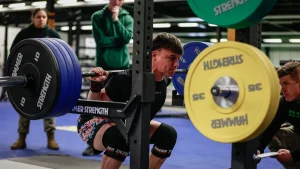
The 1RM Back Squat test is the most common strength test for measuring integrated lower-body force. A barbell is placed on the upper-mid back and a full or parallel squat movement is performed.
Preparation: Squat rack safety pins are set at the appropriate height. The participant warms up for 10 minutes generally. Squat-specific warm-up: 15 reps bodyweight squat, 10 reps light weight, 5 reps at 50%, 3 reps at 70%, 1 rep at 85%, 1 rep at 95% of estimated 1RM.
Test Procedure: The bar is placed on the shoulders (upper-mid trapezius). Foot width is shoulder-width or slightly wider, toes slightly turned out. With a neutral spine, knees bend and the hips are pushed back. Parallel position (hips at knee level) is mandatory. Then explosively stand up. At least 2 spotters are mandatory.
Trials: 3–5 minutes rest between. Advance in 2.5–5% increments toward maximum weight. 3–5 trials targeted.
Calculation: 1RM in kg. Relative 1RM = 1RM / BW. Target performance metrics: Elite male: >2.0 × BW, Elite female: >1.5 × BW.
Post-Test: Quadriceps, hamstring, and hip stretching. Results normalized to body weight are reported.
Formula
1RM (Epley) = load × (1 + 0.0333 × reps); relative 1RM = 1RM / BW
Equipment Required
squat rack or power cage, barbell, plakalar, knee sleeves (optional)
Normative Values (Age: 20-29)
| Classification | Male | Female |
|---|---|---|
| Excellent | >2.0 × BW | >1.5 × BW |
| Good | 1.6-2.0 × BW | 1.2-1.5 × BW |
| Average | 1.2-1.6 × BW | 0.9-1.2 × BW |
| Below Average | 0.9-1.2 × BW | 0.65-0.9 × BW |
| Poor | <0.9 × BW | <0.65 × BW |
Practical Applications
1RM squat forms the basis of strength training programming. It is the best indicator of integrated lower-body strength and shows a strong correlation with jumping and sprinting capacity.
Limitations
Technical error risk is high; use of a weight belt complicates standardization. Contraindicated in individuals with knee and back problems.
Related Tests: 1RM Deadlift, Isometric Mid-Thigh Pull, Lower Body Force-Velocity Profile
Sources: Baechle TR & Earle RW, 2008, NSCA Essentials; Stone MH et al., 2005, Strength Cond J

Hüseyin Akbulut is the founder of Sporeus and author of THRESHOLD (EŞİK), a 540-page Turkish-language book on endurance science.
- 540pp THRESHOLD Book
- MSc Sport Sciences
- Marmara University
Protocol The 1RM Back Squat test is the most common strength test for measuring integrated lower-body force. A barbell is placed on the upper-mid back and a full or parallel squat movement is performed. Preparation: Squat rack safety pins are set at the appropriate height. The participant warms up for 10 minutes generally. Squat-specific warm-up: 15 reps bodyweight squat, 10 reps light weight, 5 reps at 50%, 3 reps at 70%, 1 rep at 85%, 1 rep at 95% of estimated 1RM. Test Procedure: The bar is placed on the shoulders (upper-mid trapezius). Foot width is shoulder-width or slightly wider, toes slightly turned out. With a neutral spine, knees bend and the hips are pushed back. Parallel position (hips at knee level) is mandatory. Then explosively stand up. At least 2 spotters are mandatory. Trials: 3–5 minutes rest between. Advance in 2.5–5% increments toward maximum weight. 3–5 trials targeted. Calculation: 1RM in kg. Relative 1RM = 1RM / BW. Target performance metrics: Elite male: >2.0 × BW, Elite female: >1.5 × BW. Post-Test: Quadriceps, hamstring, and hip stretching. Results normalized to body weight are reported. Formula
1RM (Epley) = load × (1 + 0.0333 × reps); relative 1RM = 1RM / BW
Equipment Required
squat rack or power cage, barbell, plakalar, knee sleeves (optional)