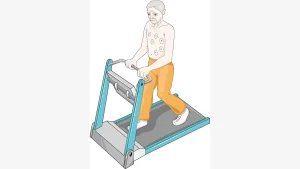
Measures: Maksimal aerobik güç (MAP), FTP tahmini
Table of Contents
Difficulty: Zor | Category: Aerobik
Protocol
The Ramp Test is a cycling protocol used to estimate maximal aerobic power (MAP) and functional threshold power (FTP) with progressively increasing power output over a relatively short duration. In the most commonly used version, power is increased by 25 W every minute.
Preparation: The smart trainer or power meter must be properly calibrated. A bike fitting check is performed — saddle height, handlebar distance, and cleat position. The participant warms up for 10–15 minutes: 5 minutes at low power, followed by 3×10-second sprints.
Protocol: The test starts at 100–150 W (depending on fitness level). Power increases by 25 W every minute. Cadence is preferably maintained around 80–100 RPM. The test continues until the participant cannot sustain the target power. Typical duration is 5–20 minutes.
Data Recording: The last completed watt value, test duration, and final heart rate are recorded.
Calculation: MAP = final watts achieved. FTP estimate = MAP × 0.75. For example, for a MAP of 350 W, FTP ≈ 262.5 W. W/kg normalization: FTP/kg is a critical performance indicator; >6 W/kg for Tour de France cyclists.
Post-Test: A 10–15 minute cool-down at low power is performed. Blood lactate measurement is optional. The FTP value is used to update training zones.
Formula
MAP = final_watts; FTP = MAP × 0.75; W/kg = FTP / bodyweight_kg
Equipment Required
bisiklet ergometre veya akıllı trainer, güç ölçer, kalp atım hızı monitörü
Normative Values (Age: 20-40 (bisikletçiler))
| Classification | Male | Female |
|---|---|---|
| Excellent | >5.5 W/kg FTP | >4.5 W/kg FTP |
| Good | 4.5-5.5 W/kg | 3.5-4.5 W/kg |
| Average | 3.5-4.5 W/kg | 2.5-3.5 W/kg |
| Below Average | 2.5-3.5 W/kg | 1.8-2.5 W/kg |
| Poor | <2.5 W/kg | <1.8 W/kg |
Practical Applications
The Ramp Test is a quick and practical method for determining FTP and training zones in cyclists. It is increasingly preferred over the 20-minute FTP test because it requires less mental endurance.
Limitations
The 0.75 coefficient may vary between individuals; for trained athletes the coefficient may be 0.77–0.80. Power meter calibration is critical.
Related Tests: FTP 20-Minute Test, Watt-max Test, Åstrand-Rhyming Test
Sources: Bini RR & Hume PA, 2014, Int J Sports Physiol Perform; Zwift Training Guide, 2023
Don't miss the latest in sports science
Join our reader community for evidence-based sports science insights, training tips, and early access to new content.
EŞİK — Book
540 pages · 22 chapters · 275 scientific references — the physiology of endurance.
Protocol The Ramp Test is a cycling protocol used to estimate maximal aerobic power (MAP) and functional threshold power (FTP) with progressively increasing power output over a relatively short duration. In the most commonly used version, power is increased by 25 W every minute. Preparation: The smart trainer or power meter must be properly calibrated. A bike fitting check is performed — saddle height, handlebar distance, and cleat position. The participant warms up for 10–15 minutes: 5 minutes at low power, followed by 3×10-second sprints. Protocol: The test starts at 100–150 W (depending on fitness level). Power increases by 25 W every minute. Cadence is preferably maintained around 80–100 RPM. The test continues until the participant cannot sustain the target power. Typical duration is 5–20 minutes. Data Recording: The last completed watt value, test duration, and final heart rate are recorded. Calculation: MAP = final watts achieved. FTP estimate = MAP × 0.75. For example, for a MAP of 350 W, FTP ≈ 262.5 W. W/kg normalization: FTP/kg is a critical performance indicator; >6 W/kg for Tour de France cyclists. Post-Test: A 10–15 minute cool-down at low power is performed. Blood lactate measurement is optional. The FTP value is used to update training zones. Formula
MAP = final_watts; FTP = MAP × 0.75; W/kg = FTP / bodyweight_kg
Equipment Required
bisiklet ergometre veya akıllı trainer, güç ölçer, kalp atım hızı monitörü