Preview
Hüseyin Akbulut, MSc (2026). Tendinopathy in Football — From Pathology to Return-to-Play. Sporeus. Retrieved, September 29, 2026. https://sporeus.com/en/performance-science/tendinopathy-football-management/
Introduction
Patellar tendinopathy — jumper’s knee — is endemic in football. Achilles tendinopathy follows closely. Together they account for a disproportionate share of training days lost in professional football, with an insidious onset pattern that frustrates players: pain that appears manageable during warming up, disappears mid-session, then returns worse the following morning. Understanding tendinopathy pathology and the evidence-based management framework is essential for any physiotherapist, coach, or player dealing with this common and often mismanaged condition.
Table of Contents
The Science
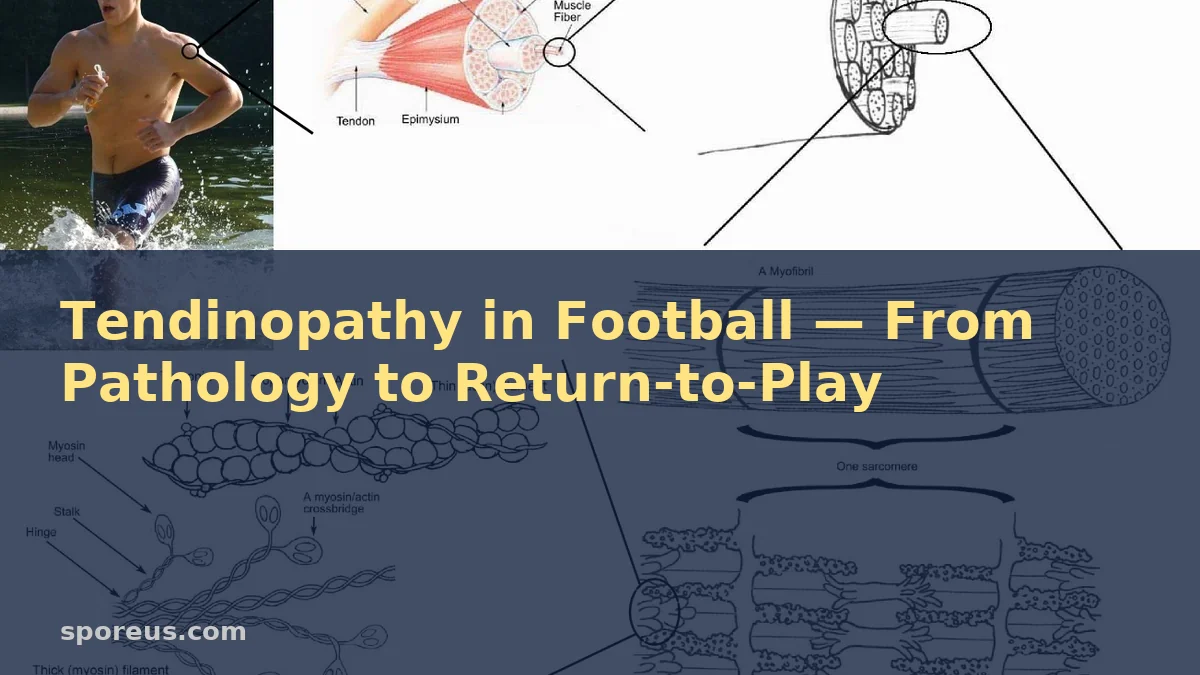
Tendon structure and pathology: Tendons are primarily type I collagen fibres organised in parallel fascicles, designed for tensile force transmission. Healthy tendons appear white and glistening; pathological tendons appear grey, disorganised, with increased vascularity (neovascularisation) on ultrasound — the hallmarks of tendinopathy.
Tendinopathy is not tendinitis: Tendinitis implies acute inflammation. Tendinopathy is a chronic degenerative condition characterised by collagen disorganisation, increased proteoglycan content, neovascularisation, and neural ingrowth. Anti-inflammatory interventions (NSAIDs, corticosteroids) do not address the underlying pathology — and corticosteroid injection, while providing short-term pain relief, has been associated with long-term tendon weakening and increased rupture risk.
The continuum model of tendinopathy (Cook & Purdam, 2009): Tendons exist on a continuum from reactive tendinopathy (acute load spike response) through tendon dysrepair (failed attempted repair) to degenerative tendinopathy (irreversible structural change). Management differs by stage — reactive tendons require load reduction; degenerative tendons require progressive loading to stimulate what remaining healthy tissue remains.
Load as both cause and cure: Tendinopathy paradoxically arises from load and is treated with load. Insufficient load leads to tendon atrophy and reduced tensile strength. Excessive load leads to microdamage accumulation exceeding repair capacity. The management target is the optimal load window — sufficient to stimulate collagen synthesis and tendon adaptation without exceeding repair capacity.
Isometric loading for pain management: Heavy isometric contractions (e.g., leg press at 70–80% of body weight, held for 45 seconds, 4–5 repetitions) produce rapid analgesia in tendinopathy — cortical pain inhibition within the same session. This isometric loading phase precedes isotonic exercise introduction in structured rehabilitation.
What Research Says
Alfredson et al. (1998) published the landmark heavy slow resistance eccentric protocol for Achilles tendinopathy in American Journal of Sports Medicine, finding that 12 weeks of heavy eccentric heel drops (on a step, single leg, 3 sets of 15 reps twice daily with added load) produced complete symptom resolution in 15/15 patients with chronic mid-portion Achilles tendinopathy — establishing eccentric exercise as the evidence basis for tendinopathy rehabilitation.
Cook et al. (2009) proposed the tendinopathy continuum model in British Journal of Sports Medicine, providing the theoretical framework for stage-specific management that remains the clinical reference standard — distinguishing reactive, dysrepair, and degenerative stages with different therapeutic targets.
Beyer et al. (2015) compared heavy slow resistance training versus eccentric training for Achilles tendinopathy in a randomised trial (American Journal of Sports Medicine), finding equivalent outcomes at 12 weeks but better adherence and patient satisfaction with heavy slow resistance training — suggesting both protocols are effective, with slow resistance training being more tolerable.
Did You Know? The morning pain after exercise that characterises tendinopathy has a specific explanation: the lack of mechanical load during sleep allows the tendon’s water content to redistribute, creating swelling pressure and increased pain sensitivity on first loading the next morning. This “morning stiffness” that resolves with activity — and worsens again after intensive sessions — is pathognomic of tendinopathy and distinguishes it from acute tendon tears, where pain does not resolve with initial activity.
Applied to Football
Evidence-based tendinopathy management in football:
- Never inject a tendon presenting with activity-related pain first time. First-time tendinopathy in a professional player should be trialled with loading protocols for 6–8 weeks before corticosteroid injection is considered. Injection provides short-term relief at potential long-term structural cost.
- Begin with isometric loading for in-season pain management. Heavy isometric holds (45 seconds × 4 repetitions) provide immediate analgesic effect for players who must compete while managing tendinopathy.
- Progress to heavy slow resistance (HSR) training. After pain is controlled with isometrics, progress to slow tempo (3 seconds up, 3 seconds down) resistance exercises — leg press, Spanish squat for patellar tendon; heel raise with added load for Achilles.
- Monitor load carefully — spikes cause setbacks. The most common tendinopathy rehabilitation failure is a sudden load increase after pain-free days. Maintain a load diary and limit week-on-week load increases to 10%.
- Address contributing factors. Tight hip flexors increasing anterior pelvic tilt, weak glutes altering force distribution, court/pitch surface changes — these load factors must be addressed alongside local tendon rehabilitation.
- Tendinopathy is a degenerative collagen disorder, not an inflammatory condition — anti-inflammatory treatments miss the target
- Cook’s continuum model guides stage-specific management: reactive = reduce load; degenerative = progressive load
- Isometric loading provides immediate analgesia; heavy slow resistance training drives structural adaptation
- Load spikes are the primary cause of tendinopathy onset and rehabilitation setbacks
- Corticosteroid injection provides short-term relief but impairs long-term structural integrity
- Alfredson, H., Pietilä, T., Jonsson, P., & Lorentzon, R. (1998). Heavy-load eccentric calf muscle training for the treatment of chronic Achilles tendinosis. American Journal of Sports Medicine, 26(3), 360–366.
- Cook, J. L., & Purdam, C. R. (2009). Is tendon pathology a continuum? A pathology model to explain the clinical presentation of load-induced tendinopathy. British Journal of Sports Medicine, 43(6), 409–416.
- Beyer, R., Kongsgaard, M., Hougs Kjær, B., Øhlenschlæger, T., Kjær, M., & Magnusson, S. P. (2015). Heavy slow resistance versus eccentric training as treatment for Achilles tendinopathy. American Journal of Sports Medicine, 43(7), 1704–1711.
Key Takeaways
References
Introduction
Patellar tendinopathy — jumper's knee — is endemic in football. Achilles tendinopathy follows closely. Together they account for a disproportionate share of training days lost in professional football, with an insidious onset pattern that frustrates players: pain that appears manageable during warming up, disappears mid-session,…
The Science
Tendon structure and pathology: Tendons are primarily type I collagen fibres organised in parallel fascicles, designed for tensile force transmission. Healthy tendons appear white and glistening; pathological tendons appear grey, disorganised, with increased vascularity (neovascularisation) on ultrasound — the hallmarks of tendinopathy.
What Research Says
Alfredson et al. (1998) published the landmark heavy slow resistance eccentric protocol for Achilles tendinopathy in American Journal of Sports Medicine, finding that 12 weeks of heavy eccentric heel drops (on a step, single leg, 3 sets of 15 reps twice daily with added load)…
Applied to Football
Evidence-based tendinopathy management in football: