Preview
Hüseyin Akbulut, MSc (2026). Aliyah Boston and the WNBA Rebounding Positioning and Mechanics of an Elite Forward. Sporeus. Retrieved, October 1, 2026. https://sporeus.com/en/science/aliyah-boston-wnba-rebounding-positioning-mechanics/
The Athlete in One Paragraph
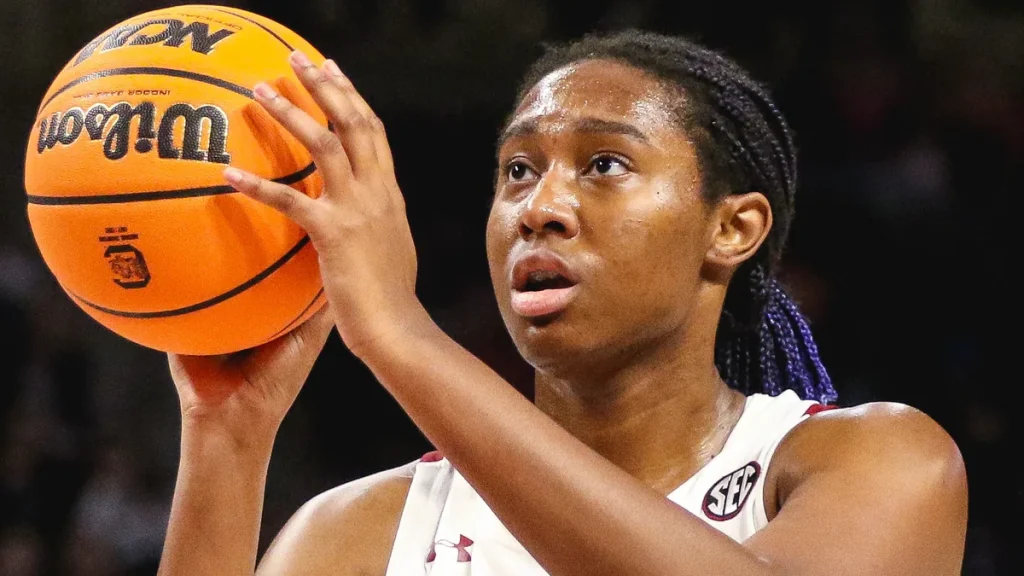
Aliyah Boston (b. 2001-12-11, St. Thomas, U.S. Virgin Islands) is, as of September 2026, a forward for the Indiana Fever and a current contributor to the United States national team, with a 2023 WNBA Rookie of the Year title on her résumé. Listed at 1.91 m and ~84 kg, she carries the anthropometry of a long-levered, high-mass interior forward whose game lives in the painted area, on the offensive glass, and at the rim — a body habitus engineered to combine standing reach with reactive vertical work in the rebound contest. The interesting case for sport science is not any single putback or contested finish but the underlying positioning-and-mechanics architecture that lets a forward of her size repeatedly arrive at the contested space first, box out from a position of leverage, and then deliver a near-maximal vertical impulse with a competing body inside her arc. The variable underneath that story is WNBA rebounding positioning and mechanics — how box-out timing, standing reach, lower-limb maximal strength and stretch-shortening-cycle efficiency combine to convert a probabilistic ball-flight into a high rebound rate inside a women’s-basketball positional template.
Table of Contents

The Physiology — what rebound positioning and mechanics actually measure
A rebound is not won by the highest jumper; it is won by the player who arrives at the right place at the right time and then expresses an adequate vertical impulse from a position of leverage. Wisløff, Castagna, Helgerud, Jones and Hoff demonstrated that maximal squat strength correlates strongly with both sprint performance and vertical jump height in elite athletes, anchoring the strength-to-jump pipeline that any interior forward depends on whenever the rebound contest goes vertical [1]. The forward who can produce force quickly relative to body mass owns the larger reservoir from which the contested rebound is drawn.
Markovic and Mikulic’s review of plyometric adaptations frames the second layer: structured plyometric exposure improves jump height through tendon stiffness changes, motor-unit recruitment patterns and inter-joint coordination, and the effect is meaningful even in already-trained populations [2]. For a rebounding forward the relevant adaptation is not absolute peak height but the ability to repeat near-maximal vertical efforts across a 40-minute game and to recover the stretch-shortening cycle quickly between possessions.
Sheppard and Young’s classification of agility is decisive for understanding the positioning half of rebounding. Planned change-of-direction is a closed skill measurable in seconds; reactive agility, by contrast, is the ability to express that capacity in response to a stimulus that is unfolding in real time [3]. Rebounding is reactive agility in the painted area — the player reads the shot trajectory, anticipates the carom direction, and executes a short, sharp box-out and re-acceleration sequence inside a window of a few hundred milliseconds. Young and Farrow’s strength-and-conditioning review of agility adds the practical implication: the elite player does not just react faster, she reads earlier, and the anticipatory model she runs in real time compresses the apparent reaction time of the box-out and frees the mechanical system to execute without hesitation [4].
Stølen, Chamari, Castagna and Wisløff’s physiology-of-soccer review, although a football reference, captures the energetic context that translates directly to elite basketball: repeated near-maximal efforts are gated by aerobic conditioning, repeated-sprint capacity, and recovery between bursts [5]. A rebounding forward who cannot recover between possessions will see her contest-rate degrade in the late minutes, regardless of how high she could jump fresh.
The concise summary is that rebound positioning is itself a mechanics question — a perceptual-cognitive layer cueing where to be, a strength layer underwriting the vertical when she gets there, and an aerobic layer keeping both available across a full game.
The Case — Aliyah Boston as positioning-and-mechanics archetype
For a 1.91 m / ~84 kg interior forward, the standing-reach advantage is real but it is not, on its own, the rebound. The reach is the upper bound of a positional contest that is decided several seconds earlier by the read; the player who arrives at the contested space first and lands inside her opponent’s centre of mass takes that reach to the contest already in possession of the leverage [3, 4]. Boston’s role on offensive glass and second-chance contests asks her to combine the cognitive read of the shot trajectory with the mechanical execution of a tight, low-leverage box-out, immediately followed by a reactive vertical against a competing body.
The mechanical layer is where her profile shows. Long levers extend the reach at the top of the jump and lengthen the arm-swing contribution to take-off velocity; the same long levers, however, mean that the force-time integral required to displace the body’s centre of mass is large in absolute terms, so the strength reserve underwriting the jump must be proportionally large [1]. The forward who carries the most absolute lower-limb strength and the cleanest unloading sequence at this body size owns the most consistent rebound profile across a full game.
The repeatability layer matters because rebound totals are not generated by one-off efforts but by the player who produces a slightly-better-than-replacement contest on every shot in her radius for forty minutes. Markovic and Mikulic’s plyometric work and Stølen’s energetic framing converge on the same operational answer: the contest-rate at the rim across the second half is gated by tendon stiffness, recovery between near-maximal efforts, and aerobic conditioning, and the discriminator at the elite level is the ability to keep producing the same contest in the fourth quarter as in the first [2, 5].
The female-athlete frame is operationally important. Reading WNBA forwards through men’s-NBA jump norms understates the relative-to-body-mass output; the discriminator at the elite women’s level is the same as at the elite men’s level — a heavy strength base, a well-trained stretch-shortening cycle, and a perceptual-cognitive layer that arrives at the contested space already loaded into a countermovement [1, 2, 4].
Match-context note: across recent WNBA seasons Boston’s per-game rebound totals and offensive-rebound share have sat among the upper band for forwards (Match data: WNBA.com / Basketball-Reference), with the discriminator being the consistency of contested-rebound rate rather than any single-game peak.

What This Means for the Reader
For a developing forward, the takeaway is that the rebound is a perceptual problem solved with mechanics [1, 2, 3, 4, 5]. Players who train the jump in isolation, the box-out drill in isolation and the film read in isolation, without ever forcing the three to operate against each other under live shot-clock pressure, build three separate skills that do not compound in a real possession.
Three measurements diagnose the limiting variable in a developing rebounder’s profile: a relative-to-body-mass squat or trap-bar deadlift, a countermovement-jump height with arm swing, and a reactive-agility test that includes a visual stimulus and a short re-acceleration. Drift in any of the three is the early signal that the rebound engine is degrading at one of its three operating layers. The diagnostic question for the developing forward: when my rebound numbers go flat in the second half, is it my position, my pop, or my recovery that has run out first?
References
- Wisløff U, Castagna C, Helgerud J, Jones R, Hoff J. (2004). Strong correlation of maximal squat strength with sprint performance and vertical jump height in elite soccer players. British Journal of Sports Medicine, 38(3): 285–288. doi:10.1136/bjsm.2002.002071
- Markovic G, Mikulic P. (2010). Neuro-musculoskeletal and performance adaptations to lower-extremity plyometric training. Sports Medicine, 40(10): 859–895. doi:10.2165/11318370-000000000-00000
- Sheppard JM, Young WB. (2006). Agility literature review: classifications, training and testing. Journal of Sports Sciences, 24(9): 919–932. doi:10.1080/02640410500457109
- Young W, Farrow D. (2006). A review of agility: practical applications for strength and conditioning. Strength and Conditioning Journal, 28(5): 24–29. doi:10.1519/00126548-200610000-00004
- Stølen T, Chamari K, Castagna C, Wisløff U. (2005). Physiology of soccer: an update. Sports Medicine, 35(6): 501–536. doi:10.2165/00007256-200535060-00004
Match-context data (descriptive only): WNBA.com / Basketball-Reference.
The Athlete in One Paragraph
Aliyah Boston (b. 2001-12-11, St. Thomas, U.S. Virgin Islands) is, as of September 2026, a forward for the Indiana Fever and a current contributor to the United States national team, with a 2023 WNBA Rookie of the Year title on her résumé. Listed at 1.91…
The Physiology — what rebound positioning and mechanics actually measure
A rebound is not won by the highest jumper; it is won by the player who arrives at the right place at the right time and then expresses an adequate vertical impulse from a position of leverage. Wisløff, Castagna, Helgerud, Jones and Hoff demonstrated that…
The Case — Aliyah Boston as positioning-and-mechanics archetype
For a 1.91 m / ~84 kg interior forward, the standing-reach advantage is real but it is not, on its own, the rebound. The reach is the upper bound of a positional contest that is decided several seconds earlier by the read; the player who…
What This Means for the Reader
For a developing forward, the takeaway is that the rebound is a perceptual problem solved with mechanics [1, 2, 3, 4, 5]. Players who train the jump in isolation, the box-out drill in isolation and the film read in isolation, without ever forcing the three…