Preview
Hüseyin Akbulut, MSc (2026). Jakob Ingebrigtsen and the 1500m VO2max Ceiling and Finishing Kick of an Elite Middle-distance Runner. Sporeus. Retrieved, September 20, 2026. https://sporeus.com/en/science/jakob-ingebrigtsen-1500m-vo2max-ceiling-and-finishing-kick/
The Athlete in One Paragraph
Jakob Ingebrigtsen (b. 2000-09-19, Sandnes, Norway) is a middle-distance runner racing for Norway across the 1500 m and 5000 m, with Olympic and world titles at both distances and a career trajectory that has redefined what a Western European athlete can do in a discipline historically dominated by East African physiologies. Listed at 1.88 m and roughly 70 kg, he carries a relatively tall frame for the event, paired with a Norwegian-school training upbringing built on threshold-loaded volume and double-threshold microcycles. The interesting case for sport science is the dual demand he meets: the 1500 m punishes anything less than a near-maximal aerobic ceiling for nearly four minutes, and it requires a final-lap finishing kick that overshoots that ceiling — a controlled excursion into anaerobic territory in the last 300 m. The variable underneath that pattern is the interaction of VO₂max with the brief, sustained over-VO₂max work of the closing kick.
Table of Contents
The Physiology — what middle-distance VO₂max-plus-kick actually demands
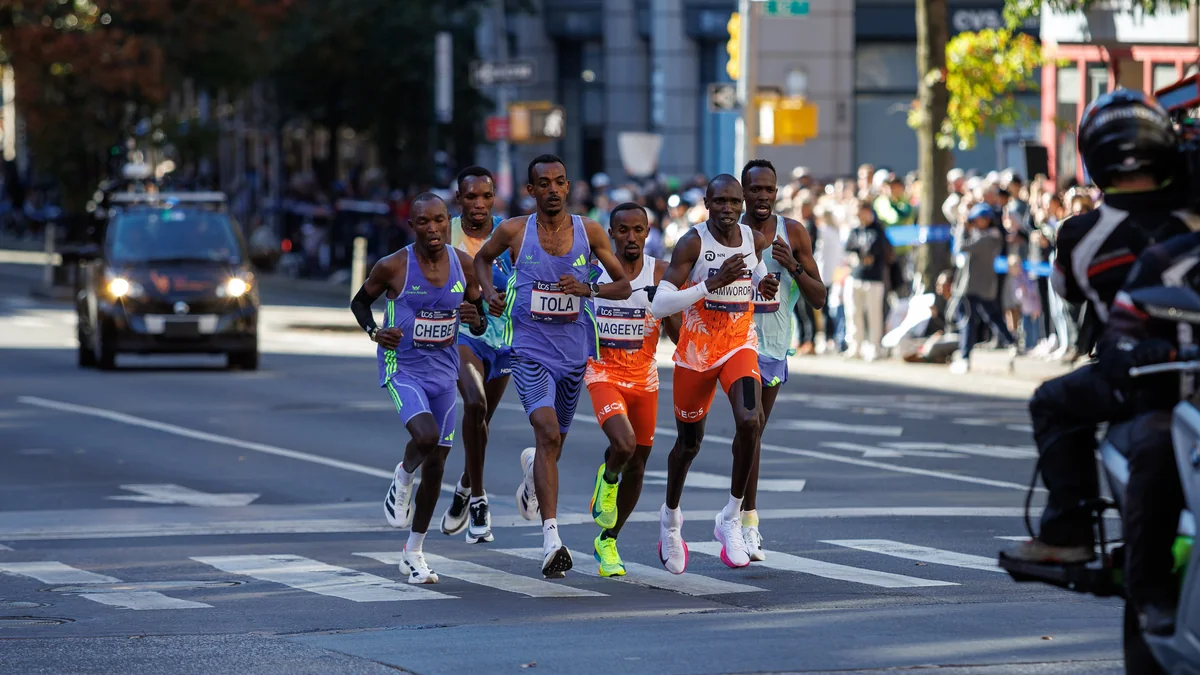
The 1500 m is metabolically a hybrid event. Joyner and Coyle’s framework for endurance performance describes three multiplicative factors — VO₂max, lactate threshold, and running economy — that together determine the speed an athlete can hold submaximally [1]. In the marathon the constraint is fractional utilisation; in the 1500 m the constraint shifts: the race is run at or above VO₂max for most of its duration, and the discriminator becomes how close to the personal ceiling the athlete can hold the first three laps without compromising the bell-lap kick.
Buchheit and Laursen’s HIIT review formalised the demand profile. Efforts above 90% of VO₂max draw heavily on both aerobic and anaerobic energy systems and require — to be programmable and trainable — careful management of work-to-rest ratio, intensity distribution, and weekly load [2]. The 1500 m racing pace sits on the boundary where elite athletes spend several minutes at or beyond the maximal sustainable aerobic intensity; the trained athlete who can hold that pace longest before anaerobic accumulation forces a slowdown wins the early sub-race against the field.
The closing kick is a different metabolic problem. In the last 300–400 m of a 1500 m, the athlete who has paced the early laps efficiently produces a brief, sustained over-VO₂max effort — heart rate already at maximum, oxygen extraction already at ceiling, and the additional power coming primarily from anaerobic glycolysis layered on top of an aerobic engine that cannot accelerate further. Saunders and colleagues’ work on running economy shows why the cost matters here: the athlete with better economy reaches the bell lap with marginally more substrate untouched, and the finishing-kick window is dictated by what is left, not by what was theoretically available at the start [3]. Faude and colleagues catalogued the lactate-threshold concepts that determine when “above-threshold” running becomes self-limiting [4]; in 1500 m, the closing kick is precisely a controlled, brief, deliberate breach of that boundary.
Helgerud’s classic intervention demonstrated that targeted aerobic interval training raises VO₂max and improves both the threshold velocity and the maximal aerobic speed available for race-paced efforts [5]. The middle-distance athlete who has developed the highest possible ceiling and the highest possible fraction of that ceiling enters the bell lap with the deepest reserve to spend on the kick.
The Case — Ingebrigtsen as VO₂max-plus-kick lens
Ingebrigtsen’s race patterns express both halves of this dual demand. His front-running tactics, deployed in many of his championship 1500 m and 5000 m victories, are an applied confidence in personal VO₂max — an athlete with a higher aerobic ceiling than the field can dictate the pace from early, force the rest of the field to sit at or above their personal ceilings, and gamble that his closing kick from a hard-paced position is still better than theirs from a tactical sit-and-kick scenario. The strategy presupposes both halves of the equation: a ceiling that is genuinely higher, and a kick that survives the full-effort early laps [1, 2].
The Norwegian-school training context reinforces this. The sub-threshold and double-threshold programming that has shaped his development emphasises high weekly volume at intensities below the lactate-deflection point, with controlled doses of supra-threshold work — the long-term aerobic adaptations Saunders described, expressed in a programming framework that minimises sympathetic load while maximising the threshold velocity itself [3, 4]. Years of accumulating this stimulus produce an athlete whose ceiling and fraction continue to climb together rather than trading off.
His anthropometry is not the canonical East-African middle-distance build; at 1.88 m and ~70 kg he is taller and heavier than many of his rivals, which has theoretical implications for mass-specific oxygen cost. The fact that he is competitive at the very top of the event suggests that economy and ceiling have compensated for any anthropometric overhead — and that he has had to develop both to a higher absolute level than rivals built more conservatively [3, 5].
(Performance data: World Athletics)
What This Means for the Reader
For the developing middle-distance athlete, the takeaway is that 1500 m and 5000 m training is not a “more VO₂max intervals” problem; it is a “raise the ceiling and the sustainable fraction and the supra-threshold tolerance” problem [1, 2]. The Norwegian-school programming logic — heavy threshold-zone volume with limited but precisely placed above-threshold sessions — is one operationalisation of this; the principle generalises beyond the brand name [4, 5].
For coaches managing the closing-kick development, the implication is that anaerobic work is not a separate season; it is the controlled application of the supra-threshold stimulus on top of an already-elevated aerobic base. An athlete trained only above threshold will plateau; an athlete trained only below threshold will lack the kick. The dual stimulus, sequenced across the macrocycle, is the lever [2, 3].
The diagnostic question for the athlete: at race pace, am I already above lactate threshold for most of the race, and how many seconds of above-threshold work can I add at the bell lap before the system collapses?
References
- Joyner MJ, Coyle EF. (2008). Endurance exercise performance: the physiology of champions. The Journal of Physiology, 586(1): 35–44. doi:10.1113/jphysiol.2007.143834
- Buchheit M, Laursen PB. (2013). High-intensity interval training, solutions to the programming puzzle. Sports Medicine, 43(5): 313–338. doi:10.1007/s40279-013-0029-x
- Saunders PU, Pyne DB, Telford RD, Hawley JA. (2004). Factors affecting running economy in trained distance runners. Sports Medicine, 34(7): 465–485. doi:10.2165/00007256-200434070-00005
- Faude O, Kindermann W, Meyer T. (2009). Lactate threshold concepts: how valid are they? Sports Medicine, 39(6): 469–490. doi:10.2165/00007256-200939060-00003
- Helgerud J, Engen LC, Wisløff U, Hoff J. (2001). Aerobic endurance training improves soccer performance. Medicine & Science in Sports & Exercise, 33(11): 1925–1931. doi:10.1097/00005768-200111000-00019
Performance data (descriptive only): World Athletics.
The Athlete in One Paragraph
Jakob Ingebrigtsen (b. 2000-09-19, Sandnes, Norway) is a middle-distance runner racing for Norway across the 1500 m and 5000 m, with Olympic and world titles at both distances and a career trajectory that has redefined what a Western European athlete can do in a discipline…
The Physiology — what middle-distance VO₂max-plus-kick actually demands
The 1500 m is metabolically a hybrid event. Joyner and Coyle's framework for endurance performance describes three multiplicative factors — VO₂max, lactate threshold, and running economy — that together determine the speed an athlete can hold submaximally [1]. In the marathon the constraint is fractional…
The Case — Ingebrigtsen as VO₂max-plus-kick lens
Ingebrigtsen's race patterns express both halves of this dual demand. His front-running tactics, deployed in many of his championship 1500 m and 5000 m victories, are an applied confidence in personal VO₂max — an athlete with a higher aerobic ceiling than the field can dictate…
What This Means for the Reader
For the developing middle-distance athlete, the takeaway is that 1500 m and 5000 m training is not a "more VO₂max intervals" problem; it is a "raise the ceiling and the sustainable fraction and the supra-threshold tolerance" problem [1, 2]. The Norwegian-school programming logic — heavy…