Preview
Hüseyin Akbulut, MSc (2026). Frenkie de Jong and the Ball-Carrying Economy of an Elite Midfielder. Sporeus. Retrieved, October 25, 2026. https://sporeus.com/en/science/frenkie-de-jong-ball-carrying-economy/
The Athlete in One Paragraph
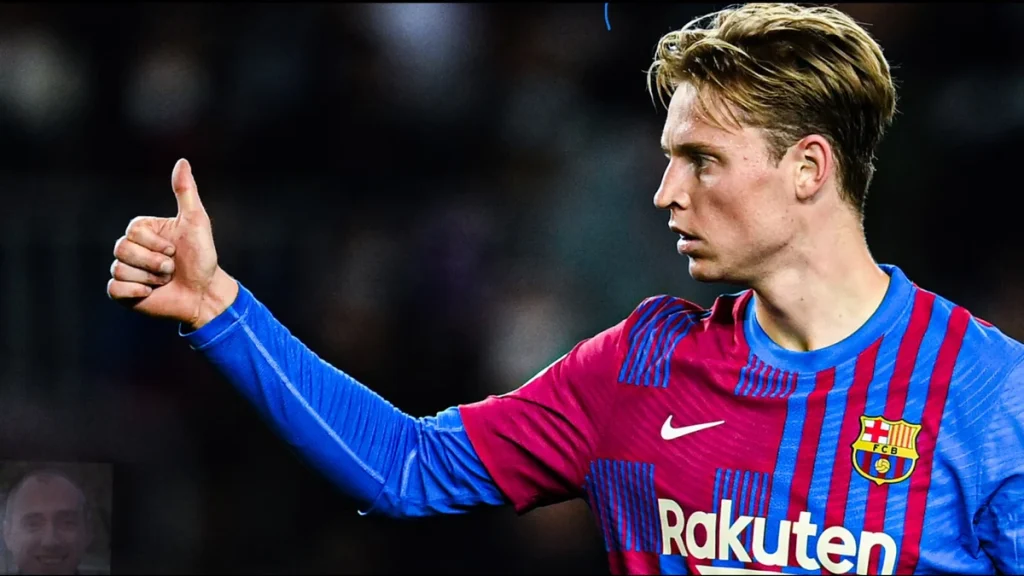
Frenkie de Jong (b. 1997-05-12, Arkel, Netherlands) is, as of September 2026, a midfielder for FC Barcelona and the Netherlands national team. Listed at 1.80 m and 74 kg, he is built medium-tall and lean for the position, with a body composition that favours sustained mechanical work over peak ballistic output. What sets him apart is a sub-skill that the standard match-running metrics struggle to capture: the ability to carry the ball forward through pressure, change of pace and contact while losing very little metabolic efficiency relative to running without the ball. The interesting case for sport science is the variable that defines him: ball-carrying economy, the metabolic cost of progressing the ball over ground under defensive pressure, and the way it sits alongside, but is distinct from, classical running economy.
Table of Contents
The Physiology: what ball-carrying economy actually measures
Running economy in trained distance runners is the steady-state oxygen cost of running at a given submaximal velocity; Saunders, Pyne, Telford and Hawley defined the construct and showed that small differences in economy translate into large differences in performance among athletes with similar VO₂max [1]. The construct generalises beyond the track: any sport that involves repeated locomotion over distance has an economy axis, and the athlete with the lower oxygen cost per metre at a given speed has a structural advantage in the late phases of the contest.
Football inherits the economy logic but layers complications on top. Stølen, Chamari, Castagna and Wisløff’s physiology-of-soccer review framed the modern game as an intermittent aerobic-anaerobic stress, with match VO₂ averaging ~70–80% of maximum and intermittent peaks approaching 100% [2]. Total distance and high-intensity distance describe the magnitude of the load; what they do not isolate is the type of running. Running with the ball is mechanically and metabolically more expensive than running without it, the foot path is constrained by the ball, the stride pattern is shortened, the trunk and arms move differently, and the perceptual demand is higher because the eye must split between ball, opponent and pitch geometry.
Bangsbo, Mohr and Krustrup’s work on elite match demands made the point explicit. The sequence of efforts in a 90-minute match is dominated by short bursts and recoveries, and the on-ball contribution to the high-intensity portion is a discriminating positional feature, central midfielders in possession-based systems carry a meaningfully larger share of their high-intensity distance with the ball than wide players do, and the metabolic cost of that on-ball portion is higher per metre than the equivalent off-ball running [3]. A central midfielder who absorbs ball-carrying load with little late-match decline is, by inference, operating with both a robust aerobic base and a well-trained ball-carrying technique that minimises the additional cost.
Mohr, Krustrup and Bangsbo’s match-fatigue analysis added the temporal layer. High-intensity output declines toward the end of each half, the canonical “transient fatigue” pattern and the magnitude of decline is itself a marker of conditioning [4]. The ball-carrying portion of high-intensity output is particularly sensitive to fatigue, because the technical demand is highest precisely when the metabolic substrate is most depleted; the player who carries the ball cleanly through pressure in the 80th minute is the player whose economy buffer has not been exhausted.
Bradley and colleagues’ Premier League analysis closed the positional loop. Central and attacking midfielders sit at the upper end of the high-intensity-distance distribution, with running profiles dominated by short bursts of 1–4 seconds; for a deep-lying creator who progresses possession by carrying the ball through the lines, those bursts are disproportionately on-ball compared with a winger or a holding midfielder [5]. Ball-carrying economy is, in this framing, the visible output of running economy, ball-handling technique and tactical reading combined.
The Case: De Jong as ball-carrying archetype
For a 1.80 m / 74 kg midfielder operating in a possession-dominant system, the running profile is consistent with a high-volume, moderate-peak-speed pattern: total distance in the upper range for central midfielders, a relatively high share of the high-intensity portion delivered with the ball at his feet, and a sprint-distance share toward the lower end of the central-midfield distribution [3, 5]. The lean anthropometry favours the economy dimension, less mass to move per metre, lower absolute energy cost per stride and the medium height supports a low, repeatable centre-of-mass trajectory that is mechanically efficient for ball-carrying.
The technical layer is what compounds the physiological one. Carrying the ball through the lines under pressure requires a constrained foot path, a shortened stride and a continuous re-orientation of the trunk to keep the ball protected; the athlete whose carrying technique is closer to free running pays a smaller economy penalty per metre than the athlete who carries with stiffer mechanics [1, 2]. The signature in such a player implies not only a robust aerobic base but a long history of high-volume on-ball training that has converted ball-handling into a near-automatic motor pattern.
The tactical context fits the physiology. In a possession-based system, the midfielder who progresses possession by carrying rather than passing pays a higher metabolic cost than the midfielder who progresses by short releases; the carrying player therefore needs a higher economy buffer to deliver the same number of progressions at the same late-match quality [3, 4]. The aerobic substrate is the upstream condition; the technique is the multiplier that determines how much of that substrate is converted into useful progression rather than dissipated in inefficient mechanics.
Match-context note: De Jong’s per-match touches, progressive-carry distance and ball-receiving volume in La Liga, Champions League and Netherlands play sit in the upper band for central midfielders (Match data: SofaScore), with the discriminator being how cleanly those carries hold up under pressure across the late stages of matches.
The repeatability dimension is what makes the case distinctive. Bangsbo and colleagues note that the players who maintain high-intensity output across full matches and across congested fixtures are the players whose aerobic base is robust enough to absorb cumulative load [3, 4]. A central midfielder who maintains ball-carrying quality across a 50+ match season at the top of two competitions is, by inference, operating with an economy profile near the upper bound of the position.
Flickr: Miami U. Libraries – Digital Collections.
What This Means for the Reader
For a developing midfielder, the takeaway is that ball-carrying economy is not a single trait but the integration of three systems, aerobic capacity, running economy and on-ball technique and the system is trainable in pieces. Three measurements diagnose the limiting variable: a Yo-Yo Intermittent Recovery test for repeated-effort capacity, a steady-state submaximal run with and without a ball at controlled paces (compare heart rate and RPE) to isolate the ball-carrying penalty, and a video review of carries from the final 20 minutes of a match to identify the technical break-points [1, 4].
The training prescription targets the diagnostic finding: athletes whose Yo-Yo score is low need short-interval aerobic work to widen the recovery window before the on-ball training compounds; athletes with a respectable aerobic base but a large penalty in the with-versus-without-ball test need volume-controlled carrying drills that match game-realistic pressure rather than open-field running [2, 5]. The single diagnostic question for the developing midfielder: when my carry breaks down in the 80th minute, is it because my legs are gone, or because my technique was paying too high a tax all match?
References
- Saunders PU, Pyne DB, Telford RD, Hawley JA. (2004). Factors affecting running economy in trained distance runners. Sports Medicine, 34(7): 465–485. doi:10.2165/00007256-200434070-00005
- Stølen T, Chamari K, Castagna C, Wisløff U. (2005). Physiology of soccer: an update. Sports Medicine, 35(6): 501–536. doi:10.2165/00007256-200535060-00004
- Bangsbo J, Mohr M, Krustrup P. (2006). Physical and metabolic demands of training and match-play in the elite football player. Journal of Sports Sciences, 24(7): 665–674. doi:10.1080/02640410500482529
- Mohr M, Krustrup P, Bangsbo J. (2003). Match performance of high-standard soccer players with special reference to development of fatigue. Journal of Sports Sciences, 21(7): 519–528. doi:10.1080/0264041031000071182
- Bradley PS, Sheldon W, Wooster B, Olsen P, Boanas P, Krustrup P. (2009). High-intensity running in English FA Premier League soccer matches. Journal of Sports Sciences, 27(2): 159–168. doi:10.1080/02640410802512775
Match-context data (descriptive only): SofaScore.

Hüseyin Akbulut is the founder of Sporeus and author of THRESHOLD (EŞİK), a 540-page Turkish-language book on endurance science.
- 540pp THRESHOLD Book
- MSc Sport Sciences
- Marmara University
The Athlete in One Paragraph
Frenkie de Jong (b. 1997-05-12, Arkel, Netherlands) is, as of September 2026, a midfielder for FC Barcelona and the Netherlands national team. Listed at 1.80 m and 74 kg, he is built medium-tall and lean for the position, with a body composition that favours sustained…
The Physiology: what ball-carrying economy actually measures
Running economy in trained distance runners is the steady-state oxygen cost of running at a given submaximal velocity; Saunders, Pyne, Telford and Hawley defined the construct and showed that small differences in economy translate into large differences in performance among athletes with similar VO₂max [1].…
The Case: De Jong as ball-carrying archetype
For a 1.80 m / 74 kg midfielder operating in a possession-dominant system, the running profile is consistent with a high-volume, moderate-peak-speed pattern: total distance in the upper range for central midfielders, a relatively high share of the high-intensity portion delivered with the ball at…
What This Means for the Reader
For a developing midfielder, the takeaway is that ball-carrying economy is not a single trait but the integration of three systems, aerobic capacity, running economy and on-ball technique and the system is trainable in pieces. Three measurements diagnose the limiting variable: a Yo-Yo Intermittent Recovery…