
Preview
Hüseyin Akbulut, MSc (2026). Anthony Davis and the Mobile Big-Man Lateral Defence of an Elite Forward-Centre. Sporeus. Retrieved, October 12, 2026. https://sporeus.com/en/science/anthony-davis-mobile-big-man-lateral-defence/
The Athlete in One Paragraph
Anthony Marshon Davis Jr. (b. 1993-03-11, Chicago, Illinois, United States) is, as of September 2026, a forward-centre for the Washington Wizards (formerly Los Angeles Lakers and Dallas Mavericks) and a long-standing member of the United States national team. Listed at 2.08 m and ~115 kg, he carries the anthropometry of a tall, long-limbed big who is asked to do something the league asked of very few players a generation ago: switch onto guards on the perimeter, mirror their first step, and brake through change-of-direction without conceding the angle. The interesting case for sport science is not any single block but the lateral-defence repertoire that allows a 2.08 m / 115 kg body to defend a 1.90 m guard without conceding the drive — the eccentric brake at large body mass, the foot-placement geometry that decides the cut, and the maximal-strength reserve that underwrites both. The variable underneath that story is mobile big-man lateral defence — how tall-body lateral quickness, eccentric deceleration, and change-of-direction mechanics interact when the system is asked to switch repeatedly across an NBA game.
Table of Contents
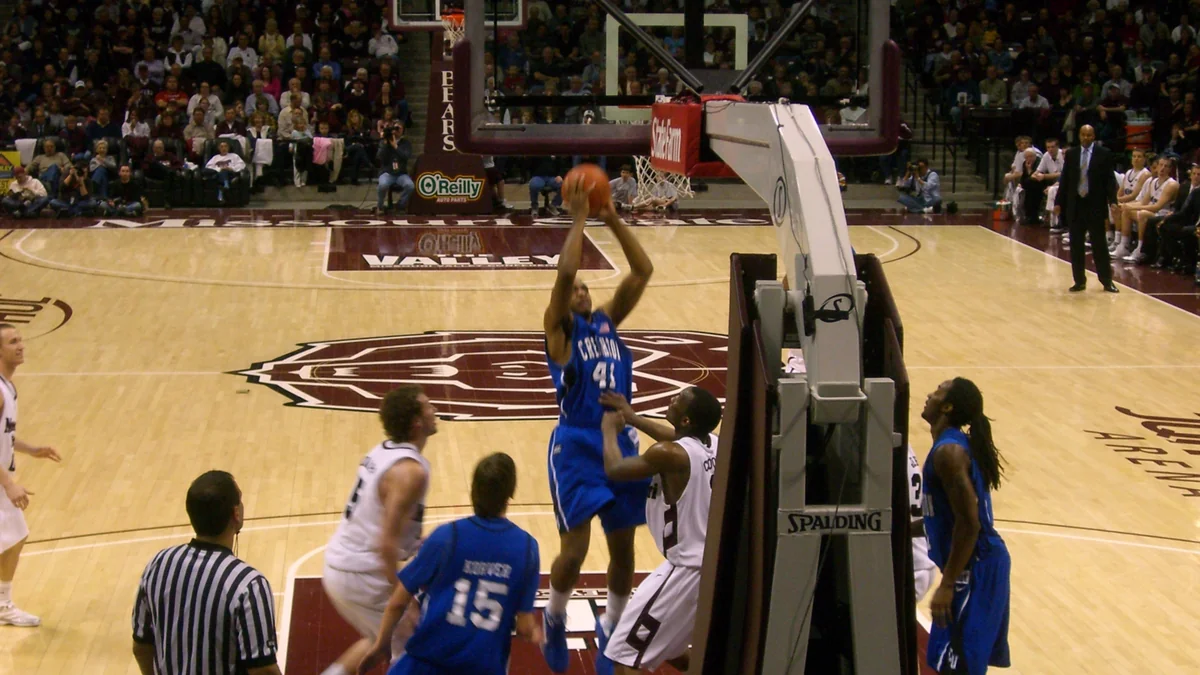
The Physiology — what mobile lateral defence actually requires
Change-of-direction performance in team sport is governed less by linear sprint speed than by the mechanical events at the plant foot — the eccentric brake that absorbs the deceleration, the orientation of ground reaction force into the new direction, and the strength reserve that allows both to be expressed without postural collapse [1]. Spiteri and colleagues, working with team-sport athletes, demonstrated that faster change-of-direction performers produced larger eccentric and concentric ground reaction forces and shorter ground-contact times than slower performers, and that maximal-strength reserve was a primary discriminator [1]. The implication for a heavy athlete is direct: at high body mass, the absolute force required to brake and re-accelerate scales with mass, and the protective margin against postural collapse is the strength base [1, 2].
Wisløff and colleagues’ work tied maximal squat strength to both sprint and vertical-jump performance in elite footballers; the same relationship — strength as the foundation underneath any explosive expression — applies in basketball with extra force, because the higher body mass amplifies the cost of any deficit [2]. Sheppard and Young’s review of agility frames the broader principle: change-of-direction performance is the integral of physical capacities (strength, power, reactive strength) and technical execution (foot placement, body lean, hip-knee-ankle geometry), and the technical layer cannot compensate fully for a deficient physical base [3]. Young and Farrow, writing for strength and conditioning practitioners, distil the same point into the practical recommendation: build the strength reserve first, then refine the change-of-direction technique on top of it [4].
The big-man case adds an angle the football literature usually does not foreground. Stølen and colleagues’ update on football physiology, used here as a more general framing, reminds us that sport-specific lateral demands — the actions that actually decide possessions — are short, repeated, and densely packed, and that the metabolic and neuromuscular cost is paid in the eccentric phase as much as the concentric one [5]. For a 2.08 m / 115 kg body, the eccentric phase of every lateral cut is a tax that lighter athletes do not pay at the same rate; the protective margin is built in the weight room and spent on the floor [1, 2, 3, 4, 5].
The key takeaway is that mobile lateral defence at large body mass is a strength-and-mechanics story before it is a quickness story, and the limiting factor is usually the eccentric brake, not the first step.
The Case — Davis as a tall-body lateral-defence case study
For a 2.08 m / ~115 kg forward-centre asked to switch onto guards on the perimeter, the geometry is unusual. The defensive sequence is decided in the first two steps after the ball-handler’s change of pace; if the big is still settling his weight when the guard hits the second step, the angle is conceded and the rim is open [1, 3]. The mechanical solution is not “be quicker” but “be braked” — to arrive at the cut with the centre of mass already controlled, the plant foot already organised, and the strength reserve to redirect ground force without standing up out of the stance [1, 2].
Davis’s playing record at the elite level is, in the language of the literature, a sustained demonstration that a tall-body athlete can hold the eccentric-brake side of the change-of-direction equation against guard-sized opponents — switching, recovering, contesting at the rim — while still anchoring the back-line as a centre [1, 5]. The training implication is that the strength base is not separable from the lateral-defence skill; the same maximal-squat reserve that supports rim protection also supports the eccentric-brake mechanics that decide the perimeter switch [2, 4].
A second feature is reactive agility — the cognitive-perceptual side of the action, where the defender reads the ball-handler’s shoulder, hip, or ball-position cue and pre-organises the cut [3, 4]. The big who must switch repeatedly across a game has less time to plant and recover than a smaller defender, so anticipation pays a higher dividend; the literature is consistent in framing reactive agility as a coachable layer that sits on top of the physical base, not as a substitute for it [3, 4].
Match-context note: across recent seasons, Davis’s defensive profile has placed him among the highest-impact rim protectors in the league while sustaining a switching-defence role on the perimeter (Match data: NBA.com / Basketball-Reference). The discriminator is not raw lateral speed against a guard one-on-one, but the integral of switching minutes absorbed without a defensive collapse.

What This Means for the Reader
For tall and heavy athletes — basketball bigs, volleyball middles, the heavier rugby forwards — the lesson is that lateral quickness at large body mass is built in the weight room and the deceleration drill before it is built in the change-of-direction drill [1, 2, 3, 4]. Train the eccentric brake; train the strength base that allows the brake to be expressed; only then layer reactive-agility work that reads opponent cues and pre-organises the cut.
Practical assessment: track three indicators — relative back-squat strength against body mass, an eccentric-deceleration test (e.g., a 505 or modified change-of-direction drill timing the brake phase), and a reactive-agility drill that adds a perceptual cue at the cut [1, 3, 4, 5]. A relative squat below 1.5× body mass in a heavy athlete is a development priority before chasing reactive-agility drills that the body cannot yet underwrite [2].
The diagnostic question for the heavy lateral defender: am I quick enough to start the cut, but strong enough to brake it without standing up?
References
- Spiteri T, Newton RU, Binetti M, Hart NH, Sheppard JM, Nimphius S. (2015). Mechanical determinants of faster change of direction and agility performance in female basketball athletes. Journal of Strength and Conditioning Research, 29(8): 2205–2214. doi:10.1519/JSC.0000000000000876
- Wisløff U, Castagna C, Helgerud J, Jones R, Hoff J. (2004). Strong correlation of maximal squat strength with sprint performance and vertical jump height in elite soccer players. British Journal of Sports Medicine, 38(3): 285–288. doi:10.1136/bjsm.2002.002071
- Sheppard JM, Young WB. (2006). Agility literature review: classifications, training and testing. Journal of Sports Sciences, 24(9): 919–932. doi:10.1080/02640410500457109
- Young WB, Farrow D. (2006). A review of agility: practical applications for strength and conditioning. Strength and Conditioning Journal, 28(5): 24–29. doi:10.1519/00126548-200610000-00004
- Stølen T, Chamari K, Castagna C, Wisløff U. (2005). Physiology of soccer: an update. Sports Medicine, 35(6): 501–536. doi:10.2165/00007256-200535060-00004
Match-context data (descriptive only): NBA.com / Basketball-Reference.
Hüseyin Akbulut is the founder of Sporeus and author of THRESHOLD (EŞİK), a 540-page Turkish-language book on endurance science.
- 540pp THRESHOLD Book
- MSc Sport Sciences
- Marmara University
The Athlete in One Paragraph
Anthony Marshon Davis Jr. (b. 1993-03-11, Chicago, Illinois, United States) is, as of September 2026, a forward-centre for the Washington Wizards (formerly Los Angeles Lakers and Dallas Mavericks) and a long-standing member of the United States national team. Listed at 2.08 m and ~115 kg,…
The Physiology — what mobile lateral defence actually requires
Change-of-direction performance in team sport is governed less by linear sprint speed than by the mechanical events at the plant foot — the eccentric brake that absorbs the deceleration, the orientation of ground reaction force into the new direction, and the strength reserve that allows…
The Case — Davis as a tall-body lateral-defence case study
For a 2.08 m / ~115 kg forward-centre asked to switch onto guards on the perimeter, the geometry is unusual. The defensive sequence is decided in the first two steps after the ball-handler's change of pace; if the big is still settling his weight when…
What This Means for the Reader
For tall and heavy athletes — basketball bigs, volleyball middles, the heavier rugby forwards — the lesson is that lateral quickness at large body mass is built in the weight room and the deceleration drill before it is built in the change-of-direction drill [1, 2,…