Preview
Hüseyin Akbulut, MSc (2026). Léon Marchand and the Multi-Stroke Energy System Balance of an Elite Individual Medley Swimmer. Sporeus. Retrieved, October 21, 2026. https://sporeus.com/en/science/leon-marchand-multi-stroke-energy-system-balance/
The Athlete in One Paragraph
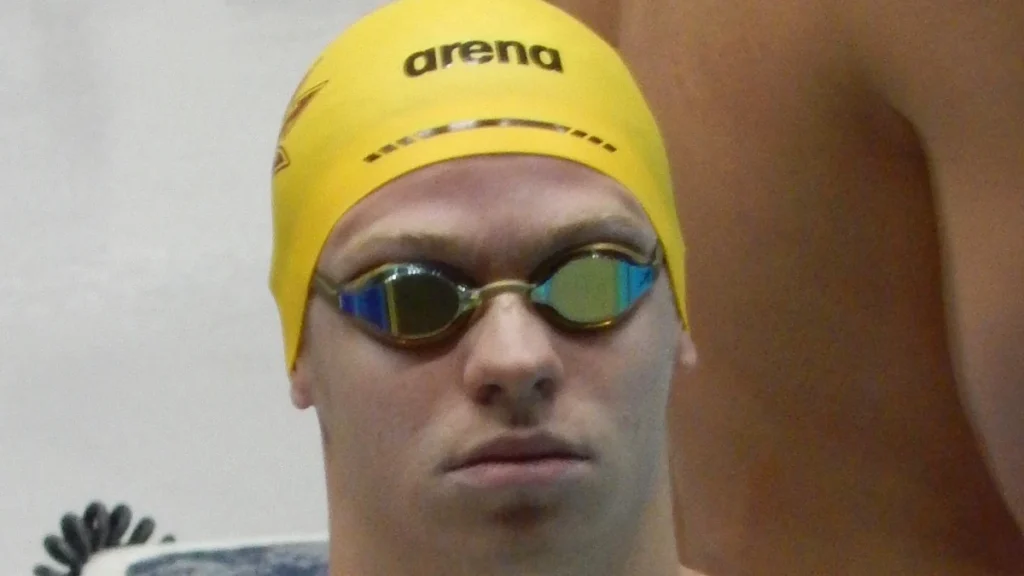
Léon Marchand (b. 2002-05-17, Toulouse, France) is the defining individual-medley figure of his generation, a four-gold Olympic champion at Paris 2024 across the 200 and 400 individual medley and the 200 breaststroke and 200 butterfly, and the world-record holder in the 400 IM. Listed at 1.88 m and roughly 79 kg, he carries a long-levered, broad-shouldered swim physique that produces stroke-length leverage in butterfly and freestyle, hip-drive capacity for breaststroke, and the trunk-rotation range that backstroke and freestyle reward. The interesting case for sport science is not whether any single one of his stroke-specific velocities is the world’s fastest in isolation; it is whether the energy-system balance required to swim four mechanically dissimilar strokes back-to-back can be developed simultaneously without one stroke’s training stimulus eroding another’s. The variable underneath that pattern is multi-stroke energy system balance, the aerobic–anaerobic interaction across four sequential metabolic demands.
Table of Contents
The Physiology: what multi-stroke energy system balance actually is
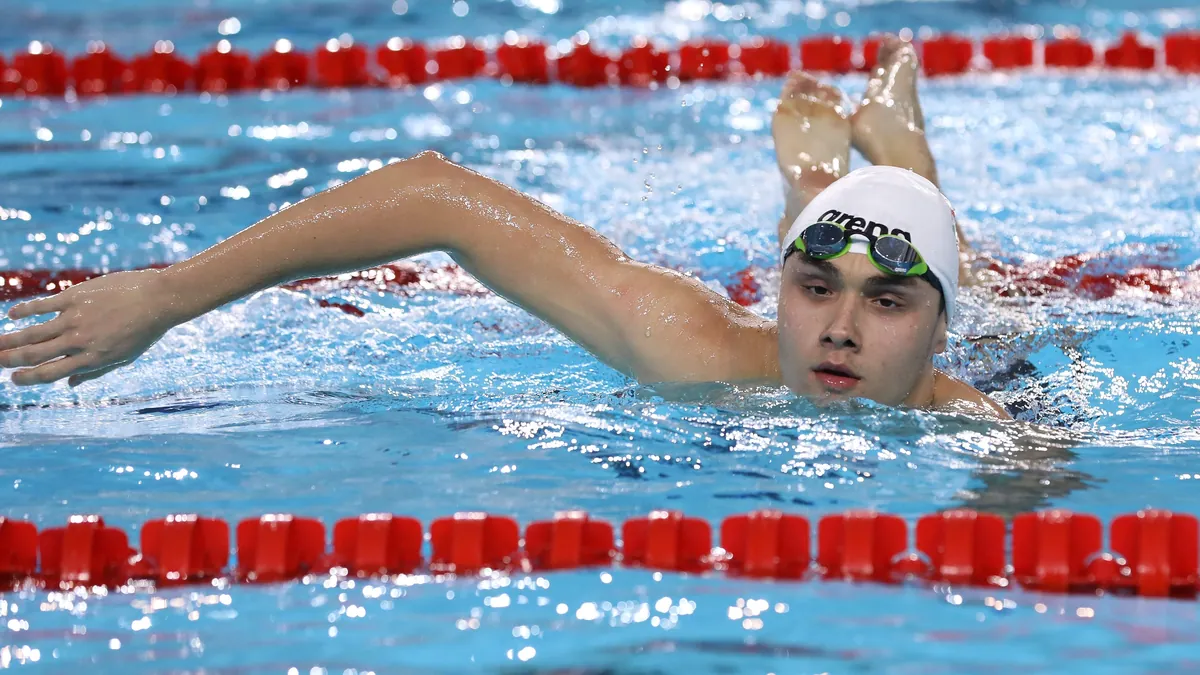
A 400-metre individual medley lasts roughly four minutes of continuous propulsion, divided into four 100-metre stroke phases, butterfly, backstroke, breaststroke, freestyle, each with a different drag profile, kick pattern, and propulsive-force distribution. Joyner and Coyle’s three-factor framework for endurance performance, VO₂max, sustainable fraction, and economy, applies, but the economy term is now four economies, not one, because each stroke imposes its own oxygen-cost-per-metre signature [1]. The athlete who optimises butterfly economy may compromise breaststroke kick recovery; the athlete who optimises breaststroke pull power may compromise the trunk rotation that keeps freestyle cheap.
Faude and colleagues clarified that the lactate-threshold concept describes a steady-state biology, a velocity at which production and clearance balance, that does not transfer cleanly across mechanically distinct movements [2]. A swimmer’s threshold velocity in freestyle and their threshold velocity in butterfly are not the same number, because the cost curves rise differently with velocity in each stroke. Across a 400 IM, the swimmer is operating above any one stroke’s individual threshold for at least part of each segment, and the ability to clear the lactate produced in the butterfly opening before the freestyle close determines how much the closing 100 metres collapses.
Buchheit and Laursen’s HIIT framework formalised the principle that aerobic capacity and high-intensity capacity are not opposed in repeated-burst sport, they are interdependent, because the recovery window between bursts is itself an aerobic process [3]. The 400 IM is the swimming analogue: the aerobic system pays the bill between the four stroke phases, re-oxidising the lactate produced in the butterfly opening and replenishing the phosphocreatine drawn down in the breaststroke pull, so that something is left for the freestyle close.
Bangsbo and colleagues, although writing about football’s stochastic effort profile, articulated the same underlying logic: an athlete with a higher maximal aerobic capacity recovers more cheaply between high-intensity efforts and therefore retains higher absolute output deeper into a long event [4]. Stølen and colleagues summarised the same picture in the canonical physiology-of-soccer review, aerobic dominance is the recovery currency that purchases late-event high-intensity capacity in any sport [5]. In a 400 IM, that recovery currency is spent four times in four minutes, and the swimmer who has built more of it across years of mixed-stroke training has a larger reserve at the back end.
The Case: Marchand as multi-stroke balance lens
Marchand’s record across the Paris 2024 programme is the cleanest applied demonstration of the principle. The 400 IM, the 200 breaststroke, and the 200 butterfly demand three different metabolic-mechanical signatures, and the 200 IM compresses the same four-stroke transition into roughly two minutes, a period in which the early-segment lactate cannot be cleared but only managed. To win all four events in a single Games requires a training history in which no one stroke has been allowed to dominate the preparation block at the others’ expense, and in which the aerobic recovery system has been built large enough to absorb four sequential anaerobic loads without late-race collapse [1, 3].
His anthropometry is consistent with the multi-stroke profile rather than any single-stroke optimum. At 1.88 m he carries the stroke-length leverage that butterfly and freestyle reward; at roughly 79 kg his mass-specific oxygen demand is competitive in the long IM event without the muscle bulk that would compromise body-line drag. The Saunders-style determinants of locomotor economy translate to swimming through stroke-mechanics economy and postural control across each of the four strokes, and the long-term training history that refines them is by definition spread across four mechanical patterns rather than concentrated in one [3, 5].
The strategic expression of the underlying physiology is the unusually controlled 400 IM split distribution Marchand has produced, a butterfly opening that does not blow the lactate budget, a backstroke and breaststroke middle that pays the bill aerobically, and a freestyle close that has reserve precisely because the earlier segments were not over-spent [2, 4]. The visual of late-race acceleration in the freestyle leg is not stylistic; it is what a multi-stroke energy-system balance looks like when the training history has been allocated correctly across all four economies.
(Performance data: World Aquatics)
What This Means for the Reader
For the developing IM swimmer or any multi-discipline endurance athlete, the takeaway is that the limiting factor is rarely the strongest stroke, it is the aerobic recovery system that joins the strokes together. Many age-group IM swimmers train as four single-stroke specialists in sequence and underweight the long aerobic threshold work that buys the inter-segment recovery; the higher-yield block is usually a sustained period of mixed-stroke threshold and aerobic-tempo work that builds the recovery currency the four-stroke event spends [2, 3]. The 400 IM time falls because the recovery between segments improves, not because any single stroke gets faster.
The second implication is balance discipline across the training year. A block that over-emphasises one stroke’s mechanics will produce localised gains and global losses, because the other strokes’ economies degrade in the absence of stimulus, and the IM total time tracks the slowest segment more than the fastest [1, 5]. The IM swimmer’s training plan is, in effect, a portfolio-management problem: rebalance regularly, do not let any single stroke’s mechanics drift outside its band, and keep the aerobic base large enough to absorb the four anaerobic loads.
The diagnostic question for the swimmer: in a 400 IM time trial, does my closing 100 metres of freestyle drop disproportionately compared with my fresh 100 metres of freestyle, and how does that gap compare with my mixed-stroke aerobic-block volume?
References
- Joyner MJ, Coyle EF. (2008). Endurance exercise performance: the physiology of champions. The Journal of Physiology, 586(1): 35–44. doi:10.1113/jphysiol.2007.143834
- Faude O, Kindermann W, Meyer T. (2009). Lactate threshold concepts: how valid are they? Sports Medicine, 39(6): 469–490. doi:10.2165/00007256-200939060-00003
- Buchheit M, Laursen PB. (2013). High-intensity interval training, solutions to the programming puzzle. Sports Medicine, 43(5): 313–338. doi:10.1007/s40279-013-0029-x
- Bangsbo J, Mohr M, Krustrup P. (2006). Physical and metabolic demands of training and match-play in the elite football player. Journal of Sports Sciences, 24(7): 665–674. doi:10.1080/02640410500482529
- Stølen T, Chamari K, Castagna C, Wisløff U. (2005). Physiology of soccer: an update. Sports Medicine, 35(6): 501–536. doi:10.2165/00007256-200535060-00004
Performance data (descriptive only): World Aquatics.

Hüseyin Akbulut is the founder of Sporeus and author of THRESHOLD (EŞİK), a 540-page Turkish-language book on endurance science.
- 540pp THRESHOLD Book
- MSc Sport Sciences
- Marmara University
The Athlete in One Paragraph
Léon Marchand (b. 2002-05-17, Toulouse, France) is the defining individual-medley figure of his generation, a four-gold Olympic champion at Paris 2024 across the 200 and 400 individual medley and the 200 breaststroke and 200 butterfly, and the world-record holder in the 400 IM. Listed at…
The Physiology: what multi-stroke energy system balance actually is
A 400-metre individual medley lasts roughly four minutes of continuous propulsion, divided into four 100-metre stroke phases, butterfly, backstroke, breaststroke, freestyle, each with a different drag profile, kick pattern, and propulsive-force distribution. Joyner and Coyle's three-factor framework for endurance performance, VO₂max, sustainable fraction, and economy,…
The Case: Marchand as multi-stroke balance lens
Marchand's record across the Paris 2024 programme is the cleanest applied demonstration of the principle. The 400 IM, the 200 breaststroke, and the 200 butterfly demand three different metabolic-mechanical signatures, and the 200 IM compresses the same four-stroke transition into roughly two minutes, a period…
What This Means for the Reader
For the developing IM swimmer or any multi-discipline endurance athlete, the takeaway is that the limiting factor is rarely the strongest stroke, it is the aerobic recovery system that joins the strokes together. Many age-group IM swimmers train as four single-stroke specialists in sequence and…