Preview
Hüseyin Akbulut, MSc (2026). Alisson Becker and the Reactive Shot-Stopping Window of an Elite Goalkeeper. Sporeus. Retrieved, October 19, 2026. https://sporeus.com/en/science/alisson-becker-reactive-shot-stopping/
The Athlete in One Paragraph
Alisson Ramsés Becker (b. 1992-10-02, Novo Hamburgo, Brazil) is, as of September 2026, the goalkeeper for Liverpool and the Brazil national team. Listed at 1.93 m and ~91 kg, he is one of the most positionally and perceptually composed first-choice goalkeepers in European football, with a reputation built less on the spectacular dive than on the routine save delivered earlier than the situation seemed to require. The interesting question for sport science is not how high he reaches but how quickly he reaches, how a goalkeeper compresses the chain of cue, decision, foot-plant and dive initiation into the sub-300-millisecond window between shot release and ball flight commitment. The variable underneath that is reactive shot-stopping, the open-skill perception–action coupling that turns geometric coverage into actual saves.
Table of Contents
The Physiology: what reactive shot-stopping actually measures
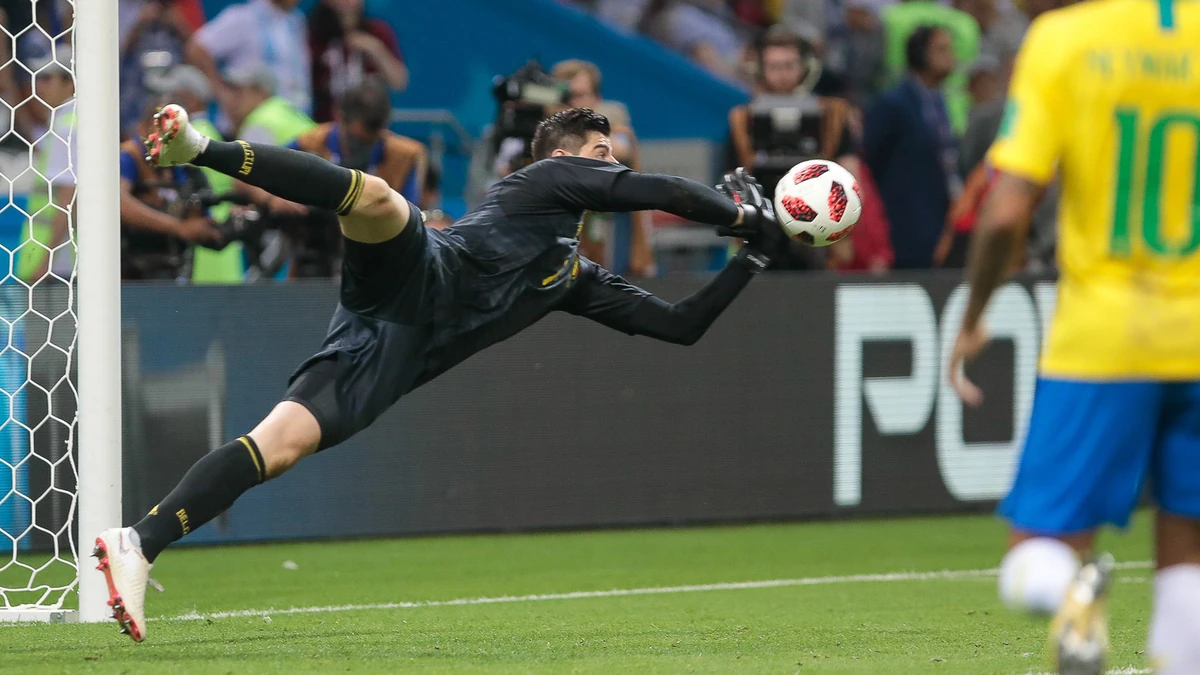
The save chain is a sequence of biological events compressed into a very small time window. The shooter’s plant foot lands roughly 100–200 ms before ball contact; the goalkeeper’s perceptual system extracts hip orientation, plant-foot angle and follow-through trajectory; the central nervous system selects a movement pattern; the foot-plant loads; the dive initiates. The total budget between shot release and ball-line crossing on a close-range strike is, depending on shot velocity, in the range of 300–500 ms, which is barely longer than the simple visual reaction time of an untrained adult. Anything more than the most rehearsed cue–response pairing arrives late.
Sheppard and Young’s agility literature review framed the conceptual split that organises this domain: change-of-direction speed (closed-skill, pre-planned) and agility (open-skill, decision-coupled) are different physical qualities trained in different ways, with agility, the open-skill side, being the one that actually predicts performance in invasion sports [1]. For a goalkeeper, every save is an open-skill action; the cue is the shooter, not a cone. Closed-skill repetition without cue-coupling produces fast, well-coordinated, late-arriving goalkeepers.
Sheppard, Young, Doyle, Sheppard and Newton tested this distinction empirically with a reactive-agility test against a video stimulus and showed that the reactive component, not the locomotor component, separated higher and lower performers [2]. The implication for goalkeepers is direct: the difference between the goalkeeper who reaches the corner and the one who arrives a half-metre late is rarely about leg speed; it is about the latency between cue and motor commitment.
Henry, Dawson, Lay and Young extended the framework into the decision-making accuracy dimension. Their work showed that under reactive-agility conditions, correctness of the directional choice, not just speed of response, discriminates higher performers, and that perceptual training produces measurable gains in this dimension that motor-only training does not [3]. For a goalkeeper, a fractionally late but correct commitment outperforms a fast but wrong-side movement; the wrong-side dive forfeits the save before the foot leaves the ground.
Paul, Gabbett and Nassis’s review of agility in team sports synthesised the perceptual-cognitive and physical sides into a unified construct. Elite agility, they argued, is the product of both perceptual-cognitive expertise (anticipatory cue use, pattern recognition) and physical capability (force, stretch-shortening cycle, foot-plant mechanics), with the perceptual side dominating in the most time-pressured situations [4]. The goalkeeper at the elite level is, by this definition, an agility athlete operating at the upper end of perceptual demand.
The mechanical substrate is not optional. Wisløff, Castagna, Helgerud, Jones and Hoff’s strength-jump-sprint correlation in elite footballers indicates that the lower-body force needed to launch a powerful lateral dive responds to maximal-strength training and predicts vertical-extension capacity [5]. Reactive timing without force produces an early but short dive; force without timing produces a late but powerful one. Neither alone defends the corner of the goal.
The Case: Alisson as reactive-timing prototype
For a 1.93 m / 91 kg goalkeeper operating in a high-line, possession-dominant Premier League and Champions League system, the perceptual demand is uneven and asymmetric: long stretches of low involvement punctuated by point-blank reactions in which the cue resolves under 300 ms [1, 2]. The case is not that he reacts faster than every other goalkeeper, simple reaction-time differences at this level are small, but that the anticipatory component of his cue use compresses the effective decision window, allowing the foot-plant to begin earlier and the dive to arrive on time more often than not.
The decision-accuracy dimension is what makes the case distinctive at the position. Henry and colleagues’ finding that correctness of the directional choice discriminates elite reactive performers maps onto what is observable at the top of goalkeeping: the goalkeeper who commits early and right is in a different category from the goalkeeper who commits early and wrong [3]. Anticipatory cue use is trained, film study, scenario-based open-skill drills, repeated exposure to live shooting under representative pressure and the goalkeepers who do this work systematically arrive on time at the relevant shots more often than the ones who do not.
The physical-cognitive integration is structural. Paul, Gabbett and Nassis’s argument that elite agility is the product of perceptual and physical capability rather than the sum implies that a deficit in either layer caps the other [4]. A perceptually elite but mechanically average goalkeeper saves the shots he reads but cannot finish the saves he cannot reach; a mechanically elite but perceptually average goalkeeper reaches the corner only on the shots he commits to early enough by chance. The goalkeeper at the upper end of the position has both layers in place.
Match-context note: Alisson’s save percentage and post-shot-expected-goals overperformance in the Premier League and Champions League sit in the upper band for first-choice goalkeepers (Match data: SofaScore), with the discriminator being the consistency of those numbers against high-xG situations rather than raw save volume against low-xG shots that any first-team goalkeeper would handle.
The lower-body mechanics complete the picture. A 91 kg goalkeeper extending laterally to a corner requires the same strength-jump correlation that drives outfield vertical-jump performance, scaled to mass, with the additional demand of a foot-plant angle that converts horizontal plant force into a low-trajectory dive [5]. The mechanical envelope is necessary but not sufficient; the perceptual layer is what decides whether it is deployed in time.
What This Means for the Reader
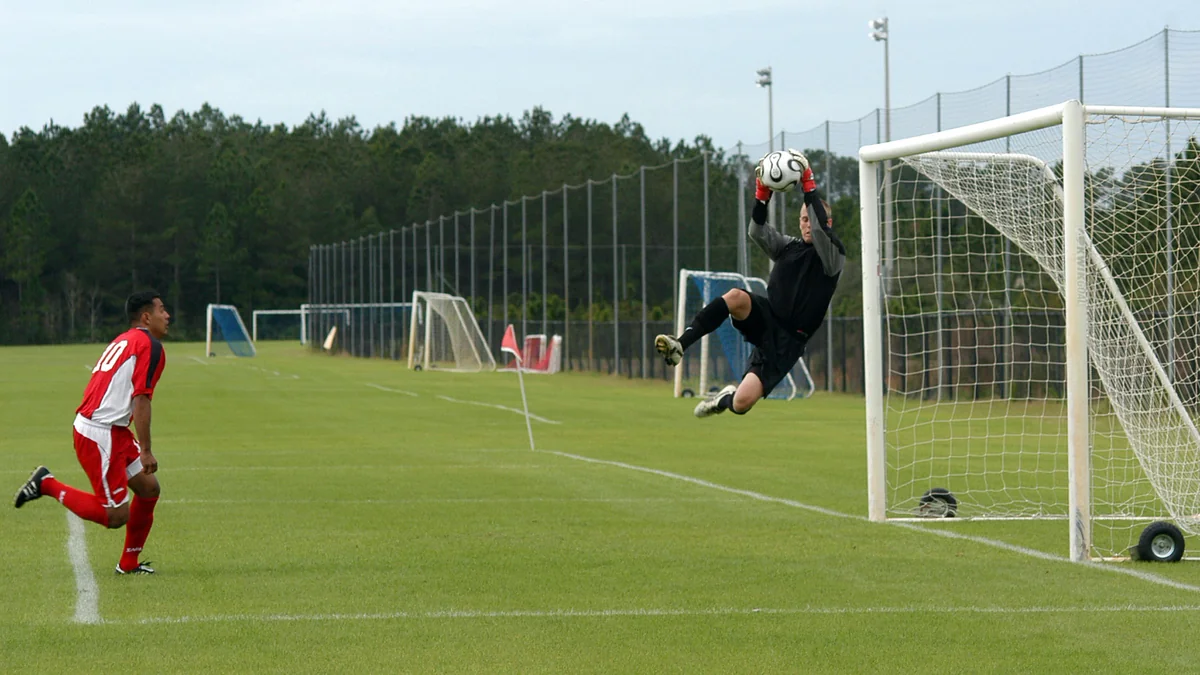
For a developing goalkeeper, the takeaway is that reaction is not a single trait but a sequence, perceptual cue, decision selection, foot-plant load, dive initiation and the most trainable layers are the first two, not the last two. Three measurements diagnose the limiting variable: a video-based reactive-agility test for cue-coupled latency, a closed-skill change-of-direction test as a baseline for locomotor speed without decision load, and a standing-jump-reach test for the mechanical extension that converts decision into save [1, 2, 5].
The training prescription targets the diagnostic finding: athletes with fast change-of-direction times but slow reactive-agility times need open-skill work, drills with live shooters, video stimuli and unpredictable cue timing, rather than more cone-pattern repetition; athletes with both slow need both, but in the right order, with perceptual exposure prioritised because it ceilings everything else [3, 4]. The single diagnostic question for the developing goalkeeper: when a shot beats me to the corner, did my legs arrive late, or did my decision arrive late?
References
- Sheppard JM, Young WB. (2006). Agility literature review: classifications, training and testing. Journal of Sports Sciences, 24(9): 919–932. doi:10.1080/02640410500457109
- Sheppard JM, Young WB, Doyle TLA, Sheppard TA, Newton RU. (2006). An evaluation of a new test of reactive agility and its relationship to sprint speed and change of direction speed. Journal of Science and Medicine in Sport, 9(4): 342–349. doi:10.1016/j.jsams.2006.05.019
- Henry GJ, Dawson B, Lay BS, Young WB. (2013). Decision-making accuracy in reactive agility: quantifying the cost of poor decisions. Journal of Strength and Conditioning Research, 27(11): 3190–3196. doi:10.1519/JSC.0b013e31828b8da4
- Paul DJ, Gabbett TJ, Nassis GP. (2016). Agility in team sports: testing, training and factors affecting performance. Sports Medicine, 46(3): 421–442. doi:10.1007/s40279-015-0428-2
- Wisløff U, Castagna C, Helgerud J, Jones R, Hoff J. (2004). Strong correlation of maximal squat strength with sprint performance and vertical jump height in elite soccer players. British Journal of Sports Medicine, 38(3): 285–288. doi:10.1136/bjsm.2002.002071
Match-context data (descriptive only): SofaScore.
Hüseyin Akbulut is the founder of Sporeus and author of THRESHOLD (EŞİK), a 540-page Turkish-language book on endurance science.
- 540pp THRESHOLD Book
- MSc Sport Sciences
- Marmara University
The Athlete in One Paragraph
Alisson Ramsés Becker (b. 1992-10-02, Novo Hamburgo, Brazil) is, as of September 2026, the goalkeeper for Liverpool and the Brazil national team. Listed at 1.93 m and ~91 kg, he is one of the most positionally and perceptually composed first-choice goalkeepers in European football, with…
The Physiology: what reactive shot-stopping actually measures
The save chain is a sequence of biological events compressed into a very small time window. The shooter's plant foot lands roughly 100–200 ms before ball contact; the goalkeeper's perceptual system extracts hip orientation, plant-foot angle and follow-through trajectory; the central nervous system selects a…
The Case: Alisson as reactive-timing prototype
For a 1.93 m / 91 kg goalkeeper operating in a high-line, possession-dominant Premier League and Champions League system, the perceptual demand is uneven and asymmetric: long stretches of low involvement punctuated by point-blank reactions in which the cue resolves under 300 ms [1, 2].…
What This Means for the Reader
For a developing goalkeeper, the takeaway is that reaction is not a single trait but a sequence, perceptual cue, decision selection, foot-plant load, dive initiation and the most trainable layers are the first two, not the last two. Three measurements diagnose the limiting variable: a…