Preview
Hüseyin Akbulut, MSc (2026). Martin Sinković and the Team Boat Stroke Synchronisation Economy of an Elite Rower. Sporeus. Retrieved, October 1, 2026. https://sporeus.com/en/science/martin-sinkovic-team-boat-stroke-synchronisation-economy/
The Athlete in One Paragraph
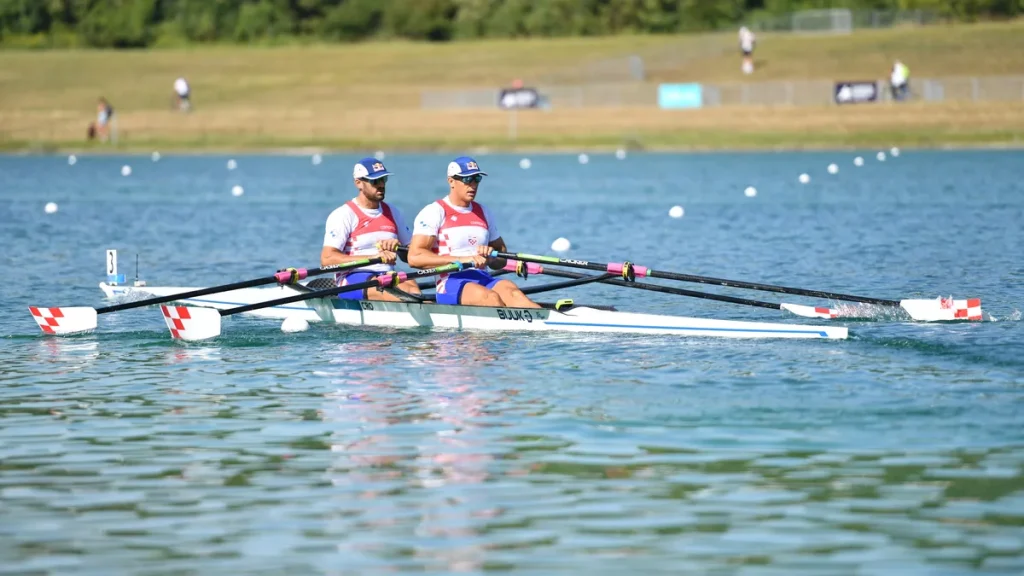
Martin Sinković (b. 1989-11-10, Zagreb, Croatia) is a rower for the Croatian national programme and an Olympic and multiple world champion in both the men’s double sculls and the men’s pair, partnered for nearly the entire arc of his elite career with his brother Valent. Listed at 1.94 m and roughly 95 kg, he carries the long-levered heavyweight rowing profile that the discipline rewards into a competitive niche where the discriminator is not individual wattage in isolation but how cleanly two athletes’ wattage couples through a shared hull. The interesting case for sport science is not whether a great rower can produce great power on his own — Sinković’s results in different boat classes establish that he can — but how the team-boat athlete loses or saves wattage at the point of synchronisation, where mistimed catches and asymmetric drives convert into hull pitch, yaw and slip that each cost measurable boat speed. The variable underneath that pattern is team boat stroke synchronisation economy — the per-stroke loss of mechanical work that arises from imperfect timing between crew members, and the sustainable race-pace boat speed that survives once that loss is minimised.
Table of Contents
The Physiology — what synchronisation economy actually is
A team boat at race pace is a single mechanical system whose speed depends on the net forward impulse at the hull, integrated across the stroke cycle. The Joyner and Coyle endurance framework — VO₂max, sustainable fraction, exercise economy — applies independently to each crew member, but the boat’s actual speed is determined by how the individual outputs combine through a shared system [1]. Two rowers with identical individual physiology can produce different boat speeds depending on whether their catches, drives and recovery phases are in phase or out of phase by a few hundredths of a second.
The mistimed catch is the largest of the synchronisation losses. If one rower’s blade enters the water before the other’s, the boat pitches and yaws in the early drive; that geometry costs propulsion and increases hydrodynamic drag. Saunders’ work on running economy frames the analogous concept — the oxygen cost of producing a given submaximal output is shaped by mechanical efficiency, and small mechanical penalties compound across the duration [2]. In the rowing context, every imperfect catch is a small per-stroke economy penalty, and 200-plus strokes across a 2000-metre race compound the cost.
The drive-phase asymmetry is the second loss. If the two rowers’ force curves do not match in shape — one peaks earlier, one peaks later, one applies more force off the catch and the other off the finish — the hull experiences torque that the rudder cannot fully correct. Stølen and colleagues’ broader endurance review reinforces that economy is a structural variable across endurance sports, and the team boat case is the cleanest illustration that economy is not a purely individual property when the system is shared [3].
The threshold position remains a determinant of the sustainable race-pace boat speed. Faude’s review of lactate-threshold concepts establishes that the highest sustainable steady-state intensity is the maximal lactate steady state; in a team-boat context, both rowers must hold their respective per-rower wattage at or near that threshold, and any synchronisation penalty effectively raises the per-rower wattage required to hold a given boat speed [4]. The boat’s speed-at-threshold is the crew’s joint property, not the individual’s.
The conditioning substrate is the same in any case. Helgerud and colleagues’ interval-training work showed that aerobic ceiling and threshold velocity in trained athletes both respond to high-intensity aerobic intervals; the team-boat crew’s joint training is built on the same stimuli, with the additional layer that the technical timing between crew members must be drilled until the synchronisation penalty is small enough to be invisible at race pace [5].
The Case — Sinković as the team-boat economy lens
For a long-tenured pair like the Sinković brothers, the case is unusual not because the underlying physiology is different from a single sculler’s — it is not — but because the discriminator at the elite level has migrated from individual output to crew economy. The Sinković brothers’ record across years of competition in both the double sculls and the pair, partnered with the same crew member, is the cleanest applied demonstration that a long-stable crew converges on a synchronisation profile that single-tournament crews cannot match [1, 3].
His anthropometry — 1.94 m, ~95 kg — is consistent with the heavyweight pair archetype, and the brother-pairing introduces an unusual additional variable: anthropometric similarity reduces the geometric mismatches that drive synchronisation losses. Two crewmembers of similar height and limb-length distribution apply force through similarly-timed lever arcs, and the per-stroke economy penalty falls accordingly [2, 5].
The training-stress implication is structural. A pair or double-scull crew that has rowed together across multiple seasons accumulates the kind of technical economy that cannot be drilled in a single training block; the catch-timing precision, the matched drive-curve, the synchronised recovery phase that allows both bodies to reset without disturbing the hull. Sinković’s career consistency in the same crew configuration is descriptively consistent with a programme that has converted years of together-time into per-stroke economy that rivals’ newer pairings cannot replicate within a normal qualification cycle [3, 4].
(Performance data: World Rowing)
What This Means for the Reader
For the developing rower or the cross-trained team-sport athlete, the takeaway is that economy in a shared system is not the sum of individual economies — it is what survives after the synchronisation penalty has been paid. The crew that drills timing precisely earns boat speed that no individual conditioning block can substitute for [1, 2].
The training implication is that team-boat practice has a fundamentally different content from single-sculls practice. The aerobic-base stimulus and the threshold-and-VO₂max work are conserved; what is added is the technical-timing block in which the crew rows together at race-pace fractions specifically to drill the catch, drive and recovery synchronisation [3, 5]. Programmes that treat team-boat training as a substitute for technical-timing work typically plateau at a boat speed that does not respond to additional volume — the bottleneck has moved to the synchronisation penalty.
The diagnostic question for the developing crew: at race-pace stroke rate, how many hundredths of a second separate the two rowers’ catches across a 2000-metre piece — and how would a closing of that gap, holding individual wattage constant, change the boat’s average speed across the same race?
References
- Joyner MJ, Coyle EF. (2008). Endurance exercise performance: the physiology of champions. The Journal of Physiology, 586(1): 35–44. doi:10.1113/jphysiol.2007.143834
- Saunders PU, Pyne DB, Telford RD, Hawley JA. (2004). Factors affecting running economy in trained distance runners. Sports Medicine, 34(7): 465–485. doi:10.2165/00007256-200434070-00005
- Stølen T, Chamari K, Castagna C, Wisløff U. (2005). Physiology of soccer: an update. Sports Medicine, 35(6): 501–536. doi:10.2165/00007256-200535060-00004
- Faude O, Kindermann W, Meyer T. (2009). Lactate threshold concepts: how valid are they? Sports Medicine, 39(6): 469–490. doi:10.2165/00007256-200939060-00003
- Helgerud J, Engen LC, Wisløff U, Hoff J. (2001). Aerobic endurance training improves soccer performance. Medicine & Science in Sports & Exercise, 33(11): 1925–1931. doi:10.1097/00005768-200111000-00019
Performance data (descriptive only): World Rowing.
The Athlete in One Paragraph
Martin Sinković (b. 1989-11-10, Zagreb, Croatia) is a rower for the Croatian national programme and an Olympic and multiple world champion in both the men's double sculls and the men's pair, partnered for nearly the entire arc of his elite career with his brother Valent.…
The Physiology — what synchronisation economy actually is
A team boat at race pace is a single mechanical system whose speed depends on the net forward impulse at the hull, integrated across the stroke cycle. The Joyner and Coyle endurance framework — VO₂max, sustainable fraction, exercise economy — applies independently to each crew…
The Case — Sinković as the team-boat economy lens
For a long-tenured pair like the Sinković brothers, the case is unusual not because the underlying physiology is different from a single sculler's — it is not — but because the discriminator at the elite level has migrated from individual output to crew economy. The…
What This Means for the Reader
For the developing rower or the cross-trained team-sport athlete, the takeaway is that economy in a shared system is not the sum of individual economies — it is what survives after the synchronisation penalty has been paid. The crew that drills timing precisely earns boat…