Preview
Hüseyin Akbulut, MSc (2026). Oliver Zeidler and the Single Sculls Power and Stroke Economy of an Elite Rower. Sporeus. Retrieved, September 28, 2026. https://sporeus.com/en/science/oliver-zeidler-single-sculls-power-and-stroke-economy/
The Athlete in One Paragraph
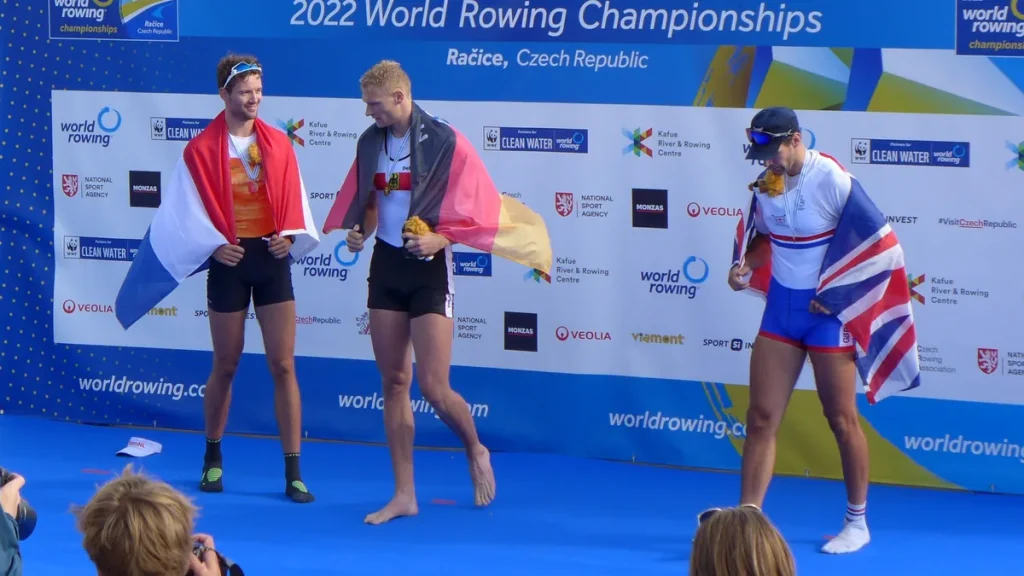
Oliver Zeidler (b. 1996-07-23, Dachau, Germany) is a rower for the German national programme and a multiple world champion in the men’s single sculls, the most physiologically exposed event in the rowing programme — one rower, two oars, no crew to share the metabolic cost. Listed at 2.03 m and roughly 95 kg, he is unusually tall even by heavyweight rowing standards; the long levers convert into an extended effective stroke and a long horizontal pull, and the absolute aerobic capacity an athlete of that frame can support pushes the upper bound of what the discipline rewards. The interesting case for sport science is not whether a 2-metre sculler can produce enormous wattage in a single stroke — he obviously can — but how that wattage is delivered economically, stroke after stroke, at a rating of 32–34 strokes per minute over the full 2000 metres. The variable underneath that pattern is single sculls power and stroke economy — the per-stroke mechanical work, multiplied by stroke rate, divided by the oxygen cost of producing it, all sustained at race-fraction VO₂max for the duration of the race.
Table of Contents
The Physiology — what single-sculls power and economy actually are
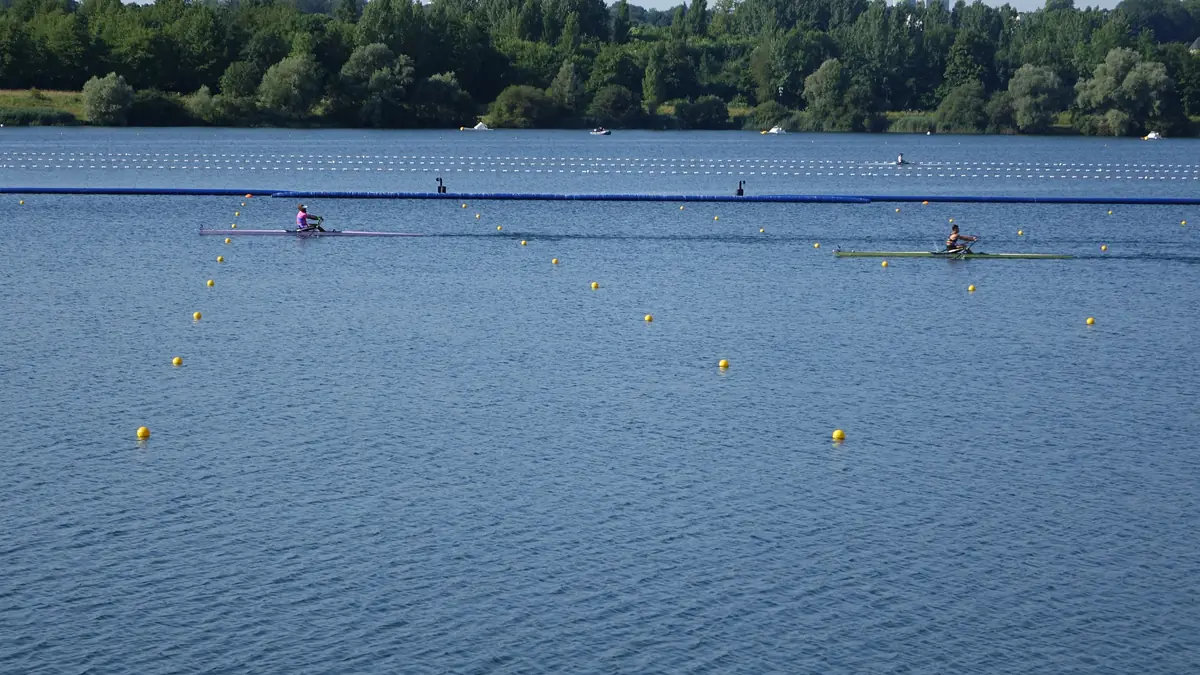
The single scull is the rowing event in which the rower’s individual physiology is most ruthlessly exposed; there is no synchronisation gain to harvest from a crew, no rhythm partner, no shared aerobic envelope. The Joyner and Coyle endurance framework — VO₂max, sustainable fraction, exercise economy — applies directly, with the additional sculler-specific twist that mechanical power is delivered through two oars in repeated cycles, and the cost of producing that power on a per-stroke basis is the variable that distinguishes a sustainable race-pace from a non-sustainable one [1].
The per-stroke mechanical work is the product of the force applied at the catch and during the drive, multiplied by the effective stroke length. For a 2.03 m athlete, the effective stroke length is structurally larger than for a shorter rower at the same rating; this is why elite scullers tend toward the upper end of the height distribution. Wisløff and colleagues’ work on maximal strength established that maximal squat strength correlates strongly with sprint and jump performance in trained athletes, and the same neuromuscular substrate — large absolute force production through a long lever, applied with the timing of the stroke — sits underneath the sculler’s catch-to-finish power profile [2].
The economy variable is the oxygen cost of producing a given submaximal wattage. Saunders and colleagues catalogued the determinants of running economy — stride mechanics, tendon stiffness, neuromuscular efficiency — and the rowing analogue maps cleanly: catch-timing precision, sequencing of leg-drive into back-swing into arm-pull, blade depth and slip, and the recovery half of the stroke cycle in which the body must reset without wasted energy [3]. Two scullers at the same wattage-per-kilogram can differ by several percent in oxygen cost, and over 6 minutes that gap is decisive.
The threshold position is the third structural variable. Faude’s review of lactate-threshold concepts establishes that the highest sustainable steady-state intensity is the maximal lactate steady state; in single-sculls terms, this is the wattage above which the second half of the race can no longer be paid for aerobically [4]. The sculler whose threshold sits closer to VO₂max has a smaller anaerobic gap to bridge across the back half of the race, and the per-stroke wattage that can be held at 32–34 strokes per minute is correspondingly higher.
Stølen and colleagues’ broader endurance review reinforces that the underlying energy distribution — predominantly aerobic with a non-trivial anaerobic top layer — is what the sculler’s training year is built around, and why the volume-of-low-intensity-aerobic-work that supports the elite single sculler is enormous [5].
The Case — Zeidler as the oversized-sculler archetype
For a 2.03 m, 95 kg single sculler, the arithmetic is unusual because the athlete is operating near the upper edge of what a single-scull boat is structurally designed for. The long levers convert into a long effective stroke, which raises per-stroke mechanical work at any given rating; the absolute aerobic capacity supported by 95 kg of trained tissue is exceptional; and the oxygen cost per stroke must be kept economical, because high absolute wattage is useless if it costs disproportionately more to produce than the rivals’ [1, 2].
The stroke-rate management is the operational expression of the underlying physiology. A sculler at 32–34 strokes per minute is producing more impulse per stroke than a rower at 36–38 strokes per minute at the same boat speed, but only if the per-stroke mechanical work is correspondingly larger. Zeidler’s competitive record in the single sculls is consistent with a rower who has converted his anthropometric advantage — long levers, large absolute aerobic capacity — into per-stroke mechanical work that compensates for the lower rating, and economy refined enough that the oxygen cost of that wattage does not over-deplete the substrate budget across 6 minutes [3, 4].
The economy variable is where the years of accumulated training write themselves onto the athlete. Saunders’ framework makes clear that economy is a slow-developing trait — the oxygen cost of a given submaximal wattage refines itself across years of consistent technical and aerobic work, not across weeks of intensified training [3]. Zeidler’s profile in the single sculls is descriptively consistent with a sculler whose anthropometric ceiling is high and whose economy variable has caught up with that ceiling [1, 5].
(Performance data: World Rowing)
What This Means for the Reader
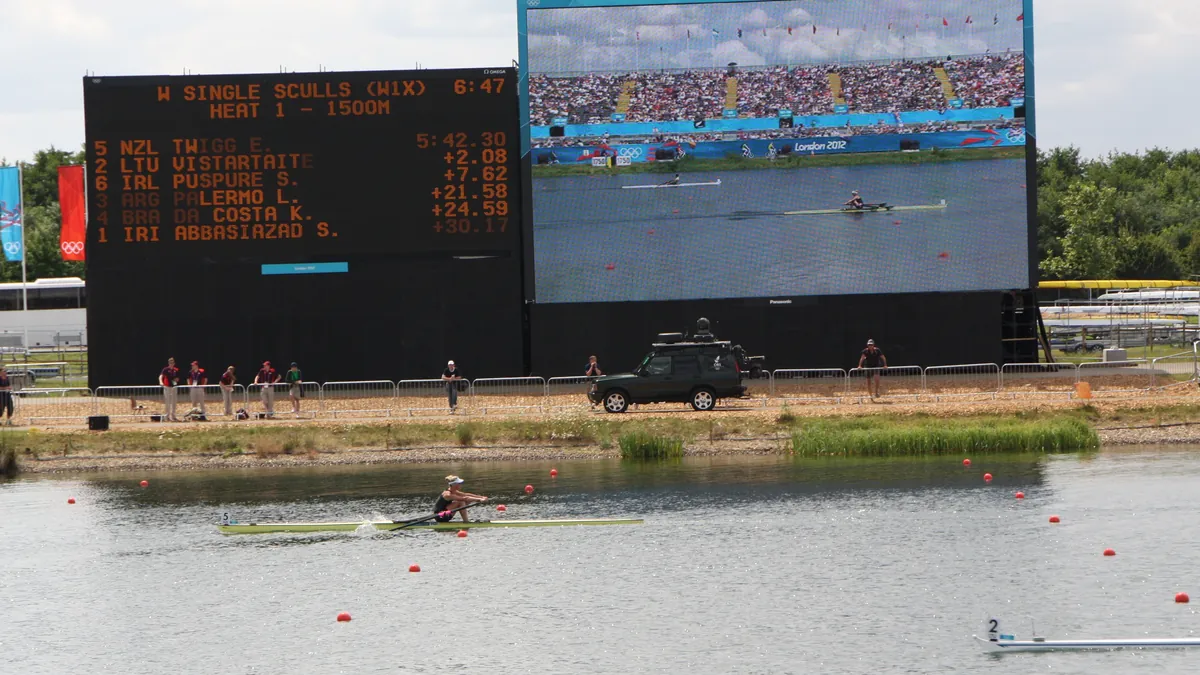
For the developing sculler or the cross-trained endurance athlete, the takeaway is that wattage in isolation is a vanity metric. The relevant value is per-stroke mechanical work multiplied by sustainable stroke rate, divided by the oxygen cost of producing it; raising any one component without the others raises a number that does not translate into boat speed at race distance [1, 3].
The training implication is that technical economy — catch timing, sequencing, blade work — is not separable from the aerobic conditioning. The aerobic-base block builds the ceiling; the strength block raises the per-stroke mechanical work the body can produce; the technical block lowers the oxygen cost of producing it [2, 3, 5]. Programmes that pursue one to the exclusion of the others typically plateau at a per-stroke wattage that does not respond to additional volume; the bottleneck has moved to the variable that was being neglected.
The diagnostic question for the developing sculler: at race-pace stroke rate over a 2000-metre piece, what is your per-stroke mechanical work — and is the oxygen cost of producing it consistent with a sustainable race-fraction of VO₂max, or is it consistent with a fade in the second half?
References
- Joyner MJ, Coyle EF. (2008). Endurance exercise performance: the physiology of champions. The Journal of Physiology, 586(1): 35–44. doi:10.1113/jphysiol.2007.143834
- Wisløff U, Castagna C, Helgerud J, Jones R, Hoff J. (2004). Strong correlation of maximal squat strength with sprint performance and vertical jump height in elite soccer players. British Journal of Sports Medicine, 38(3): 285–288. doi:10.1136/bjsm.2002.002071
- Saunders PU, Pyne DB, Telford RD, Hawley JA. (2004). Factors affecting running economy in trained distance runners. Sports Medicine, 34(7): 465–485. doi:10.2165/00007256-200434070-00005
- Faude O, Kindermann W, Meyer T. (2009). Lactate threshold concepts: how valid are they? Sports Medicine, 39(6): 469–490. doi:10.2165/00007256-200939060-00003
- Stølen T, Chamari K, Castagna C, Wisløff U. (2005). Physiology of soccer: an update. Sports Medicine, 35(6): 501–536. doi:10.2165/00007256-200535060-00004
Performance data (descriptive only): World Rowing.
The Athlete in One Paragraph
Oliver Zeidler (b. 1996-07-23, Dachau, Germany) is a rower for the German national programme and a multiple world champion in the men's single sculls, the most physiologically exposed event in the rowing programme — one rower, two oars, no crew to share the metabolic cost.…
The Physiology — what single-sculls power and economy actually are
The single scull is the rowing event in which the rower's individual physiology is most ruthlessly exposed; there is no synchronisation gain to harvest from a crew, no rhythm partner, no shared aerobic envelope. The Joyner and Coyle endurance framework — VO₂max, sustainable fraction, exercise…
The Case — Zeidler as the oversized-sculler archetype
For a 2.03 m, 95 kg single sculler, the arithmetic is unusual because the athlete is operating near the upper edge of what a single-scull boat is structurally designed for. The long levers convert into a long effective stroke, which raises per-stroke mechanical work at…
What This Means for the Reader
For the developing sculler or the cross-trained endurance athlete, the takeaway is that wattage in isolation is a vanity metric. The relevant value is per-stroke mechanical work multiplied by sustainable stroke rate, divided by the oxygen cost of producing it; raising any one component without…