Preview
Hüseyin Akbulut, MSc (2026). William Saliba and the Aerial Duel Mechanics of an Elite Centre-Back. Sporeus. Retrieved, September 22, 2026. https://sporeus.com/en/science/william-saliba-aerial-duel-mechanics/
The Athlete in One Paragraph
William Saliba (b. 2001-03-24, Bondy, France) is a centre-back for Arsenal and the France national team, listed at 1.92 m and ~86 kg. He is treated by analysts as a modern aerial reference for the position because of how rarely his duels look like brute-force contests; the take-off is timed against the flight of the ball rather than against the opponent, the contact is made at the apex rather than on the way up, and the recovery from the landing is fast enough to defend the second ball. The interesting case for sport science is not Saliba’s standing reach or his isolated vertical jump, but the mechanical and timing components of an aerial duel — a composite skill that is correlated with, but not reducible to, raw vertical jump height.
Table of Contents
The Physiology — what aerial duel mechanics actually involve
A jump in a defensive aerial duel is mechanically a counter-movement jump (CMJ) executed under three perturbations rarely modelled in the laboratory: a sub-optimal preparatory step, contact with another body, and a head-and-neck task at the apex. The classical CMJ depends on the stretch-shortening cycle (SSC), in which a rapid eccentric pre-stretch loads tendon and connective tissue elastically and the subsequent concentric phase reuses the stored energy [1]. The advantage of a CMJ over a squat jump (typically 2–4 cm of additional height) is the SSC contribution, and the magnitude of the advantage is sensitive to the speed and depth of the eccentric phase [1].
Wisløff and colleagues, working with elite Norwegian footballers, established that maximal half-squat strength was strongly correlated with both 30 m sprint time and vertical jump height — a foundational finding that links lower-limb maximal force to vertical impulse [2]. The interpretation is that the strength reservoir bounds the absolute jump height, while the SSC mechanics determine how much of that reservoir is actually expressed in the brief contact time available during a counter-movement.
For team-sport athletes, Markovic’s meta-analytical review of plyometric training showed that lower-extremity plyometric protocols produce small-to-moderate but consistent improvements in vertical jump performance, with the effect sizes mediated by the athlete’s training age, the SSC-specificity of the protocol, and the inclusion of a maximal-strength component [3]. Power and jump height are therefore two distinct but related variables, and the training prescription depends on which is the limiting factor for a given athlete.
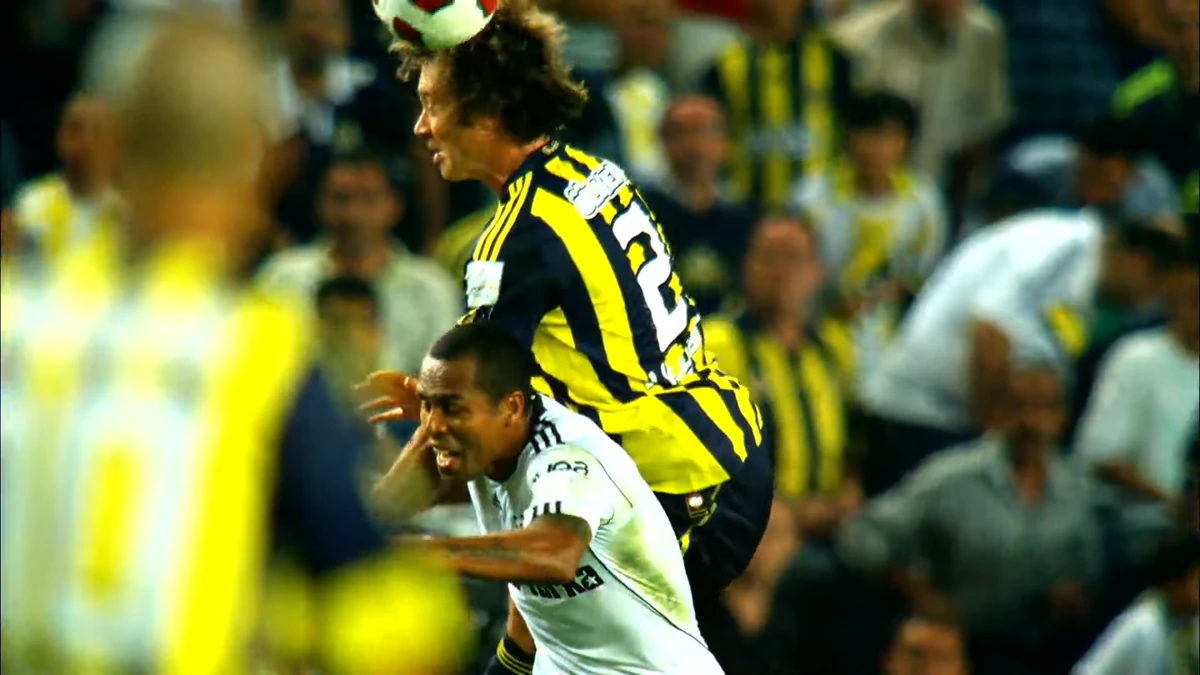
The match-context layer matters because the laboratory CMJ is not the duel. Stølen, Chamari, Castagna and Wisløff’s physiology-of-soccer review made clear that match demands are mediated by tactical context and contact dynamics that lab tests cannot fully reproduce [4]. The aerial duel adds a contact at the apex, which loads the cervical spine and shoulder girdle in a way that demands neck and trunk stiffness for both the contest itself and for safe landing — a mechanical requirement that has gained increased attention in the heading and head-impact literature [5].
The takeaway is that aerial duel performance is a layered skill: lower-limb strength sets the ceiling, SSC mechanics determine expression, plyometric and ballistic training shape the velocity component, and timing plus neck-trunk stiffness convert all of that into a successful contest.
The Case — Saliba as aerial-mechanics archetype
For a 1.92 m, 86 kg centre-back, Saliba’s anthropometric profile is at the upper-mid range of the modern position — tall enough to be a credible aerial threat but lean enough to express the strength he carries through a fast SSC. His take-off pattern reads as timing-led rather than reach-led; the run-in is short, the eccentric dip is shallow and fast, and the contact with the ball is made near the apex of the jump rather than on the upward acceleration phase. This is consistent with a high-quality SSC profile in which the elastic component is doing meaningful work [1].
The strength foundation matters because the upper limit of vertical impulse during a one-step CMJ is constrained by the eccentric force the lower limbs can absorb without collapse [2]. A defender with insufficient maximal strength can technically jump high in a controlled CMJ but is unable to maintain that height when the eccentric phase is shortened by an opponent’s pressure or by an awkward run-in. Saliba’s profile reads as a defender who keeps jump height under perturbation — a robustness property that maps onto the strength-jump correlation Wisløff documented [2].
The plyometric and ballistic training context is relevant because raw squat strength does not by itself produce the rapid switch from eccentric to concentric phases that a duel demands; Markovic’s review and the broader literature on neuro-musculoskeletal adaptations to plyometric training emphasise that SSC quality is itself trainable, and that the adaptations are partly distinct from those of heavy strength training [3]. An elite aerial defender therefore reads as the product of both strength and ballistic work, not either in isolation.
The neck-trunk stiffness layer is the one most easily missed. Aerial duels load the cervical spine at contact, and the head-impact literature has converged on neck strength as a modifiable variable that influences both the kinematics of the head impact and the reported symptom burden after repeated heading [5]. A defender whose neck is stiff and whose trunk is set before contact transmits less of the impact into uncontrolled head acceleration; the same stiffness also stabilises the head as a platform for the ball-strike, which improves clearance accuracy.
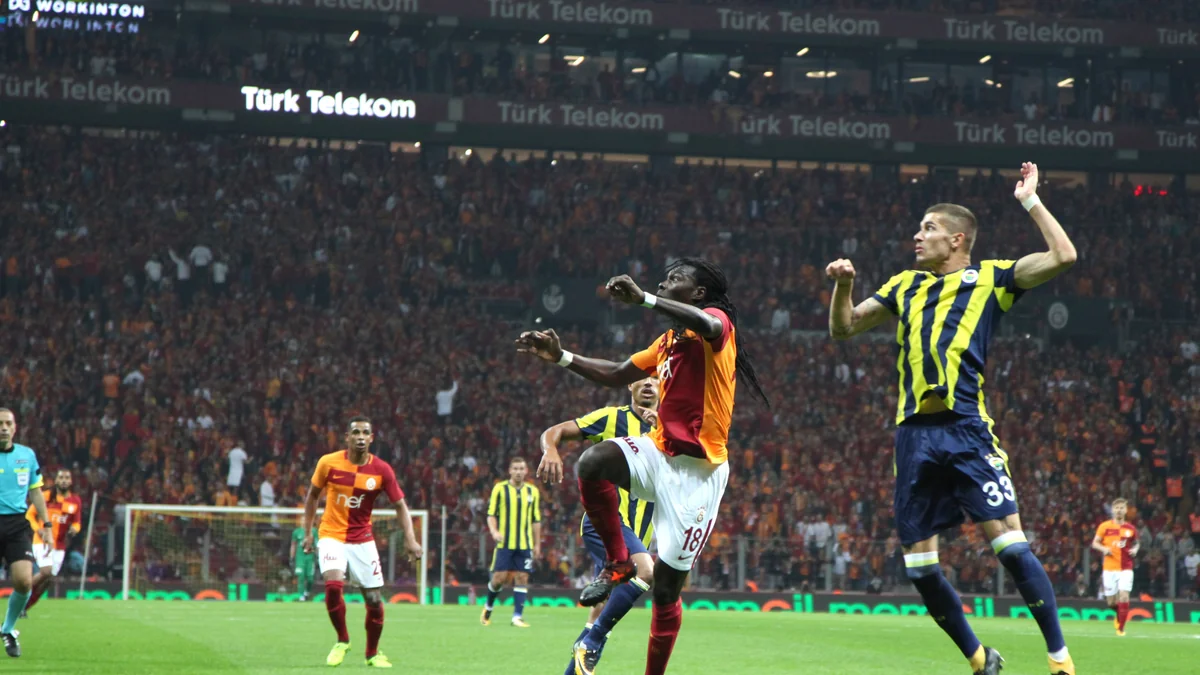
(Match data: SofaScore.) Reporting on Saliba across recent Premier League and European campaigns places his aerial-duel win rate in the upper centre-back band, with clearance and interception volumes consistent with a defender whose contact point is high and whose recovery from the landing is quick enough to engage the second ball.
What This Means for the Reader
For amateur and developing defenders — and for any field-sport athlete whose role demands repeated jumps under contact — the takeaway is that the duel is not won by the highest CMJ on a force plate. It is won by the jump that survives the perturbations of a real contest: a rushed run-in, an opponent’s body, a head that must remain stable through contact. The conditioning prescription is layered: a maximal-strength base sufficient to bound the eccentric absorption capacity [2]; a ballistic and plyometric layer that trains SSC quality and rate of force development [1, 3]; and a neck-and-trunk programme that protects the head and stabilises the contact [5].
A practical self-assessment uses three measurements rather than one: a CMJ height, a CMJ-to-squat-jump ratio (a proxy for SSC contribution), and a contested-jump version of the same test in which the run-in is restricted or a partner provides controlled contact. Athletes whose CMJ is high but whose contested-jump drops sharply are robustness-limited and benefit from contact-tolerant training; athletes whose CMJ itself is the ceiling benefit from strength and ballistic work [3, 4].
The diagnostic question for the developing defender is not “how high do I jump?” but “how high do I jump when somebody is in my way?” The answer determines training emphasis.
References
- Komi PV. (2000). Stretch-shortening cycle: a powerful model to study normal and fatigued muscle. J Biomech, 33(10): 1197–1206. doi:10.1016/s0021-9290(00)00064-6
- Wisløff U, Castagna C, Helgerud J, Jones R, Hoff J. (2004). Strong correlation of maximal squat strength with sprint performance and vertical jump height in elite soccer players. British Journal of Sports Medicine, 38(3): 285–288. doi:10.1136/bjsm.2002.002071
- Markovic G. (2007). Does plyometric training improve vertical jump height? A meta-analytical review. British Journal of Sports Medicine, 41(6): 349–355. doi:10.1136/bjsm.2007.035113
- Stølen T, Chamari K, Castagna C, Wisløff U. (2005). Physiology of soccer: an update. Sports Medicine, 35(6): 501–536. doi:10.2165/00007256-200535060-00004
- Lipton ML, Kim N, Zimmerman ME, Kim M, Stewart WF, Branch CA, Lipton RB. (2013). Soccer heading is associated with white matter microstructural and cognitive abnormalities. Radiology, 268(3): 850–857. doi:10.1148/radiol.13130545
Match-context data (descriptive only): SofaScore.
The Athlete in One Paragraph
William Saliba (b. 2001-03-24, Bondy, France) is a centre-back for Arsenal and the France national team, listed at 1.92 m and ~86 kg. He is treated by analysts as a modern aerial reference for the position because of how rarely his duels look like brute-force…
The Physiology — what aerial duel mechanics actually involve
A jump in a defensive aerial duel is mechanically a counter-movement jump (CMJ) executed under three perturbations rarely modelled in the laboratory: a sub-optimal preparatory step, contact with another body, and a head-and-neck task at the apex. The classical CMJ depends on the stretch-shortening cycle…
The Case — Saliba as aerial-mechanics archetype
For a 1.92 m, 86 kg centre-back, Saliba's anthropometric profile is at the upper-mid range of the modern position — tall enough to be a credible aerial threat but lean enough to express the strength he carries through a fast SSC. His take-off pattern reads…
What This Means for the Reader
For amateur and developing defenders — and for any field-sport athlete whose role demands repeated jumps under contact — the takeaway is that the duel is not won by the highest CMJ on a force plate. It is won by the jump that survives the…