Preview
Hüseyin Akbulut, MSc (2026). Mert Gunok and the Late-Career Reaction Time of an Elite Goalkeeper. Sporeus. Retrieved, September 22, 2026. https://sporeus.com/en/science/mert-gunok-late-career-reaction-time/
The Athlete in One Paragraph
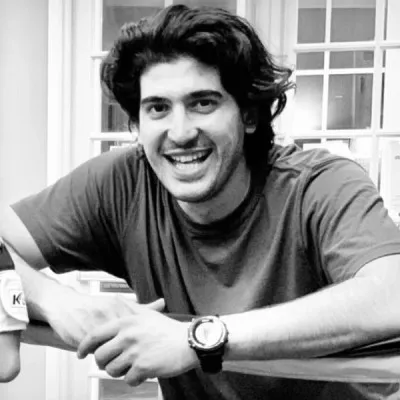
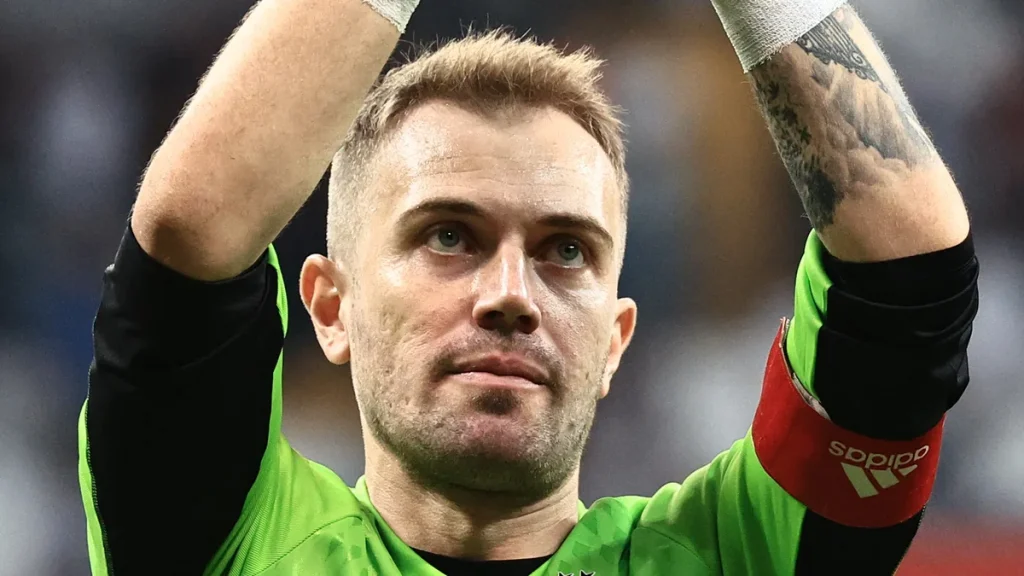
Mert Günok (b. 1989-03-01, Karamürsel, Türkiye) is the goalkeeper for Beşiktaş and the Türkiye national team. Listed at 1.96 m and ~86 kg, he is one of the tallest first-choice goalkeepers in European football, and at the time of writing he is operating at international level into his mid-30s — a career stage at which most positional peers have already declined past first-choice eligibility. The interesting question for sport science is not whether he is faster than the goalkeepers a decade younger — he is not, and any honest analysis says so — but how the components of his reaction time have aged differentially, and which ones a 35-year-old goalkeeper can still train against the slow downward drift of the simple-reaction baseline. The variable underneath that pattern is late-career reaction time — the maintained decision-and-response window that converts perceptual cue into a save commitment in athletes operating beyond the typical age-of-peak for the position.
Table of Contents
The Physiology — what late-career reaction time actually measures
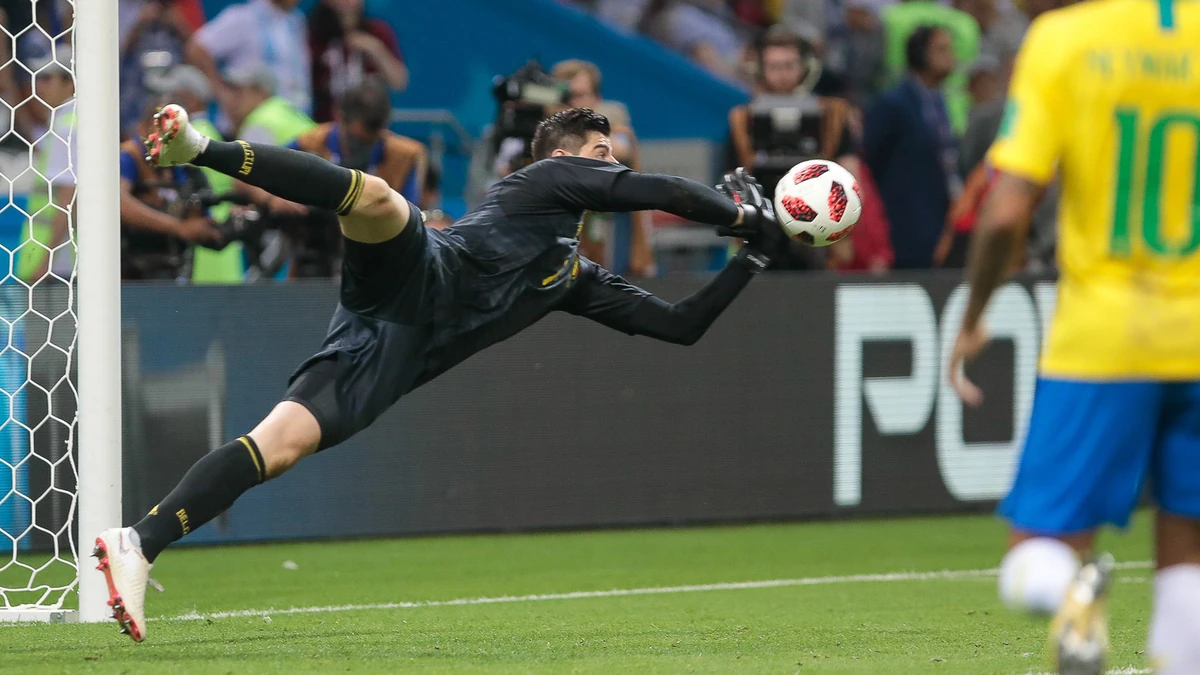
Reaction time is not a single quantity. It is decomposed into a perceptual phase (cue extraction, anticipatory pattern recognition), a decision phase (selection between competing motor programmes), a pre-motor phase (efferent-command lag), and a motor phase (foot-plant load, dive initiation). Each phase has its own age-trajectory and its own training response. The total budget between shot release and the goalkeeper’s hand reaching the ball-line on a close-range strike sits in the range of 300–500 ms — barely longer than the simple visual reaction time of an untrained adult — so any phase that lengthens with age has to be compensated by another phase that shortens, or the system arrives late.
Henry, Dawson, Lay and Young anchored the decision-cost dimension. Their reactive-agility data showed that under cue-coupled conditions, the correctness of the directional choice — not just the speed of response — discriminates higher performers, and that decision latency is itself a trainable variable that responds to perceptual exposure rather than to additional running [1]. For an aging goalkeeper, this is the operative finding: the simple-reaction baseline drifts slowly downward across a career, but the decision-cost component — the share of the total response attributable to which movement is selected, not just how fast a given movement starts — remains responsive to perceptual training well into the late career.
Sheppard, Young, Doyle, Sheppard and Newton’s reactive-agility test work refined the picture. Their data showed that reactive (cue-coupled) and closed-skill (pre-planned) speed are dissociable qualities that respond differently to training, with the reactive component being more strongly determined by perceptual rather than locomotor capacity [2]. The implication for the late-career goalkeeper is direct: the locomotor side of the response may decline gently with age, but the perceptual side — the part that lets a shorter, earlier commitment substitute for a slower, later launch — does not necessarily decline at the same rate.
Young and Farrow’s practical synthesis closed the training-side loop. Their argument that agility is best developed by exposure to representative cue-coupled demands — live shooters, video stimuli, scenario drills with unpredictable timing — rather than by closed-skill repetition implies that the most defensible training emphasis for an aging goalkeeper is the perceptual layer, because that is the layer where compensation is still gettable [3]. Closed-skill cone work in a 35-year-old goalkeeper preserves a quality that was already adequate; it does not buy back the response window that the simple-reaction baseline has surrendered.
Paul, Gabbett and Nassis synthesised the perceptual-cognitive and physical sides into a unified agility construct. Elite agility, they argued, is the product of perceptual-cognitive expertise (anticipatory cue use, pattern recognition, scan frequency) and physical capability (acceleration, deceleration, foot-plant strength), with the perceptual side dominating in the most time-pressured situations [4]. For a goalkeeper past 30, the relative importance of the perceptual layer is even greater than for a 25-year-old, because the perceptual layer compensates for the gentle decline of the physical layer.
Stølen, Chamari, Castagna and Wisløff’s physiology-of-soccer review provides the supporting metabolic context. Goalkeepers cover less total distance than outfield players but produce a meaningful share of high-intensity output in short, irregular bursts, and the goalkeeper who maintains higher fractional aerobic recovery between bursts is the one who stays sharp into the 80th minute — a quality that, like the perceptual layer, is trainable into the late career rather than fixed by chronological age [5]. Late-career reaction time is, in this framing, an outcome variable supported by both perceptual training and aerobic recovery rather than an immutable trait.
The Case — Günok as late-career perceptual prototype
For a 1.96 m / 86 kg goalkeeper still operating at international level into his mid-30s, the case for late-career reaction time as the defining variable is structural. The simple-reaction baseline declines gently with age across most adult populations, but the decision-cost and anticipatory-cue components — the components that compress the effective response window by triggering the foot-plant earlier — are responsive to deliberate perceptual training and remain trainable well past 30 [1, 2]. A goalkeeper who has spent a career building those layers is, in effect, depositing into a reserve that the body can draw on as the locomotor reserve thins.
The training-side implication is that the goalkeepers who stay sharp into their 30s are disproportionately the ones whose practice diet has emphasised the perceptual layer all along — film, scenario drills, live representative pressure — rather than the ones who relied on raw foot-speed compensation [3, 4]. Closed-skill drilling preserves a quality that was already adequate; it does not buy back the response window that the simple-reaction baseline has slowly surrendered. The case for the late-career goalkeeper is, therefore, the case for perceptual training emphasis as the gettable compensation.
The metabolic envelope completes the picture. A goalkeeper who maintains the recovery profile that lets the 80th-minute reaction be as sharp as the 30th-minute reaction is a goalkeeper whose aerobic substrate has been kept conditioned across the late career rather than allowed to drift with the natural decline curve [5]. Late-career reaction time is, in this framing, supported on two trainable layers — perceptual and aerobic — that are in the goalkeeper’s hands well past the point at which the simple-reaction baseline starts to fall.
Match-context note: Günok had a famous reaction save against Austria at Euro 2024 that became the descriptive talking point of the tournament for Türkiye (Match data: SofaScore); the save is a useful illustration of the late-career goalkeeper’s continued operating ceiling but should not be read as proof of the underlying mechanism, which is supported by the cited literature rather than by any single match event.
The integration is structural. Paul, Gabbett and Nassis’s argument that elite agility is the product of perceptual and physical capability rather than the sum implies that the late-career goalkeeper who maintains both layers operates at a higher ceiling than the one who maintains only one [4]. The goalkeeper who has kept the perceptual layer sharp and the aerobic recovery layer trained is, by the structure of the agility construct, the one whose reaction window is not yet compressed by age.
What This Means for the Reader
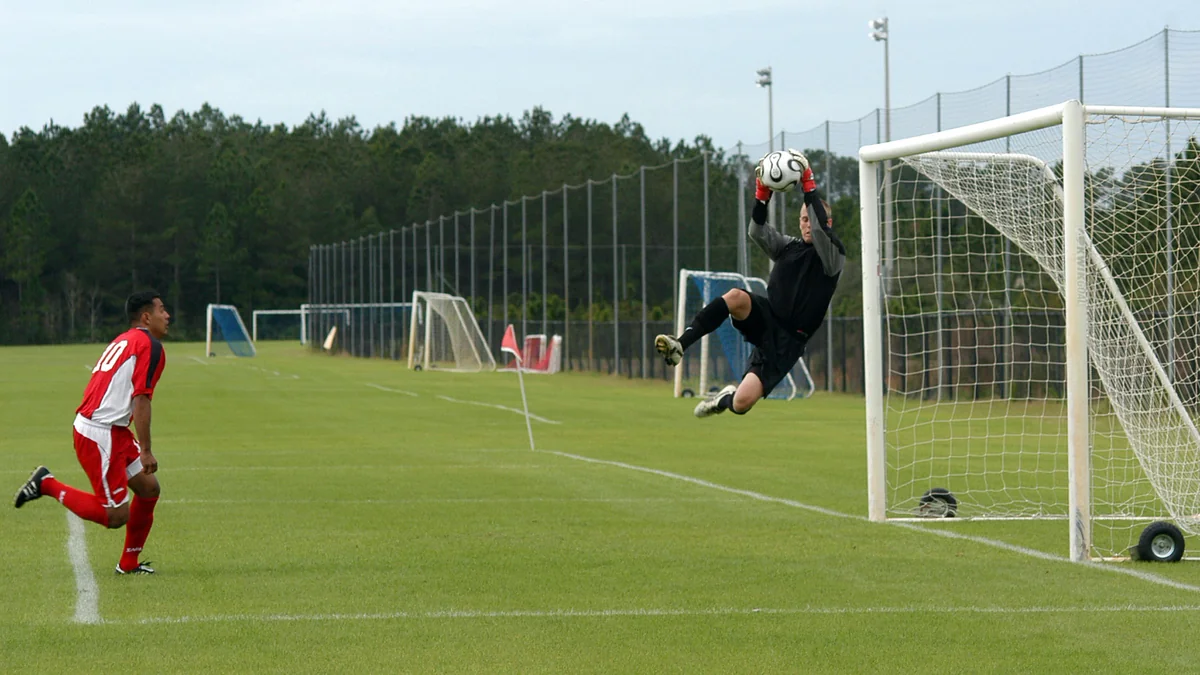
For an aging goalkeeper or a coach managing one, the takeaway is that reaction time at 35 is not a single trait but a system of differentially-trainable components, and the components that age the slowest — perceptual cue use, decision correctness, anticipatory pattern recognition — are also the ones that compensate the most for the components that age the fastest. Three measurements diagnose the limiting variable: a video-based reactive-agility test for cue-coupled latency and decision correctness, a closed-skill change-of-direction test as a baseline for locomotor speed without decision load, and a repeated-effort protocol for the recovery between actions that lets the late-match reaction stay as sharp as the early-match one [1, 2, 5].
The training prescription targets the diagnostic finding: athletes with adequate locomotor speed but slow reactive-agility times need open-skill perceptual exposures rather than more cone drills; athletes with slow recovery need aerobic and repeated-effort work alongside perceptual exposure; athletes with deficits in both need both, with perceptual work prioritised because it ceilings the competitive expression of the rest [3, 4]. The single diagnostic question for the developing or aging goalkeeper: when a shot beats me, did my legs arrive late, did my decision arrive late, or did my recovery between actions leave me half a step behind the moment?
References
- Henry GJ, Dawson B, Lay BS, Young WB. (2013). Decision-making accuracy in reactive agility: quantifying the cost of poor decisions. Journal of Strength and Conditioning Research, 27(11): 3190–3196. doi:10.1519/JSC.0b013e31828b8da4
- Sheppard JM, Young WB, Doyle TLA, Sheppard TA, Newton RU. (2006). An evaluation of a new test of reactive agility and its relationship to sprint speed and change of direction speed. Journal of Science and Medicine in Sport, 9(4): 342–349. doi:10.1016/j.jsams.2006.05.019
- Young WB, Farrow D. (2006). A review of agility: practical applications for strength and conditioning. Strength and Conditioning Journal, 28(5): 24–29. doi:10.1519/00126548-200610000-00004
- Paul DJ, Gabbett TJ, Nassis GP. (2016). Agility in team sports: testing, training and factors affecting performance. Sports Medicine, 46(3): 421–442. doi:10.1007/s40279-015-0428-2
- Stølen T, Chamari K, Castagna C, Wisløff U. (2005). Physiology of soccer: an update. Sports Medicine, 35(6): 501–536. doi:10.2165/00007256-200535060-00004
Match-context data (descriptive only): SofaScore.
The Athlete in One Paragraph
Mert Günok (b. 1989-03-01, Karamürsel, Türkiye) is the goalkeeper for Beşiktaş and the Türkiye national team. Listed at 1.96 m and ~86 kg, he is one of the tallest first-choice goalkeepers in European football, and at the time of writing he is operating at international…
The Physiology — what late-career reaction time actually measures
Reaction time is not a single quantity. It is decomposed into a perceptual phase (cue extraction, anticipatory pattern recognition), a decision phase (selection between competing motor programmes), a pre-motor phase (efferent-command lag), and a motor phase (foot-plant load, dive initiation). Each phase has its own…
The Case — Günok as late-career perceptual prototype
For a 1.96 m / 86 kg goalkeeper still operating at international level into his mid-30s, the case for late-career reaction time as the defining variable is structural. The simple-reaction baseline declines gently with age across most adult populations, but the decision-cost and anticipatory-cue components…
What This Means for the Reader
For an aging goalkeeper or a coach managing one, the takeaway is that reaction time at 35 is not a single trait but a system of differentially-trainable components, and the components that age the slowest — perceptual cue use, decision correctness, anticipatory pattern recognition —…