Preview
Hüseyin Akbulut, MSc (2026). Naim Süleymanoğlu and the Weightlifting Relative-Strength Record of an Elite 60 kg Champion. Sporeus. Retrieved, September 16, 2026. https://sporeus.com/en/science/naim-suleymanoglu-weightlifting-relative-strength-record/
The Athlete in One Paragraph
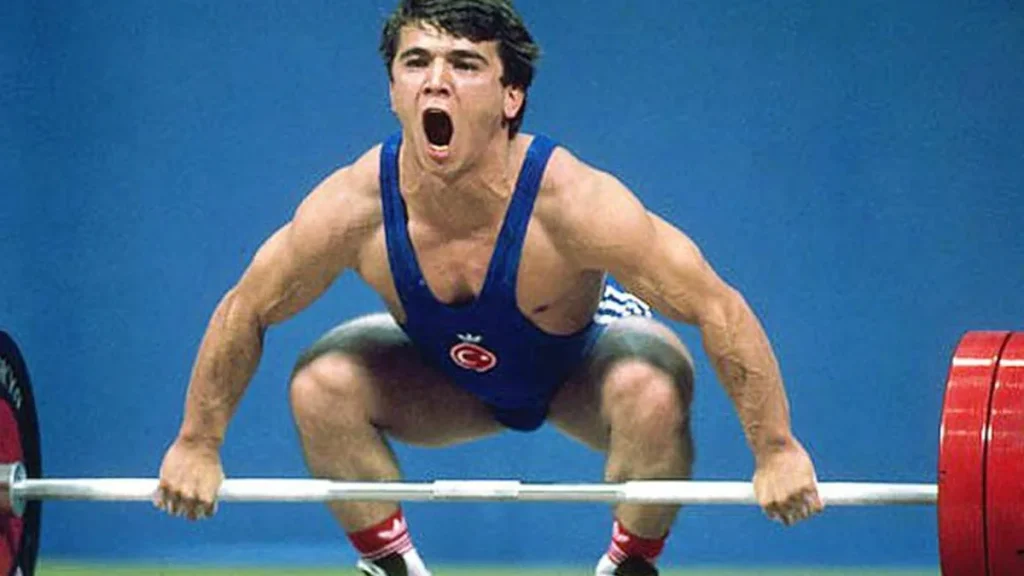
Naim Süleymanoğlu (b. 1967-01-23, Pticharska, Bulgaria — d. 2017-11-18, Istanbul, Türkiye) was a featherweight weightlifter who competed for Türkiye after his defection in 1986 and won three consecutive Olympic gold medals (Seoul 1988, Barcelona 1992, Atlanta 1996), earning him the enduring nickname “Pocket Hercules”. Listed at 1.47 m and 60 kg in competition, he produced clean-and-jerks at and around 190 kg — over three times his bodyweight — and snatches in the 150 kg range, numbers that defined the upper bound of human relative-strength performance for his era. He was not the largest lifter in any room he entered, not the longest-levered, not the heaviest in absolute terms; what distinguished him was the ratio between the weight on the bar and the weight on the platform — the relative-strength signature that, decades after his retirement and years after his death in 2017, remains the reference case for what a small-bodied, technically exceptional, neurologically gifted lifter can accomplish. The interesting case for sport science is the variable that lies underneath that signature: weightlifting relative-strength record, the upper bound of how much external load can be moved per kilogram of bodyweight in a maximally-coordinated full-body action.
Table of Contents
The Physiology — what relative strength actually depends on
Relative strength — the ratio of external load lifted to the lifter’s own bodyweight — is not a single physiological variable but the product of three interacting systems: the muscle’s force-producing machinery, the nervous system’s ability to recruit and synchronise that machinery at speed, and the technical-coordinative pattern that delivers the force to the bar with minimal mechanical waste [1, 2, 3]. The relative-strength outliers of the sport are not the athletes with extraordinary single-system advantages, but the ones whose three systems align with each other to a degree the rest of the population does not match.
Wisløff and colleagues established, in the team-sport literature, that maximal-strength expression correlates strongly with explosive output — vertical jump, sprint acceleration — across athletic populations [1]. The principle generalises: maximal force production, expressed at speed, is the substrate of nearly every powerful athletic action, and the lifter who can produce force at speed against a 3× bodyweight load is operating at the human upper bound of that substrate.
Cormie, McGuigan and Newton’s review of maximal neuromuscular power frames the velocity dimension explicitly: power is the product of force and velocity, and at the heaviest loads the velocity component is small but non-zero — the lifter who produces force quickly against a near-maximal load wins the lift, and the lifter who produces force slowly fails it [2]. The neural-drive component of relative-strength performance is therefore not a soft factor; it is a measurable contributor to the outcome.
Komi’s stretch-shortening cycle framework adds the elastic-energy component. The clean-and-jerk and snatch involve rapid eccentric-concentric transitions — the catch, the dip, the drive — in which stored elastic energy in tendons and the muscle-tendon unit contributes to concentric output [3]. A lifter whose connective tissue is well-conditioned to fast eccentric-to-concentric transitions extracts more useful force from the same muscle contraction than a lifter who relies on concentric-only mechanics.
Suchomel, Nimphius and Stone’s review reinforces the integrative claim: muscular strength is the foundation of nearly every athletic performance variable, and its development requires sustained heavy loading across years, not seasons [4]. The relative-strength outlier is, almost by definition, the athlete who has accumulated more high-quality heavy-lifting volume across a development pathway that protected technique while raising the load. Stølen, Chamari, Castagna and Wisløff’s broader framing of athletic physiology adds the system-level reminder that elite performance is the integration of multiple subsystems rather than the maximisation of any one [5].
The Case — Süleymanoğlu as the relative-strength reference
For a 1.47 m / 60 kg lifter producing clean-and-jerks at and around 190 kg, the technical and physiological story is one of three systems aligned to a degree that defined an era. The fibre-composition contribution is unmeasurable from the outside, but the published lift values and the technical signature on film are consistent with an athlete carrying an unusually high proportion of fast-twitch motor units recruited under exquisite neural control [1, 2]. The fibre-composition floor is what lets the bar accelerate at all under near-maximal load; the neural-drive ceiling is what lets that acceleration be timed precisely enough to produce the catch.
The technical-coordinative dimension is where the legacy is most visible. Süleymanoğlu’s lifts on film show the textbook proximal-to-distal sequencing — drive from the floor with full hip-knee-ankle extension, transition into the second pull with a precisely-timed shrug, drop under the bar at the last possible moment to receive the load with the smallest possible bar-displacement — executed at body-weight ratios that compress every error into a missed lift [3, 4]. The technique is not separable from the physiology; it is the physiology, expressed.
The career-length dimension is also relevant to the legacy framing. Three Olympic cycles at the top of a sport is not a function of single-session peak ability; it is a function of training years that protected the athlete’s tissue against the cumulative load of competition lifts, that maintained the strength-power floor across the calendar, and that adapted the programme as the athlete matured [4, 5]. The reference case for relative-strength performance is therefore not a single 190 kg clean-and-jerk in 1988 but the sustained capacity to perform at that level across nearly a decade.
The legacy case extends past performance into reference. The 3× bodyweight clean-and-jerk that Süleymanoğlu repeatedly executed at the highest level remains the operational anchor for what a 60 kg human can do in this lift; coaches and sport scientists who train light-bodyweight lifters reference that ceiling implicitly when they design programmes, and the sport itself uses his career as the touchstone of what relative-strength weightlifting looks like at its outer bound. He died on 18 November 2017, but the data points his career produced continue to define the upper edge of the human relative-strength envelope.
Match-context note: across his three Olympic gold medals and multiple world records at the bantamweight and featherweight categories, Süleymanoğlu’s competitive output sat at the historical upper bound for the 60 kg division (Performance data: IWF). The relative-strength signature he produced has been approached but not unambiguously exceeded by featherweight lifters of subsequent generations.
What This Means for the Reader
For a developing strength athlete, the lesson is that relative-strength outliers are made by the alignment of three systems, not by maxing one. Three diagnostics tell the story: a heavy reference lift relative to bodyweight (back squat, front squat, or competition lift), a measure of force-application rate under near-maximal load (bar-velocity at moderate-heavy loads), and a movement-quality screen for the eccentric-to-concentric transitions on which Olympic lifts depend [1, 2, 3].
The training prescription depends on the gap. Force-floor-limited athletes need years of well-programmed heavy work, not a peaking phase; rate-of-force-development-limited athletes need explicit ballistic and high-velocity contrast work alongside the heavy stimulus; transition-quality-limited athletes need plyometric and Olympic-lift technical work that conditions the stretch-shortening cycle directly [3, 4]. The three legs reinforce each other; collapsing one leaves the other two exposed.
The diagnostic question for the developing relative-strength athlete: when I miss at near-maximal load, am I missing because of force, because of force at speed, or because of the eccentric-to-concentric transition? The answer determines training emphasis — and the legacy of Pocket Hercules is the reminder that, when the three legs do align, the upper bound is further out than most lifters dare to imagine.
References
- Wisløff U, Castagna C, Helgerud J, Jones R, Hoff J. (2004). Strong correlation of maximal squat strength with sprint performance and vertical jump height in elite soccer players. British Journal of Sports Medicine, 38(3): 285–288. doi:10.1136/bjsm.2002.002071
- Cormie P, McGuigan MR, Newton RU. (2011). Developing maximal neuromuscular power: Part 1 — biological basis of maximal power production. Sports Medicine, 41(1): 17–38. doi:10.2165/11537690-000000000-00000
- Komi PV. (2000). Stretch-shortening cycle: a powerful model to study normal and fatigued muscle. Journal of Biomechanics, 33(10): 1197–1206. doi:10.1016/s0021-9290(00)00064-6
- Suchomel TJ, Nimphius S, Stone MH. (2016). The importance of muscular strength in athletic performance. Sports Medicine, 46(10): 1419–1449. doi:10.1007/s40279-016-0486-0
- Stølen T, Chamari K, Castagna C, Wisløff U. (2005). Physiology of soccer: an update. Sports Medicine, 35(6): 501–536. doi:10.2165/00007256-200535060-00004
Match-context data (descriptive only): IWF.
The Athlete in One Paragraph
Naim Süleymanoğlu (b. 1967-01-23, Pticharska, Bulgaria — d. 2017-11-18, Istanbul, Türkiye) was a featherweight weightlifter who competed for Türkiye after his defection in 1986 and won three consecutive Olympic gold medals (Seoul 1988, Barcelona 1992, Atlanta 1996), earning him the enduring nickname "Pocket Hercules". Listed…
The Physiology — what relative strength actually depends on
Relative strength — the ratio of external load lifted to the lifter's own bodyweight — is not a single physiological variable but the product of three interacting systems: the muscle's force-producing machinery, the nervous system's ability to recruit and synchronise that machinery at speed, and…
The Case — Süleymanoğlu as the relative-strength reference
For a 1.47 m / 60 kg lifter producing clean-and-jerks at and around 190 kg, the technical and physiological story is one of three systems aligned to a degree that defined an era. The fibre-composition contribution is unmeasurable from the outside, but the published lift…
What This Means for the Reader
For a developing strength athlete, the lesson is that relative-strength outliers are made by the alignment of three systems, not by maxing one. Three diagnostics tell the story: a heavy reference lift relative to bodyweight (back squat, front squat, or competition lift), a measure of…