Preview
Emre Köse (2026). Shoulder Injuries in Tennis: Rotator Cuff and Labrum. Sporeus. Retrieved, October 8, 2026. https://sporeus.com/en/tennis/shoulder-injuries-rotator-cuff-labrum-tennis/
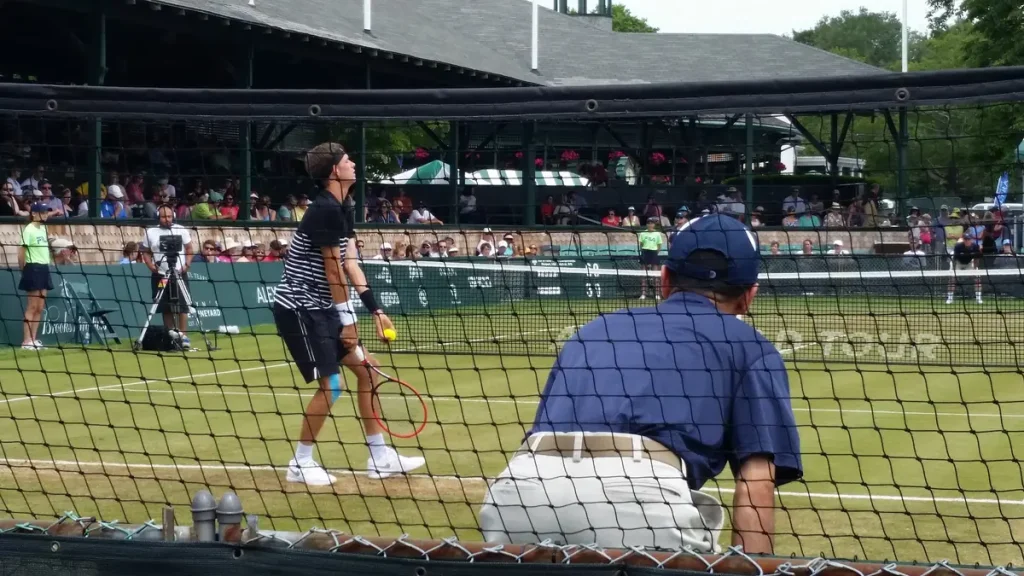
The tennis shoulder is engineered for one thing: throwing. The kinematic chain that lets a serve leave the racquet at 200 km/h is essentially the same chain that lets a baseball pitcher hit 95 mph. Both systems pay the same price. The shoulder is the most chronically vulnerable joint in any throwing sport, and tennis is no exception. Rotator cuff and labral pathology together account for the majority of serious adult tennis shoulder presentations I see, and most of them are preventable, manageable, or both. What is not preventable is treating the shoulder as if it heals like a knee.
Table of Contents
What the shoulder is doing on a serve
During the late cocking and acceleration phases of a serve, the shoulder is in maximum external rotation — typically 165 to 175 degrees in elite servers, which is past the limit a static stretch could safely reach. Angular velocity at the joint hits 1500 to 2500 degrees per second through the acceleration phase (Elliott, 2006). The deceleration phase, where the arm has to slow this motion after ball contact, generates the highest eccentric loads on the rotator cuff of any motion in sport. Each serve is, in mechanical terms, a controlled near-miss.
The cuff — supraspinatus, infraspinatus, teres minor, subscapularis — is not the prime mover during the serve. The prime mover is the kinetic chain delivered through the latissimus, pectoralis, and the rotational core. The cuff’s job is to keep the humeral head centered in the glenoid while all of this is happening. The labrum, a fibrocartilaginous ring deepening the glenoid, helps stabilize against the translational forces the cuff cannot fully control. When either fails, you do not lose serve speed first. You lose the ability to decelerate cleanly.
Rotator cuff: the slow failure
Most rotator cuff problems in adult players are not acute tears. They are tendinopathies — degenerative microtrauma that accumulates over months or years. The supraspinatus is the most common site because of its anatomical position: it passes under the acromion and is squeezed during overhead motion. Decades of squeezing produces a tendon that looks, on ultrasound, more like frayed rope than smooth cable.
The classic warning signs in tennis players, in the order they typically appear: dull ache after long practice sessions that goes away with rest; pain reproducible at the top of the serve motion; difficulty sleeping on the affected side; loss of serve speed without a clear technical reason. The mistake adults make is treating the first two symptoms as “normal soreness from training hard” and continuing to load the tendon. The mistake coaches make is failing to ask about sleep position — that single question is one of the best clinical indicators of true cuff pathology.
The research on conservative management of rotator cuff tendinopathy is now relatively settled. The current best-evidence intervention is heavy slow eccentric loading of the cuff and surrounding scapular musculature, not rest (Littlewood et al., 2013). Rest deconditions the tendon. Properly progressed loading remodels it. A player who is told to “take three weeks off” without a loading protocol typically returns with the same tendon and now also a deconditioned shoulder.
The labrum: the acute failure mode
Labral injuries — particularly the SLAP lesion, where the superior labrum and biceps anchor tear away from the glenoid — are different. They are more often acute or sub-acute, and the typical mechanism is the deceleration phase of a heavy serve, where the biceps tendon pulls the labrum off its attachment. Players describe a “click” or “pop” during the serve, sometimes painful, sometimes not, often followed by a deep ache and a sense of “looseness” in the shoulder.
SLAP lesions are harder to manage conservatively than cuff tendinopathy. Mild ones — Type I or partial Type II — can be rehabilitated to full play in roughly twelve to sixteen weeks of progressive loading. Full Type II and above generally need surgical repair before serious tennis is possible again. Diagnosis requires MRI with contrast (MRA), not standard MRI, because the labrum does not image well without arthrographic dye. A player presenting with deep posterior shoulder pain, mechanical symptoms during serve, and a normal-looking standard MRI is a common pattern that resolves only when the right scan is finally ordered.
The honest coaching reality here is that I cannot diagnose a SLAP lesion. Neither can the player. The pattern recognition is what gets a player into the orthopedic appointment that produces a diagnosis. The cost of missing one is a serve that gets progressively worse and a shoulder that compensates badly until the cuff also fails.
The prevention work that actually works
Most “shoulder care” routines I see adult players doing are wrong. Resistance band external rotations done with the elbow flapping around at the side of the body do not load the cuff in the position where it actually fails. The cuff fails at end range, in the late cocking position, under high eccentric load. Prevention work has to look more like that.
The protocol I run with the adult competitive players I coach has three components, done twice a week, twenty minutes total:
- Scapular control work: Push-up plus, prone Y-T-W raises, wall slides. The scapula is the platform the cuff works on. A scapula that does not stabilize forces the cuff to do its job badly.
- Cuff loading in serve-relevant positions: Side-lying external rotation with a dumbbell (not a band) at 90 degrees of shoulder abduction. Eccentric emphasis — slow lowering. Progressive load over months. This is the part most amateurs do wrong because they use bands and stay in low-load comfortable positions.
- Posterior capsule mobility: Sleeper stretch, cross-body adduction, ninety-ninety stretches. Most adult servers develop posterior capsule tightness — the back of the shoulder gets stiff from years of decelerating. Loss of internal rotation correlates with cuff injury risk (Wilk et al., 2011). Restoring it is preventive.
What I do not include: overhead press as cuff work; isolated supraspinatus dumbbell flies above 90 degrees (“empty cans”); stretching that goes into deep flexion or extreme external rotation without warm-up. The “empty can” exercise has shown up in textbooks for decades. The current evidence suggests it provokes impingement in the population it is most often prescribed to, and there are better cuff loaders available.
Return to play after a shoulder problem
The transition back from any shoulder issue — tendinopathy or labrum — follows the same logic. Restore mobility. Restore strength. Restore controlled load. Restore stroke-specific motion. Restore serve. The mistake adults make is collapsing these into “rest, then go back to playing.” That sequence virtually guarantees recurrence.
A workable adult timeline after symptomatic cuff tendinopathy looks like four weeks of pain reduction with isometric and light eccentric work, four weeks of heavier eccentric loading and scapular work, two weeks of overhead range under controlled load including light medicine ball throwing, then progressive return to serve at increasing intensities — fifty percent, seventy percent, eighty-five percent, full — over three to four weeks. So twelve to fourteen weeks total, conservatively. Players who attempt to come back in six are the same players I see again in three months.
For post-surgical SLAP repair, the timeline is longer and protocol-driven. The orthopedic surgeon and the physiotherapist run that protocol. The coach’s job is to enforce it — most adults will try to cheat the schedule. Do not let them.
When to send the player to imaging
The coach is not the diagnostician, but the coach decides whether the player goes to one. My threshold: any of these in combination should produce a referral, not a wait-and-see — pain at night that disturbs sleep on the affected side; serve speed loss of more than ten percent without a clear technical cause; a “click” or mechanical symptom during the serve; reduced internal rotation range measured against the contralateral shoulder by more than twenty degrees. Any two of these means imaging. All four, immediate referral.
One thing to do on court tomorrow
Test your own internal rotation. Lie face down with your shoulder at ninety degrees abduction, elbow bent ninety degrees, forearm hanging down toward the floor. Compare both sides. If your serving arm cannot drop within twenty degrees of vertical when the non-serving arm can, you have lost posterior capsule mobility. Start the sleeper stretch three times a day, fifteen seconds, against the affected side. Do it for four weeks before your next serving session and check again. You may not feel the change. The shoulder will know.
Related in this series: A Warm-up That Actually Works · Tennis Elbow: Mechanism, Prevention, Return to Play · Lower Back Pain in Tennis · The Serve Is Tennis’s Only Fully Closed Skill
Selected reading:
- Elliott, B. (2006). Biomechanics and tennis. British Journal of Sports Medicine, 40(5), 392–396.
- Littlewood, C., et al. (2013). The effectiveness of therapeutic exercise for rotator cuff tendinopathy: A systematic review. Physiotherapy, 99(2), 113–120.
- Wilk, K. E., et al. (2011). Correlation of glenohumeral internal rotation deficit and total rotational motion to shoulder injuries in professional baseball pitchers. American Journal of Sports Medicine, 39(2), 329–335.
- Cools, A. M., et al. (2014). Rehabilitation of scapular dyskinesis: From the office worker to the elite overhead athlete. British Journal of Sports Medicine, 48(8), 692–697.

Tennis coach at Istanbul Beykoz Tennis Club for over 12 years. Graduate of the Coaching Education programme at Marmara University Faculty of Sport Sciences.
- 12+ Years on Court
- Graduate of Marmara University Faculty of Sport Sciences
What the shoulder is doing on a serve
During the late cocking and acceleration phases of a serve, the shoulder is in maximum external rotation — typically 165 to 175 degrees in elite servers, which is past the limit a static stretch could safely reach. Angular velocity at the joint hits 1500 to…
Rotator cuff: the slow failure
Most rotator cuff problems in adult players are not acute tears. They are tendinopathies — degenerative microtrauma that accumulates over months or years. The supraspinatus is the most common site because of its anatomical position: it passes under the acromion and is squeezed during overhead…
The labrum: the acute failure mode
Labral injuries — particularly the SLAP lesion, where the superior labrum and biceps anchor tear away from the glenoid — are different. They are more often acute or sub-acute, and the typical mechanism is the deceleration phase of a heavy serve, where the biceps tendon…
The prevention work that actually works
Most "shoulder care" routines I see adult players doing are wrong. Resistance band external rotations done with the elbow flapping around at the side of the body do not load the cuff in the position where it actually fails. The cuff fails at end range,…
Return to play after a shoulder problem
The transition back from any shoulder issue — tendinopathy or labrum — follows the same logic. Restore mobility. Restore strength. Restore controlled load. Restore stroke-specific motion. Restore serve. The mistake adults make is collapsing these into "rest, then go back to playing." That sequence virtually…