Preview
Hüseyin Akbulut, MSc (2026). Alexia Putellas and the ACL Return-to-Play of an Elite Attacking Midfielder. Sporeus. Retrieved, September 29, 2026. https://sporeus.com/en/science/alexia-putellas-acl-return-to-play/
The Athlete in One Paragraph
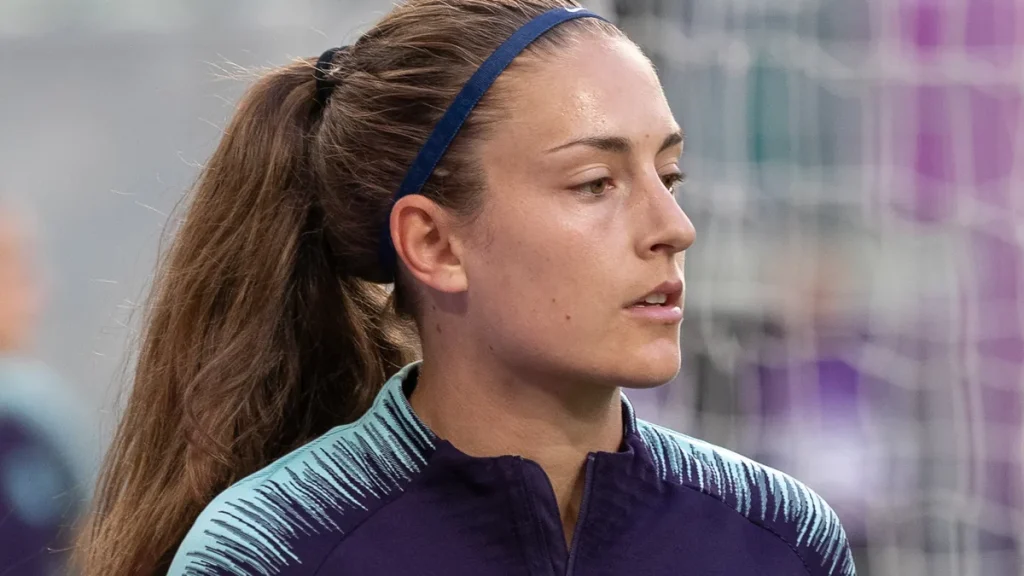
Alexia Putellas Segura (b. 1994, Mollet del Vallès, Spain) is an attacking midfielder for FC Barcelona Femení and the Spain national team, and the back-to-back Ballon d’Or Féminin winner in 2021 and 2022. Listed at 1.74 m and ~64 kg, she is medium-built for her position, with the physical signature of a creative number-ten — strong enough to ride contact in the half-spaces, fast enough to drive the ball into final-third pockets, technically clean enough to dictate possession against compact mid-blocks. In July 2022, on the eve of UEFA Women’s EURO 2022, she suffered an anterior cruciate ligament rupture and missed nearly a full season; she returned to the elite level the following year. The interesting case for sport science is the variable that defines her recovery arc: ACL return-to-play, the cluster of neuromuscular, eccentric and plyometric adaptations that determine whether a reconstructed knee withstands cutting, decelerating and unanticipated loading at elite intensity over a full season.
Table of Contents
The Physiology — what ACL return-to-play actually requires
ACL injury epidemiology in women’s football sits at roughly two-to-six times the rate observed in men’s football at comparable competitive levels, with the bulk of ruptures occurring in non-contact mechanisms — a sudden deceleration, a planted-foot cut at a sharp angle, an unanticipated change of direction with the knee in a vulnerable valgus position. Spiteri, Newton, Binetti, Hart, Sheppard and Nimphius’s work on the mechanical determinants of faster change of direction makes the strength side of this story explicit: stronger athletes produce greater braking forces over a shorter contact time and finish the cut with the centre of mass better aligned over the support foot, reducing peak knee abduction moments [1]. Strength is not cosmetic in the cutting task — it is the substrate that protects the joint while it produces the action.
Wisløff, Castagna, Helgerud, Jones and Hoff’s analysis of maximal squat strength in elite footballers tied lower-body strength directly to the high-speed actions that the post-reconstruction knee must absorb. Stronger players sprint faster, jump higher, and crucially decelerate more efficiently across the same braking distance, because the same eccentric force is produced over a shorter time at lower joint stress [2]. The post-ACL athlete must rebuild this eccentric capacity before returning to unrestricted high-intensity play; otherwise the reconstructed knee absorbs deceleration loads that the surrounding musculature should be sharing.
Cormie, McGuigan and Newton’s framework on developing maximal neuromuscular power placed the rate-of-force-development variable alongside maximal strength as a separable training target. Power is the time-derivative of force, and the cutting and decelerating tasks of the post-ACL athlete are dominated by short-duration, high-rate actions — the foot is on the ground for ~150–250 ms, and the strength that does not arrive in that window does not protect the joint [3]. Rebuilding maximal-strength capacity is necessary; rebuilding the rate at which that strength is expressed is also necessary, and the two adaptations follow different training protocols.
Markovic and Mikulic’s review of plyometric adaptations supplied the reactive-strength layer. Plyometric work develops the stretch-shortening cycle — the elastic recoil of tendon and connective tissue that recycles braking energy into the next push-off — and the post-ACL athlete must reload this cycle gradually, beginning with bilateral low-amplitude work and progressing through unilateral, multi-directional and reactive-agility variants over months [4]. The plyometric pyramid is not optional in return-to-play; it is the bridge between strength on a barbell and strength on a planted foot mid-cut.
Bourne, Timmins, Opar and colleagues’ work on eccentric hamstring training closed the chain. The hamstrings are co-protectors of the ACL during deceleration and cutting, and eccentric capacity in the hamstrings — the ability to produce force while lengthening — is trainable through specific protocols (Nordic curls, eccentric-emphasised hip-extension work) and measurable on dynamometry [5]. A reconstructed knee with under-developed eccentric hamstring strength is at higher re-injury risk; a reconstructed knee with developed eccentric capacity sits closer to baseline tolerance.
The Case — Alexia Putellas as ACL-return case
For a 1.74 m / 64 kg attacking midfielder operating in a possession-dominant system, the running profile that her reconstructed knee must absorb is consistent with the central-attacking-midfielder pattern: many short receives in the half-spaces, repeated 5–15 m accelerations and decelerations, frequent change-of-direction at moderate angles with frequent unanticipated cuts when the press arrives unexpectedly [1, 2]. The cut-volume is high; the cut-angle is variable; the eccentric-load demand is unrelenting across 90 minutes.
Putellas’s documented ACL rupture in July 2022, before the UEFA Women’s EURO 2022 opener, removed her from elite play for nearly a full season; she returned to FC Barcelona Femení and Spain colours over 2023 and continued at the elite level thereafter. The literature does not support speculation about the internal mechanism of any single injury; what the literature does support is the framework that determines a successful return. Eccentric strength rebuilt to within ~10% of the contralateral limb, plyometric and reactive-agility work progressed across months, and unanticipated-cutting drills layered in only once the closed-skill foundation is robust [1, 4, 5].
The age dimension matters in interpretation. An athlete returning at 28–29 years old has time for a long, careful return arc and the training-history substrate to support it; the muscle quality, tendon stiffness and motor-control patterning developed across a decade of elite play are still present and trainable [3]. The challenge is not building from zero — it is rebuilding to within tolerance and then progressively reloading the unanticipated, reactive load that competitive matches deliver.
The tactical context fits the physiology of the recovery. In a possession-dominant system, the attacking midfielder’s match has a higher proportion of closed-skill actions (rehearsed passing patterns, anticipated movements off the ball) and a lower proportion of unanticipated open-skill actions than, for instance, a wide forward in transition [2]. The system itself reduces the cut-volume per match modestly, which favours a careful return to elite intensity. The discriminator at the top end is whether the unanticipated cuts that do occur — when the press breaks unexpectedly, when a turnover throws the player into an open-skill cut — are absorbed by a knee whose surrounding musculature has been rebuilt to baseline.
Match-context note: Putellas’s per-match touch volume, completed-pass rate and chance-creation count in Liga F and Champions League play sit in the upper band for attacking midfielders post-return (Match data: SofaScore), with the discriminator being the consistency of those numbers across consecutive matches and across short turnaround weeks rather than any single peak performance.
Flickr: Miami U. Libraries – Digital Collections.
What This Means for the Reader
For a developing or amateur athlete navigating return from ACL reconstruction, the takeaway is that the strength, power, plyometric and eccentric-hamstring layers are separable training targets, each with its own protocol, and the return arc is built by progressing through them in the right order [1, 3, 4, 5]. Three diagnostics dominate: a single-leg countermovement-jump symmetry index against the contralateral limb, a Nordic-hamstring eccentric-strength score (or its dynamometry equivalent), and a reactive-cut task with unanticipated cue under load.
The training prescription targets the diagnostic finding: athletes with low strength symmetry need maximal-strength work before plyometric volume scales; athletes with strength symmetry but low rate-of-force-development need explosive and plyometric work; athletes with both rebuilt but who collapse in unanticipated cuts need progressive open-skill cutting work under cue [4, 5]. The diagnostic question for the post-ACL athlete returning to high-intensity sport: when I plant and cut on the operated leg, am I producing the same force in the same time as on the uninvolved leg, and am I doing it without thinking?
References
- Spiteri T, Newton RU, Binetti M, Hart NH, Sheppard JM, Nimphius S. (2015). Mechanical determinants of faster change of direction. Journal of Strength and Conditioning Research, 29(8): 2205–2214. doi:10.1519/JSC.0000000000000876
- Wisløff U, Castagna C, Helgerud J, Jones R, Hoff J. (2004). Strong correlation of maximal squat strength with sprint performance and vertical jump height. British Journal of Sports Medicine, 38(3): 285–288. doi:10.1136/bjsm.2002.002071
- Cormie P, McGuigan MR, Newton RU. (2011). Developing maximal neuromuscular power: Part 1. Sports Medicine, 41(1): 17–38. doi:10.2165/11537690-000000000-00000
- Markovic G, Mikulic P. (2010). Neuro-musculoskeletal and performance adaptations to lower-extremity plyometric training. Sports Medicine, 40(10): 859–895. doi:10.2165/11318370-000000000-00000
- Bourne MN, Duhig SJ, Timmins RG, Opar DA, Al Najjar A, Kerr GK, Shield AJ. (2017). Impact of the Nordic hamstring and hip extension exercises on hamstring architecture and morphology: implications for injury prevention. British Journal of Sports Medicine, 51(5): 469–477. doi:10.1136/bjsports-2016-097068
Match-context data (descriptive only): SofaScore.
The Athlete in One Paragraph
Alexia Putellas Segura (b. 1994, Mollet del Vallès, Spain) is an attacking midfielder for FC Barcelona Femení and the Spain national team, and the back-to-back Ballon d'Or Féminin winner in 2021 and 2022. Listed at 1.74 m and ~64 kg, she is medium-built for her…
The Physiology — what ACL return-to-play actually requires
ACL injury epidemiology in women's football sits at roughly two-to-six times the rate observed in men's football at comparable competitive levels, with the bulk of ruptures occurring in non-contact mechanisms — a sudden deceleration, a planted-foot cut at a sharp angle, an unanticipated change of…
The Case — Alexia Putellas as ACL-return case
For a 1.74 m / 64 kg attacking midfielder operating in a possession-dominant system, the running profile that her reconstructed knee must absorb is consistent with the central-attacking-midfielder pattern: many short receives in the half-spaces, repeated 5–15 m accelerations and decelerations, frequent change-of-direction at moderate…
What This Means for the Reader
For a developing or amateur athlete navigating return from ACL reconstruction, the takeaway is that the strength, power, plyometric and eccentric-hamstring layers are separable training targets, each with its own protocol, and the return arc is built by progressing through them in the right order…