
Preview
Hüseyin Akbulut, MSc (2026). Cole Palmer and the Late-Bloomer Movement Rhythm of an Elite Attacking Midfielder. Sporeus. Retrieved, October 7, 2026. https://sporeus.com/en/science/cole-palmer-late-bloomer-movement-rhythm/
The Athlete in One Paragraph
Cole Jermaine Palmer (b. 2002-05-06, Manchester, England) is, as of September 2026, an attacking midfielder for Chelsea and the England national team — listed at 1.89 m and ~80 kg, taller than the role mean and built lean rather than imposing. Palmer’s career path is unusual in elite English football: a Manchester City academy graduate who saw fragmentary senior minutes through his late teens, broke through fully only at 21 after the move to Chelsea, and then immediately performed at international level — including a Euro 2024 final goal — without an obvious transitional season. The interesting case for sport science is not the late-career step up; the interesting case is what was happening underneath the surface across the years before it. The variable underneath the trajectory is late-bloomer movement rhythm — the cadence, step rate and ball-receiving timing that lets a player whose breakthrough lagged peers compete on a tempo register rather than on raw pace.
Table of Contents
The Physiology — what movement rhythm actually means
Football is intermittent in its load profile, but it is rhythmic in its execution. Bangsbo, Mohr and Krustrup’s foundational decomposition shows total distance ~10–12 km per match, dominated by walking and jogging, with high-intensity output concentrated into short bursts of 1–4 seconds and recoveries between them [1]. The bursts and the recoveries together compose a tempo, and the elite player is the one whose tempo — step rate, stride length, change of cadence under pressure — is matched to the role demand without being constrained to a single setting.
Saunders, Pyne, Telford and Hawley’s review of running economy framed the underlying principle in endurance terms — the metabolic cost of running at a given submaximal velocity is determined by the integration of stride length, stride frequency, vertical oscillation and ground-contact time, and small adjustments to that integration produce measurable economy gains [2]. The football corollary is that the midfielder who can shift cadence economically — slower into reception, sharper into the turn, longer into the carry — is exporting less energy per unit of decision than a peer whose cadence is locked.
Stølen, Chamari, Castagna and Wisløff’s physiology-of-soccer review extended the framework to the integrated demands of the modern game — aerobic substrate, repeated-sprint capacity, lower-limb strength, and the perceptual-cognitive coupling between cue recognition and movement execution all operate concurrently across the 90 minutes [3]. The economy of cadence shifting is not an isolated trait; it sits inside a multi-system load. The athlete who shifts cadence smoothly is conserving cognitive bandwidth as well as metabolic substrate.
Mohr, Krustrup and Bangsbo’s match-fatigue work added the temporal dimension: the high-intensity output of the first 15-minute period is consistently higher than the output of the 75–90-minute period, and the discriminator across players is not who runs the most early but who maintains decision and movement quality late [4]. Movement rhythm — the capacity to keep cadence and reception timing intact under accumulated fatigue — is the trait that converts raw conditioning into sustained late-match contribution.
Bradley and colleagues’ Premier League high-intensity-running analysis positioned attacking midfielders at the upper end of the high-intensity-distance distribution, with a running profile dominated by short bursts triggered by tactical cues rather than by pre-planned drills [5]. The cue-driven nature of the bursts is the operational link to rhythm: the player whose cadence is set up to anticipate the next reception is launching the burst with the shortest possible delay between cue and movement. Movement rhythm, in this framing, is not a stylistic flourish — it is a perceptual-motor efficiency variable.
The Case — Palmer as late-bloomer rhythm archetype
For a 1.89 m / 80 kg attacking midfielder whose breakthrough came later than the academy norm, the underlying performance signature has to come from somewhere other than the physical-precocity profile typical of early-elite footballers. The candidate is movement rhythm: the capacity to receive on the back foot with minutes of pressure already on the body, to shift cadence into the carry, and to time the release pass to the moment the defender has committed to the wrong foot [1, 4]. The role demand is rhythmic before it is athletic, and the late-bloomer who survives to senior level has typically optimised the rhythmic layer at the expense of the brute-pace layer.
Saunders’ running-economy framework supplies the underlying mechanism: economy is produced by the integration of cadence variables, and small adjustments to the integration produce measurable gains [2]. The amateur lesson is that running economy is trainable, but the elite-football corollary is that movement-rhythm economy is also trainable — it is shaped by the cumulative reps of small-sided games, possession rondos and reception-under-pressure drills that the late-bloomer has typically banked across the late-academy and early-senior years that his early-elite peers spent in different competitive environments.
The Stølen integrated framework matters here. The cadence-shifting capacity is not isolated from the aerobic substrate or the perceptual-cognitive load; it operates inside both [3]. The late-bloomer’s rhythm is sustainable across 90 minutes only if the aerobic substrate sustains the cognitive bandwidth that maintains it. The career-trajectory implication is that the late-bloomer who does break through is typically the one whose physiological substrate caught up with his rhythm in the years before the breakthrough — the substrate is the carrier, the rhythm is the signal.
Mohr’s match-fatigue framework explains the tactical signature of late-bloomer rhythm. The player whose first-15-minute output is comparable to peers but whose 75–90-minute output is better is exporting the rhythmic-economy advantage into the late match — the cadence and reception timing that hold up under accumulated fatigue are the visible outputs of the underlying integration [4]. Bradley’s positional decomposition supplies the per-match volume substrate within which that signature becomes legible [5].
The under-discussed dimension is the developmental cost. The late-bloomer who survives to elite level has, by definition, been retained in a development environment past the point at which his early-elite peers moved on, which means that the development pathway tolerated a longer return horizon than the average academy operates on. The system-level lesson is that movement-rhythm specialists are produced by patience as much as by talent.
Match-context note: Palmer’s per-match key-pass count, progressive-pass involvement and late-match goal contribution at Chelsea and for England sit at the upper band for attacking midfielders (Match data: SofaScore), with the discriminator being the consistency of the rhythmic signature across late-match phases rather than any single peak performance.
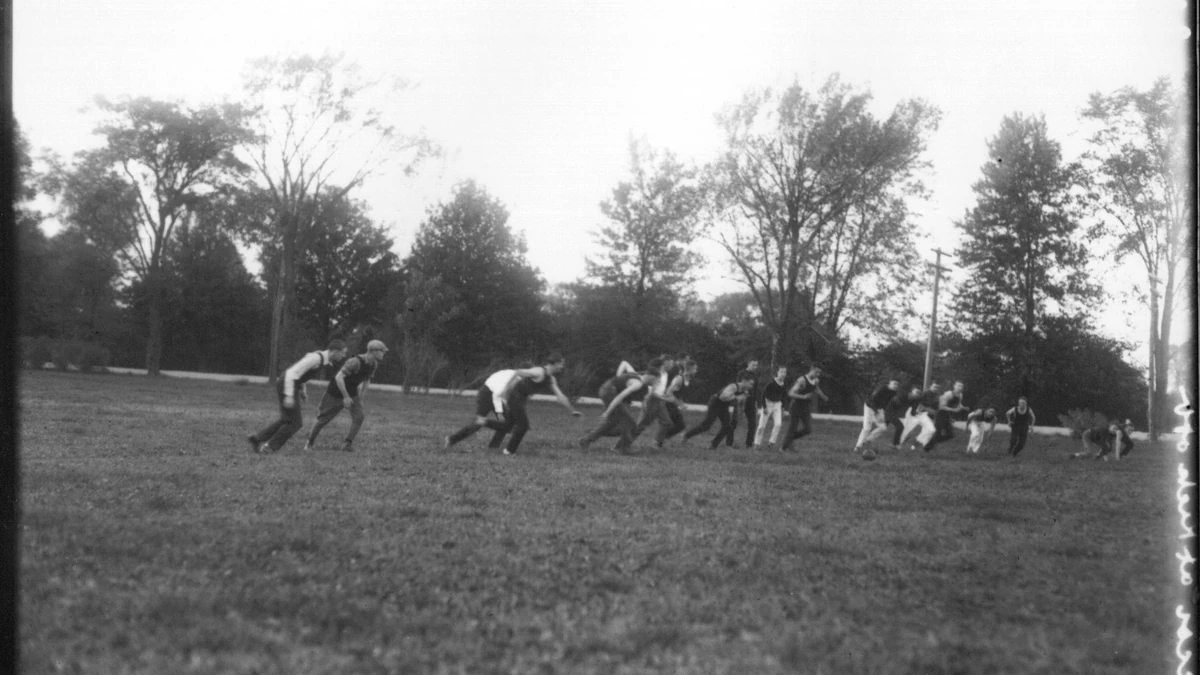
Flickr: Miami U. Libraries – Digital Collections.
What This Means for the Reader
For developing footballers and the coaches working with them, the takeaway is that movement rhythm is a real, trainable variable distinct from raw pace, and the late-bloomer’s path to elite contribution often runs through it. The transferable diagnostic uses three measurements: a stride-and-cadence economy test in submaximal running (Saunders’ framework) [2], a possession-receive-and-release decision-time test in a small-sided drill, and a session-by-session log of late-match decision quality to track whether the rhythmic layer holds up under fatigue [4, 5].
The training prescription targets the diagnostic finding. Athletes whose pure-pace metrics are mid-range but whose rhythmic-reception output is high benefit from continued investment in possession-density drills, constraint-led small-sided games and reception-under-pressure rehearsal; athletes whose rhythmic output drops sharply under fatigue benefit from aerobic-substrate work to lift the carrier, not just from more cadence drills [3, 4]. The most common error in amateur development is treating raw pace as the discriminator and dismissing the rhythmic-reception specialist as “not athletic”; the elite literature treats the rhythmic-reception specialist as a fully realised variant.
The diagnostic question for the developing midfielder: does my cadence hold up in the last 15 minutes of a match, and does my reception timing get sharper or duller under accumulated fatigue? The honest answer changes the meaning of the conditioning programme.
References
- Bangsbo J, Mohr M, Krustrup P. (2006). Physical and metabolic demands of training and match-play in the elite football player. Journal of Sports Sciences, 24(7): 665–674. doi:10.1080/02640410500482529
- Saunders PU, Pyne DB, Telford RD, Hawley JA. (2004). Factors affecting running economy in trained distance runners. Sports Medicine, 34(7): 465–485. doi:10.2165/00007256-200434070-00005
- Stølen T, Chamari K, Castagna C, Wisløff U. (2005). Physiology of soccer: an update. Sports Medicine, 35(6): 501–536. doi:10.2165/00007256-200535060-00004
- Mohr M, Krustrup P, Bangsbo J. (2003). Match performance of high-standard soccer players with special reference to development of fatigue. Journal of Sports Sciences, 21(7): 519–528. doi:10.1080/0264041031000071182
- Bradley PS, Sheldon W, Wooster B, Olsen P, Boanas P, Krustrup P. (2009). High-intensity running in English FA Premier League soccer matches. Journal of Sports Sciences, 27(2): 159–168. doi:10.1080/02640410802512775
Match-context data (descriptive only): SofaScore.

Hüseyin Akbulut is the founder of Sporeus and author of THRESHOLD (EŞİK), a 540-page Turkish-language book on endurance science.
- 540pp THRESHOLD Book
- MSc Sport Sciences
- Marmara University
The Athlete in One Paragraph
Cole Jermaine Palmer (b. 2002-05-06, Manchester, England) is, as of September 2026, an attacking midfielder for Chelsea and the England national team — listed at 1.89 m and ~80 kg, taller than the role mean and built lean rather than imposing. Palmer's career path is…
The Physiology — what movement rhythm actually means
Football is intermittent in its load profile, but it is rhythmic in its execution. Bangsbo, Mohr and Krustrup's foundational decomposition shows total distance ~10–12 km per match, dominated by walking and jogging, with high-intensity output concentrated into short bursts of 1–4 seconds and recoveries between…
The Case — Palmer as late-bloomer rhythm archetype
For a 1.89 m / 80 kg attacking midfielder whose breakthrough came later than the academy norm, the underlying performance signature has to come from somewhere other than the physical-precocity profile typical of early-elite footballers. The candidate is movement rhythm: the capacity to receive on…
What This Means for the Reader
For developing footballers and the coaches working with them, the takeaway is that movement rhythm is a real, trainable variable distinct from raw pace, and the late-bloomer's path to elite contribution often runs through it. The transferable diagnostic uses three measurements: a stride-and-cadence economy test…