Preview
Hüseyin Akbulut, MSc (2026). The Autonomic Nervous System and Hormonal Function in Exercise. Sporeus. Retrieved, November 17, 2026. https://sporeus.com/en/science/autonomic-nervous-system-hormonal-function/
Alongside voluntary muscle movement and the basic business of keeping the body running, the brain and nervous system support movement and performance during exercise through the autonomic nervous system.
Table of Contents
While you are running, the autonomic nervous system monitors and directs body temperature, breathing and heart rate. As set out elsewhere, it divides into two branches: the sympathetic and the parasympathetic nervous system (see Motor Control: Signals from the Nervous System to the Muscles).
During exercise it is primarily the sympathetic branch that is active. It raises heart rate, opens the airways, suppresses digestion, and redistributes blood flow: vessels feeding the working muscles dilate while those supplying inactive tissue constrict, so that a larger share of cardiac output reaches the muscles doing the work.
Homeostasis
Homeostasis is the internal balance the body works to hold on to in spite of changing conditions.
The autonomic nervous system cooperates with the endocrine system to maintain that balance, by way of hormones released into the systemic circulation. Hormones, put simply, are chemical messages that direct cellular function.
They have important roles in the control of a long list of physiological reactions, from energy metabolism to tissue growth.
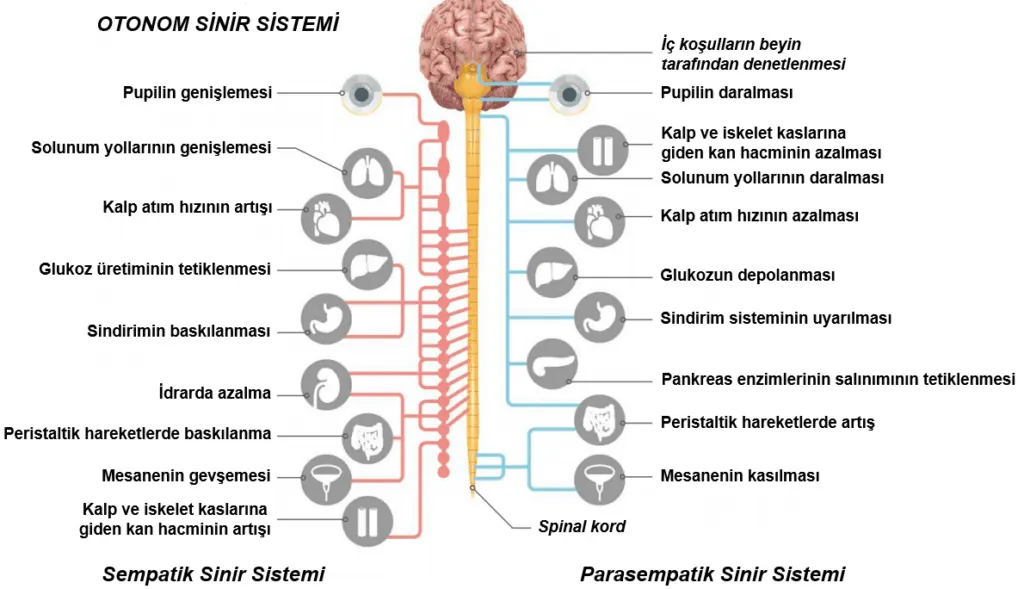
The sympathetic nervous system. Known by the description that has stuck to it, the “fight or flight” response, this branch does its work when a situation arises that the organism reads as stressful.
The easiest responses to observe are the rise in heart rate and in stroke volume. The airways open, and blood flow to the working muscles increases so that circulation can keep up with demand.
The parasympathetic nervous system. This branch is responsible for a great many of the organism’s functions, as the figure above summarises. It plays a considerable part in the recovery period after exercise, and it governs digestion and the efficient use of energy. In the processes where both branches act, it tends to work in the opposite direction to the sympathetic system.
Hormonal Balance
The endocrine system handles the synthesis and release of hormones, so that they are available when vital functions call for them.
Overtraining — the state of exhaustion that follows when the body can no longer cope with training loads and the other stresses piled on top of them — can disturb hormonal balance. This is one reason a properly judged load should be followed by a proper rest interval: that is how the balance is preserved.
Hormones Under Pressure
Oestrogen. Overtraining, or chronically excessive load, can drive oestrogen levels down in women. That fall can in turn reduce bone density and raise the rate of musculoskeletal injury.
Where oestrogen is low, the primary answer is adequate energy intake and a reduction in training load. Hormonal treatment is a decision for a physician alone, and it has not been shown to restore bone density fully.
Thyroxine. Excessive training loads, or hypothyroidism, can lower circulating thyroxine, and with it metabolic rate and protein synthesis.
Insulin. Insulin’s most important function is regulating the passage of glucose into tissue. Without it, too little glucose enters the cells, which does serious damage to tissue over time. In type 1 diabetes the pancreas no longer produces insulin and injected insulin is required; in type 2 diabetes the tissues respond poorly to the insulin that is present, and treatment usually begins with lifestyle measures and oral medication.
Hormones and Their Exercise-Related Effects
| Hormone | Site of production | Function |
| Cortisol | Adrenal glands | Stimulates glucose production. Cortisol levels tend to be raised in overtraining syndrome. Known as the stress hormone, cortisol at sustained high levels promotes protein breakdown and is associated with disturbed sleep. |
| Testosterone | Testes in men; ovaries and adrenal glands in women | Contributes to gains in muscle and bone mass. Higher levels support muscle growth and, rather than impairing recovery, assist tissue repair after exercise. |
| Oestrogen | Ovaries in women; testes and adrenal glands in men, with a substantial share produced by conversion in adipose tissue | Involved in the use of stored fat as fuel. Helps keep bone density at normal levels. |
| EPO | Kidneys | Stimulates the bone marrow to produce red blood cells, which raises the amount of oxygen the blood can carry from the lungs to the muscles. |
| Endorphins | Pituitary gland and central nervous system | Long associated with the euphoric state endurance athletes report. More recent work suggests the endocannabinoid system plays at least as large a part in that sensation. |
| Epinephrine (adrenaline) | Adrenal glands | Triggers the fight-or-flight response. |
| Thyroxine | Thyroid gland | Has an important role in regulating metabolic rate, muscle and brain function and the action of many other hormones. Keeping thyroxine in balance is essential if muscle is to go on functioning normally. |
| Insulin | Pancreas | Allows glucose to be used or stored as glycogen in muscle and liver. |
| Atrial natriuretic peptide | Cardiac muscle | Helps regulate blood pressure by promoting sodium and water excretion, which lowers blood volume and pressure. It is released when the atrial wall is stretched, as happens during endurance exercise. |
| Growth hormone | Pituitary gland | Important for protein synthesis, muscle mass, bone density and the structure of tendon and ligament, which is what makes it matter to athletes. The acute release of growth hormone scales with the intensity and volume of a session, and a load the body has fully adapted to produces a smaller response than it once did. |
Looking at the autonomic nervous system and what it does, the thing worth holding on to is this: with a training programme in which loading and rest are correctly judged, and with sound everyday nutrition — and depending, of course, on the rest of an athlete’s life — it is perfectly normal to train for years without running into hormonal imbalance.
You may also like: Balance, Through the Coordination of Nerve Signals
References
- White, D.W. & Raven, P.B. (2014). Autonomic neural control of heart rate during dynamic exercise: revisited. The Journal of Physiology, 592(12): 2491–2500. doi:10.1113/jphysiol.2014.271858
- Kraemer, W.J. & Ratamess, N.A. (2005). Hormonal responses and adaptations to resistance exercise and training. Sports Medicine, 35(4): 339–361. doi:10.2165/00007256-200535040-00004
- Meeusen, R., Duclos, M., Foster, C., Fry, A., Gleeson, M., Nieman, D., et al. (2013). Prevention, diagnosis and treatment of the overtraining syndrome: joint consensus statement of the European College of Sport Science and the American College of Sports Medicine. European Journal of Sport Science, 13(1): 1–24. doi:10.1080/17461391.2012.730061
- Mastorakos, G., Pavlatou, M., Diamanti-Kandarakis, E. & Chrousos, G.P. (2005). Exercise and the stress system. Hormones (Athens), 4(2): 73–89.

Hüseyin Akbulut is the founder of Sporeus and author of THRESHOLD (EŞİK), a 540-page Turkish-language book on endurance science.
- 540pp THRESHOLD Book
- MSc Sport Sciences
- Marmara University
Homeostasis
Homeostasis is the internal balance the body works to hold on to in spite of changing conditions.
Hormonal Balance
The endocrine system handles the synthesis and release of hormones, so that they are available when vital functions call for them.
Hormones Under Pressure
Oestrogen. Overtraining, or chronically excessive load, can drive oestrogen levels down in women. That fall can in turn reduce bone density and raise the rate of musculoskeletal injury.