Preview
Hüseyin Akbulut, MSc (2026). Enzymes: How Chemical Reactions Start and Keep Going. Sporeus. Retrieved, November 22, 2026. https://sporeus.com/en/science/enzymes-how-chemical-reactions-work/
Enzymes are indispensable to biological systems. The human body is the product of countless chemical reactions and processes. So how do these reactions start, and how are they controlled?
Table of Contents
Anselme Payen (1795-1871, Paris, France) was the French chemist to whom we owe the discovery of cellulose, one of the basic components of plant cells. In 1833, working with Jean-François Persoz, he identified an agent that plays a vital role in triggering chemical processes and named it “diastase”.
Enzymes are biological catalysts that speed up biochemical reactions. Most are proteins; some are RNA molecules (ribozymes).
Enzymes are highly selective about what they bind, and they play an active role in changing the molecules they bind to.
To understand how an enzyme speeds up a chemical process, the first thing to know is that enzymes lower the activation energy needed for a reaction to start and make it easier for the molecules they bind to form new bonds.
The molecules they act on (substrates) bind to a special pocket in the enzyme, the active site. The size, shape and chemical properties of the active site differ from enzyme to enzyme and are determined by the amino acids that form it.
Besides the active site, many enzymes need a non-protein component called a cofactor. Cofactors can be positively charged metal ions such as magnesium, zinc or iron, or organic molecules called coenzymes; they take part in the active site and make the enzyme functional.
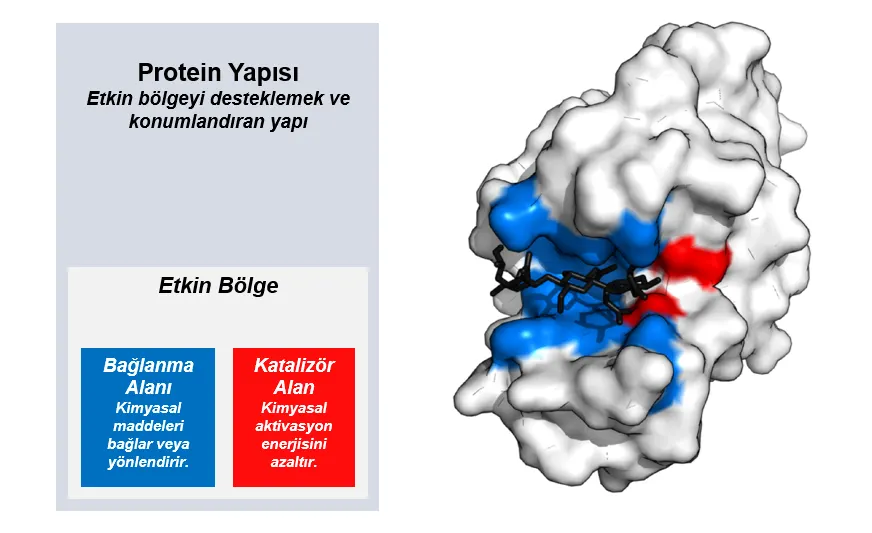
Many enzymes act as catalysts only when bound to their coenzymes.
The protein part of an enzyme on its own, which is inactive, is called the apoenzyme. Together with its cofactor it forms the active holoenzyme.
So the formula for a holoenzyme is: holoenzyme = apoenzyme + cofactor (a metal ion or a coenzyme).
Two Models of Enzyme Action
The simplest model for understanding how enzymes work is the lock-and-key hypothesis. It assumes that substrates fit neatly into the active site and so start the reaction, just as a key fits a lock. In other words, the shapes of the substrate and the enzyme are thought to match like jigsaw pieces.
In another model, the induced-fit hypothesis, substrate and enzyme do not fit perfectly at first, but the enzyme changes its shape to grip the substrate more tightly.

Environmental Factors in Enzyme Function
The active sites of enzymes are very sensitive structures. They can register even very small changes in their environment, and their responses change accordingly.
Most human enzymes work best at around body temperature, 37 °C. When the temperature falls, reactions slow down; when it rises markedly, the weak bonds that hold the active site in shape begin to break.
Higher temperatures cause the enzyme’s structure to break down (denaturation). Heat-driven vibration disturbs the amino acids within the structure and impairs function.
As long as there is enough substrate, the reaction rate rises as the amount of enzyme rises, because more enzyme molecules can bind substrate at the same time.
Increasing substrate concentration also raises the reaction rate, because substrate molecules can meet more enzyme molecules. Beyond a certain point, however, all the active sites are occupied (saturation), and adding more substrate no longer speeds up the reaction.
Inhibition of enzyme activity: substances called inhibitors, which are not necessarily harmful, can slow down and suppress the biochemical reactions enzymes catalyse.
At the elite level, enzymes are one of the most concrete markers of training adaptation. In Holloszy’s classic 1967 study, the activity of mitochondrial respiratory enzymes in the skeletal muscle of rats put through running training roughly doubled. In endurance athletes, years of training raise oxidative enzyme capacity far above that of sedentary people; this is one of the main reasons they produce less lactate and burn more fat at the same pace.
You may also be interested in: the cell, homeostasis and metabolism
References
- Payen, A., & Persoz, J.F. (1833). Mémoire sur la diastase, les principaux produits de ses réactions, et leurs applications aux arts industriels. Annales de Chimie et de Physique, 53, 73-92.
- Koshland, D.E. (1958). Application of a Theory of Enzyme Specificity to Protein Synthesis. Proceedings of the National Academy of Sciences, 44(2), 98-104. https://doi.org/10.1073/pnas.44.2.98

Hüseyin Akbulut is the founder of Sporeus and author of THRESHOLD (EŞİK), a 540-page Turkish-language book on endurance science.
- 540pp THRESHOLD Book
- MSc Sport Sciences
- Marmara University
Two Models of Enzyme Action
The simplest model for understanding how enzymes work is the lock-and-key hypothesis. It assumes that substrates fit neatly into the active site and so start the reaction, just as a key fits a lock. In other words, the shapes of the substrate and the enzyme…
Environmental Factors in Enzyme Function
The active sites of enzymes are very sensitive structures. They can register even very small changes in their environment, and their responses change accordingly.