Preview
Hüseyin Akbulut, MSc (2026). Joshua Kimmich and the Dual-Position Load Profile of an Elite Hybrid Midfielder. Sporeus. Retrieved, October 13, 2026. https://sporeus.com/en/science/joshua-kimmich-dual-position-load/
The Athlete in One Paragraph
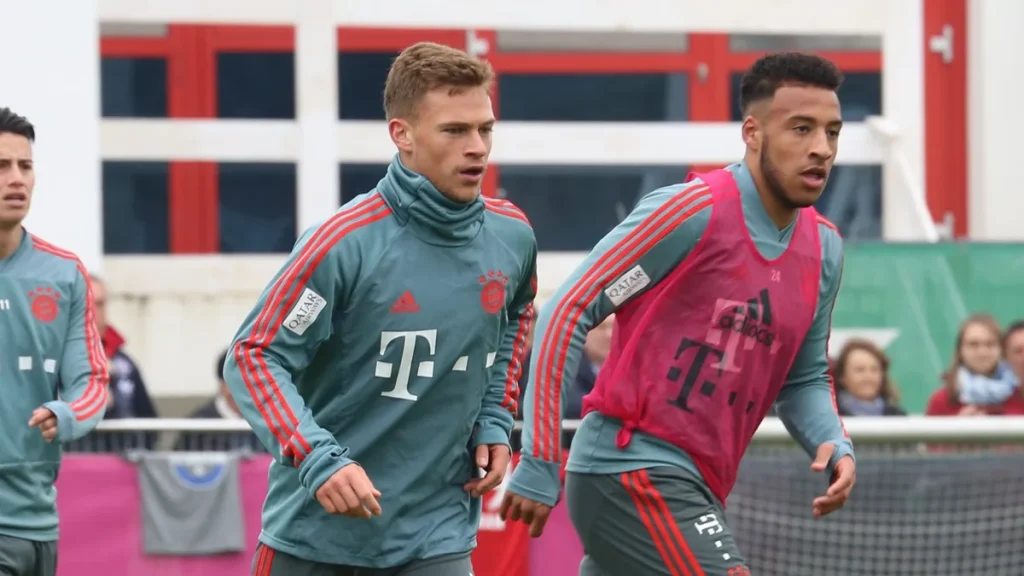
Joshua Walter Kimmich (b. 1995, Rottweil, Germany) is, as of September 2026, the Bayern Munich and Germany international who has spent the better part of a decade alternating — sometimes within the same season, occasionally within the same fixture week — between right-back and central midfield. Listed at 1.77 m and ~75 kg, he is built closer to the midfielder archetype than to the modern overlapping fullback, yet the tactical demand placed on him has consistently required him to deliver both profiles at the level of the European elite. The interesting case for sport science is not whether he is “better” at one role; it is the variable that the dual usage forces him to manage across a season: dual-position load, the asymmetric mechanical-and-metabolic cost of absorbing two distinct demand profiles — the sprint-rich, deceleration-heavy fullback profile and the continuous, high-volume central-midfield profile — without the recovery margin a single-position specialist enjoys.
Table of Contents
The Physiology — what dual-position load actually measures
Match running in elite football is positional, not generic. Bangsbo, Mohr and Krustrup decomposed the 90-minute demand into the canonical pattern — total distance ~10–12 km, of which roughly 8–12% is high-intensity, with the remainder distributed across walking, jogging and standing recovery — and made explicit that the shape of that distribution differs sharply by role [1]. Fullbacks pay a higher share of their cost in repeated maximum-velocity sprints and deceleration cycles; central midfielders pay a higher share in continuous high-intensity covering across the middle third. The aerobic substrate underwrites both, but the neuromuscular substrate they tax is not the same.
Bradley and colleagues’ analysis of Premier League matches sharpened the positional layer. Central midfielders covered the most total high-intensity distance of any outfield position, while fullbacks logged the most repeated short-burst sprint cycles, with the running profile dominated by 1–4-second efforts rather than long open-field sprints [2]. The implication for a dual-role player is that the limiting variable is no longer one capacity but two — repeated-effort recovery for the midfield weeks and maximum-velocity reproducibility for the fullback weeks — and the conditioning load must reach into both without overshooting either.
Buchheit and Laursen’s high-intensity-interval-training framework provides the training-side mirror. The aerobic adaptations that support repeated high-intensity efforts — cardiac output, mitochondrial density, capillarisation, lactate clearance — are best driven by short-interval work at 90–95% of VO₂max with brief recoveries, while the neuromuscular adaptations that support repeated sprint reproducibility require a different stimulus altogether: short, complete-recovery sprints at near-maximal velocity with low aggregate volume [3]. The dual-role athlete must touch both stimulus families inside a single microcycle without the residual fatigue of one impairing the other.
Impellizzeri, Marcora and Coutts’ fifteen-year reflection on training-load monitoring made the operational point that internal load (heart-rate, RPE, biochemical markers) and external load (GPS distance, accelerations, sprints) must be reconciled per athlete and per role; the same external GPS distance produces a different internal cost depending on which cycles dominate the session [4]. For a hybrid midfielder, the same 10 km can hide a fullback-shaped profile or a midfielder-shaped profile, and the recovery prescription differs accordingly.
Carling, Le Gall and Dupont’s fixture-density analysis closed the loop. Recovery between high-intensity matches is incomplete in the densest fixture windows, and the residue of a high-intensity match decays slowly enough that consecutive high-load games in a short turnaround compound rather than reset [5]. A hybrid midfielder asked to fill two demand shapes across the same week is therefore the worst-case sample of the fixture-density problem — and the case where load monitoring stops being optional.
The Case — Kimmich as dual-position load manager
For a 1.77 m / 75 kg player operating across right-back and central-midfield duty in a possession-dominant system, the season-long running profile is consistent with a high-volume, high-acceleration pattern with asymmetric weekly fingerprints: in fullback weeks, the count of maximum-velocity sprints and decelerations rises, and the share of total distance covered above the high-intensity threshold concentrates into short bursts; in midfield weeks, the count of sprints falls but the total high-intensity distance and the count of mid-pitch covering actions rise [1, 2]. Two demand shapes, one nervous system, one set of tendons.
The anthropometry constrains the trade-off. A 1.77 m / 75 kg frame is favourable for the midfield profile — the absolute energy cost per unit distance is moderate, the aerobic work-rate per kilogram of body mass is competitive — but it is not the heavyset, sprint-specialist build that rotates fullbacks toward repeated maximum-velocity work [1]. The compensation is technical: a fullback’s sprint efficiency at sub-maximal velocity, supported by the midfielder’s aerobic base, can substitute for raw top speed across most defensive recovery sequences.
The fixture-density layer is where dual-position load becomes a separable variable. A player asked to deliver a fullback-shaped match on Saturday and a midfield-shaped match on Wednesday is taxing two recovery substrates without giving either the cleaner microcycle a single-position specialist receives [5]. The cumulative cost is not visible in any single match’s GPS summary; it is visible only across the rolling fixture window, in the gradual rise of session-RPE relative to identical external load.
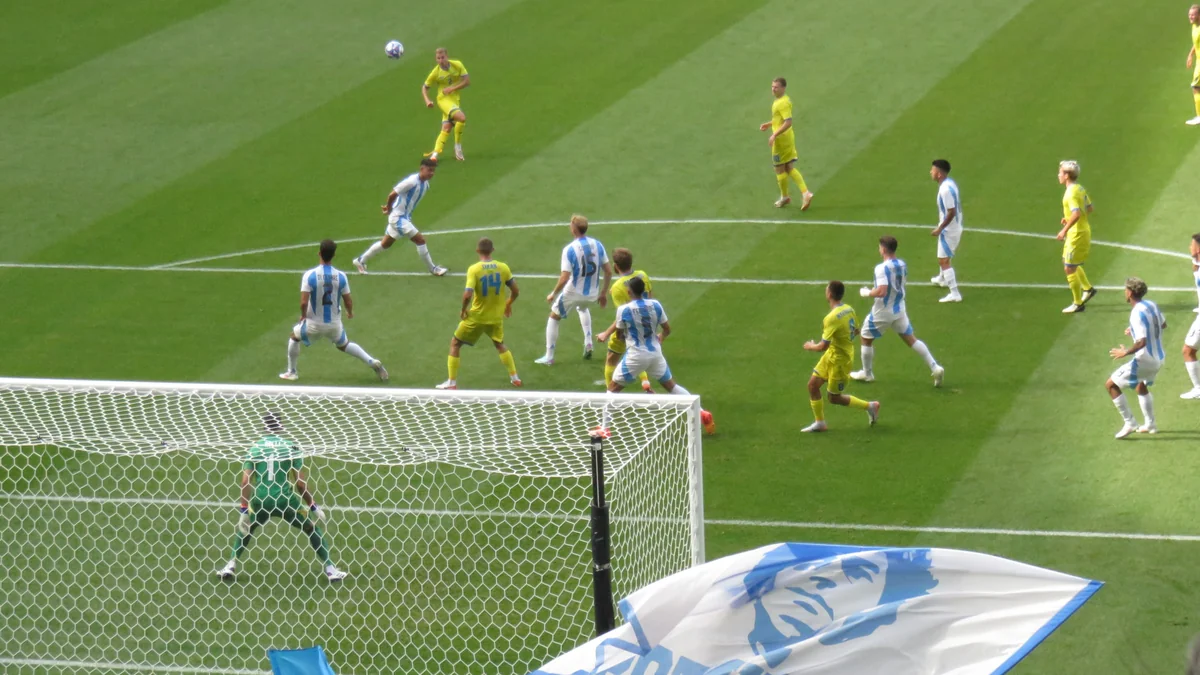
Match-context note: Kimmich’s per-match distance-covered and pass-volume figures across Bundesliga and Champions League play sit consistently in the upper band for both fullbacks and central midfielders (Match data: SofaScore), with the discriminator being not a single peak performance but the ability to deliver upper-band figures regardless of which role he is asked to occupy that week.
The training-monitoring case is the under-discussed dimension. Impellizzeri’s framework implies that for a dual-role athlete the GPS-distance summary is insufficient; what matters is the shape of the load — sprint count, deceleration count, time above the high-intensity threshold — assessed per role and reconciled with a per-session RPE log [4]. The athlete who manages dual-position load is the one whose internal cost stays stable across role switches, which is itself a marker of an aerobic base broad enough to absorb both demand families [3].
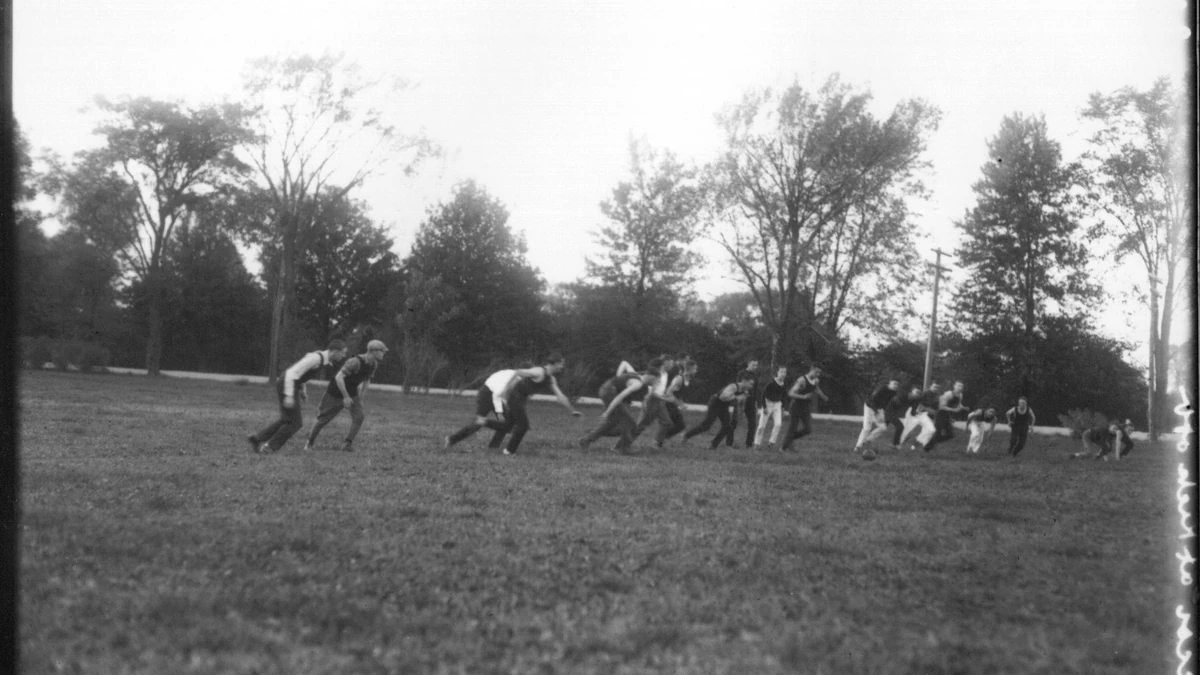
Flickr: Miami U. Libraries – Digital Collections.
What This Means for the Reader
For a developing player asked to swing between two positions, the takeaway is that dual-position load is not a single trait but a conditioning strategy — an aerobic base broad enough to underwrite both demand families, plus role-specific neuromuscular maintenance, plus a load-monitoring discipline that distinguishes a fullback-shaped 10 km from a midfielder-shaped 10 km. Three measurements diagnose the limiting variable: a Yo-Yo Intermittent Recovery score for repeated-effort capacity, a 30-metre flying-sprint time for top-end reproducibility, and a per-session RPE log reconciled with GPS-distance to track the internal cost of each role [3, 4].
The training prescription targets the asymmetry: athletes whose midfield weeks feel harder need short-interval work to convert VO₂max into repeated-effort capacity; athletes whose fullback weeks feel harder need short, complete-recovery sprint sets with low aggregate volume; athletes whose RPE drifts upward across both weeks need a longer aerobic base block before role-specific work compounds [3, 5]. The single diagnostic question for the dual-role player: when I struggle late in a match, is it because the role itself outpaced me, or because last week’s role left a residue I never repaid?
References
- Bangsbo J, Mohr M, Krustrup P. (2006). Physical and metabolic demands of training and match-play in the elite football player. Journal of Sports Sciences, 24(7): 665–674. doi:10.1080/02640410500482529
- Bradley PS, Sheldon W, Wooster B, Olsen P, Boanas P, Krustrup P. (2009). High-intensity running in English FA Premier League soccer matches. Journal of Sports Sciences, 27(2): 159–168. doi:10.1080/02640410802512775
- Buchheit M, Laursen PB. (2013). High-intensity interval training, solutions to the programming puzzle. Sports Medicine, 43(5): 313–338. doi:10.1007/s40279-013-0029-x
- Impellizzeri FM, Marcora SM, Coutts AJ. (2019). Internal and external training load: 15 years on. International Journal of Sports Physiology and Performance, 14(2): 270–273. doi:10.1123/ijspp.2018-0935
- Carling C, Le Gall F, Dupont G. (2012). Analysis of repeated high-intensity running performance in professional soccer. Journal of Sports Sciences, 30(4): 325–336. doi:10.1080/02640414.2011.652655
Match-context data (descriptive only): SofaScore.

Hüseyin Akbulut is the founder of Sporeus and author of THRESHOLD (EŞİK), a 540-page Turkish-language book on endurance science.
- 540pp THRESHOLD Book
- MSc Sport Sciences
- Marmara University
The Athlete in One Paragraph
Joshua Walter Kimmich (b. 1995, Rottweil, Germany) is, as of September 2026, the Bayern Munich and Germany international who has spent the better part of a decade alternating — sometimes within the same season, occasionally within the same fixture week — between right-back and central…
The Physiology — what dual-position load actually measures
Match running in elite football is positional, not generic. Bangsbo, Mohr and Krustrup decomposed the 90-minute demand into the canonical pattern — total distance ~10–12 km, of which roughly 8–12% is high-intensity, with the remainder distributed across walking, jogging and standing recovery — and made…
The Case — Kimmich as dual-position load manager
For a 1.77 m / 75 kg player operating across right-back and central-midfield duty in a possession-dominant system, the season-long running profile is consistent with a high-volume, high-acceleration pattern with asymmetric weekly fingerprints: in fullback weeks, the count of maximum-velocity sprints and decelerations rises, and…
What This Means for the Reader
For a developing player asked to swing between two positions, the takeaway is that dual-position load is not a single trait but a conditioning strategy — an aerobic base broad enough to underwrite both demand families, plus role-specific neuromuscular maintenance, plus a load-monitoring discipline that…