Preview
Hüseyin Akbulut, MSc (2026). Federico Valverde and the Total Covered Distance and Box-to-Box Demand of an Elite Midfielder. Sporeus. Retrieved, October 16, 2026. https://sporeus.com/en/science/federico-valverde-total-covered-distance/
The Athlete in One Paragraph
Federico Santiago Valverde Dipetta (b. 1998-07-22, Montevideo, Uruguay) is, as of September 2026, a box-to-box midfielder for Real Madrid CF and the Uruguay national team. Listed at 1.82 m and ~78 kg, he carries a build that sits in the structural sweet spot for a player whose primary job is to cover the entire pitch — long enough to stride efficiently, light enough to repeat that stride for ninety minutes, robust enough to absorb the dual-direction loading of attacking runs and defensive recoveries. He is not a winger who occasionally tracks back, nor a holder who rarely advances; he is, in the literal positional sense, asked to be present at both penalty boxes. The interesting case for sport science is the variable that defines the role itself: total covered distance and the dual-direction running demand that separates an elite box-to-box engine from every other midfield archetype.
Table of Contents
The Physiology — what total covered distance actually measures
Total distance covered in a match is the simplest external load metric and also the most misleading one. Mohr, Krustrup and Bangsbo’s match-performance study established the canonical reference values for elite outfield players: roughly 10–13 km of total distance per match, with significant variation by position and tactical role [1]. Top-class midfielders in their dataset covered the highest total distances of any outfield position, reflecting the structural reality that the centre of the pitch sees the most ball circulation and the most defensive transitions.
Bradley and colleagues’ analysis of high-intensity running in Premier League matches refined the picture by separating distance into intensity bands [2]. They reported total match distances of approximately 10.7 km on average, but high-intensity running (>5.5 m/s) accounted for only ~2.4 km — and the distribution of that high-intensity component was sharply position-dependent. Central midfielders had the most uniform load profile, with consistent bursts spread across both halves; box-to-box midfielders specifically showed the highest combined low-intensity-plus-high-intensity volume [2].
Bangsbo, Mohr and Krustrup’s review of the physical and metabolic demands of training and match-play unpacked what produces this volume [3]. Aerobic energy turnover during a match averages roughly 70–75% of VO2max, with maximum heart rates reached during high-intensity actions and sustained near anaerobic threshold for much of the match. The substrate cost is substantial: glycogen depletion in type II fibres after a 90-minute match approaches the levels seen after a 90-minute run at race pace, and the recovery time-course exceeds 48 hours for full muscle-glycogen restoration [3].
Stølen, Chamari, Castagna and Wisløff’s update on soccer physiology placed the role-specific variation in context [4]. Top-level central midfielders typically display VO2max values in the 60–67 mL/kg/min range — below those of professional distance runners, but achieved while carrying the lower-body strength required for sprinting, jumping and tackling. The aerobic engine functions as a recovery machine more than a steady-state engine: it determines how rapidly anaerobic by-products are cleared between repeated high-intensity efforts, not how fast a single sprint can be performed [4].
Carling, Le Gall and Dupont then quantified what fatigue does to repeated high-intensity running across a match [5]. The number of high-intensity sprints declined progressively from the first to the second half in their professional sample, and the recovery interval between sprints shortened relative to the recovery requirement — meaning that late-match sprints were performed under increasing metabolic deficit. The clean takeaway is that total distance is a poor performance index in isolation; the variable that matters is the combination of total volume, repeated high-intensity capacity and resistance to within-match decline.
The Case — Valverde as box-to-box engine
For a 1.82 m / 78 kg midfielder asked to occupy both attacking and defensive thirds, the mechanical signature is consistent with a long-stride aerobic chassis paired with the neuromuscular capacity for repeated high-intensity efforts. Valverde’s role at Real Madrid — registered in central and right-sided central positions, with frequent late-game runs into the opposition box and equally frequent defensive recoveries — is the textbook tactical context for the total-distance demand profile that Mohr’s [1] and Bradley’s [2] datasets characterise as the central-midfield maximum.
The dual-direction component matters more than raw distance. A winger who covers 10.5 km may do so almost entirely in straight-line attacking runs; a holding midfielder who covers 10.0 km does so in shorter shuttles around the centre circle. The box-to-box midfielder’s distance is structurally bidirectional — every attacking transit eventually requires a defensive recovery, and the recovery is performed at sub-maximal speeds while the cardiovascular system is still clearing the cost of the prior high-intensity effort. This is exactly the pattern Bangsbo and colleagues identified as the metabolic signature of the most-loaded outfield positions [3].
Stølen’s review noted that aerobic capacity sets the ceiling for the recovery rate between repeated efforts [4], and Carling’s data showed that repeated-sprint capacity declines toward the end of matches in proportion to how much was spent earlier [5]. For a player whose tactical brief includes box arrivals in the 80th minute, this is not optional: the aerobic engine has to be large enough that the late-match runs are not made under cumulative deficit. Valverde’s reputation for late-game involvement — both attacking and defensive — is consistent with that aerobic profile, though without published GPS data we frame it as profile-consistent rather than measured.
The body composition fits the profile too. At 78 kg on a 1.82 m frame, Valverde sits at a body-mass index in the range typical of central midfielders in Premier League and La Liga datasets, and the lean-mass distribution implied by his sprint and aerial work is consistent with the Stølen profile of central midfielders who must combine endurance with the lower-body strength to win duels and strike from distance [4].
Match-context note: Valverde’s distance and high-intensity output across recent Real Madrid seasons sits at the upper end of Champions League midfielder samples (Match data: SofaScore), with the discriminator being not raw kilometres but the share of those kilometres performed in the high-intensity band.
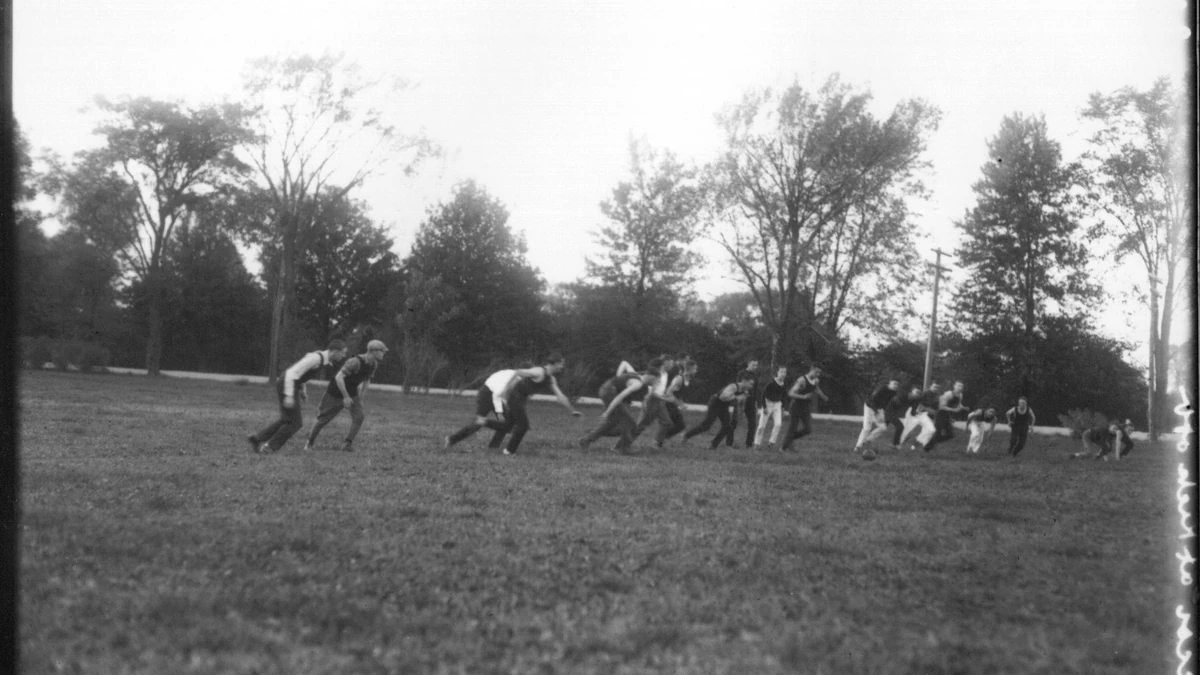
Flickr: Miami U. Libraries – Digital Collections.
What This Means for the Reader
For a developing midfielder, the takeaway is that volume is a precondition, not a target. Three measurements diagnose where the limiting variable sits: total distance per match (or training session, with GPS or even a phone-based estimate), the proportion of that distance performed above 5.5 m/s, and the within-session decline in high-intensity output from first to second half [1, 2, 5]. The first tells you whether the aerobic chassis is large enough; the second tells you whether the neuromuscular capacity is being expressed; the third tells you whether the two are integrated.
The training prescription targets the diagnostic finding: low-volume athletes need long, steady aerobic work to build the chassis; low-high-intensity-share athletes need repeated-sprint blocks (e.g., 6 × 30 m with short rests) layered on top of the chassis; high-decline athletes need both aerobic capacity and conditioning that specifically resists late-session fatigue.
The diagnostic question for the developing box-to-box midfielder: when I fade in the last twenty minutes, am I fading because the aerobic engine is too small, because my high-intensity reserve is already spent, or because I am not recovering between sprints? The answer determines training emphasis.
References
- Mohr M, Krustrup P, Bangsbo J. (2003). Match performance of high-standard soccer players with special reference to development of fatigue. Journal of Sports Sciences, 21(7): 519–528. doi:10.1080/0264041031000071182
- Bradley PS, Sheldon W, Wooster B, Olsen P, Boanas P, Krustrup P. (2009). High-intensity running in English FA Premier League soccer matches. Journal of Sports Sciences, 27(2): 159–168. doi:10.1080/02640410802512775
- Bangsbo J, Mohr M, Krustrup P. (2006). Physical and metabolic demands of training and match-play in the elite football player. Journal of Sports Sciences, 24(7): 665–674. doi:10.1080/02640410500482529
- Stølen T, Chamari K, Castagna C, Wisløff U. (2005). Physiology of soccer: an update. Sports Medicine, 35(6): 501–536. doi:10.2165/00007256-200535060-00004
- Carling C, Le Gall F, Dupont G. (2012). Analysis of repeated high-intensity running performance in professional soccer. Journal of Sports Sciences, 30(4): 325–336. doi:10.1080/02640414.2011.652655
Match-context data (descriptive only): SofaScore.
Hüseyin Akbulut is the founder of Sporeus and author of THRESHOLD (EŞİK), a 540-page Turkish-language book on endurance science.
- 540pp THRESHOLD Book
- MSc Sport Sciences
- Marmara University
The Athlete in One Paragraph
Federico Santiago Valverde Dipetta (b. 1998-07-22, Montevideo, Uruguay) is, as of September 2026, a box-to-box midfielder for Real Madrid CF and the Uruguay national team. Listed at 1.82 m and ~78 kg, he carries a build that sits in the structural sweet spot for a…
The Physiology — what total covered distance actually measures
Total distance covered in a match is the simplest external load metric and also the most misleading one. Mohr, Krustrup and Bangsbo's match-performance study established the canonical reference values for elite outfield players: roughly 10–13 km of total distance per match, with significant variation by…
The Case — Valverde as box-to-box engine
For a 1.82 m / 78 kg midfielder asked to occupy both attacking and defensive thirds, the mechanical signature is consistent with a long-stride aerobic chassis paired with the neuromuscular capacity for repeated high-intensity efforts. Valverde's role at Real Madrid — registered in central and…
What This Means for the Reader
For a developing midfielder, the takeaway is that volume is a precondition, not a target. Three measurements diagnose where the limiting variable sits: total distance per match (or training session, with GPS or even a phone-based estimate), the proportion of that distance performed above 5.5…