Preview
Hüseyin Akbulut, MSc (2026). Lamine Yamal and the Skeletal-Immaturity Load of an Elite Teenage Winger. Sporeus. Retrieved, October 4, 2026. https://sporeus.com/en/science/lamine-yamal-teen-prodigy-skeletal-immaturity-load/
The Athlete in One Paragraph
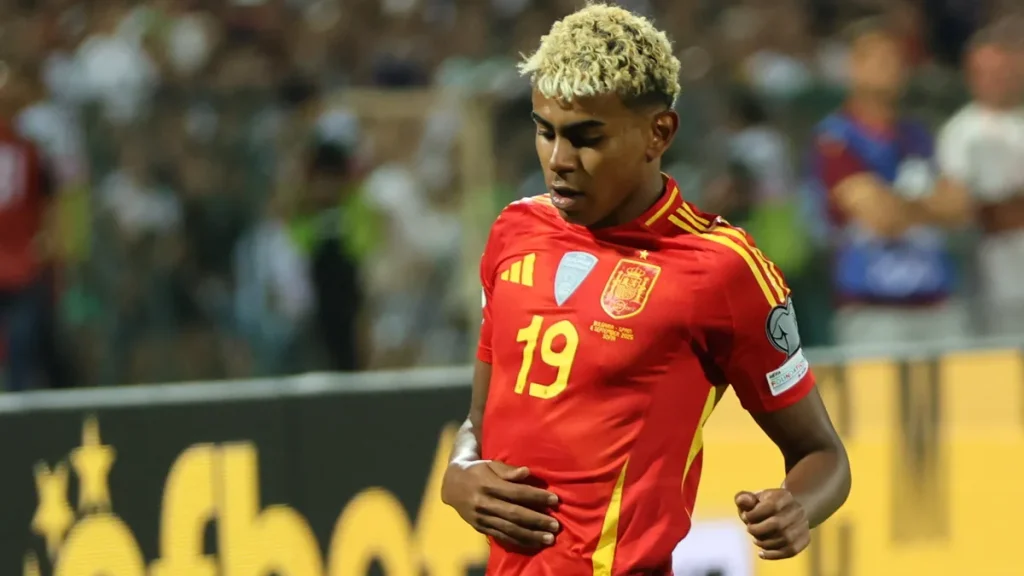
Lamine Yamal Nasraoui Ebana (b. 2007-07-13, Esplugues de Llobregat, Spain) is, as of September 2026, a winger for FC Barcelona and the Spain national team — listed at 1.80 m and ~73 kg, and already a senior international and the youngest UEFA European Championship winner in history. The interesting case for sport science is not whether he is talented; the body of work answers that question. The interesting case is what is happening underneath the senior shirt — a footballer who has reached top-flight match minutes while still inside the developmental window where the long bones, tibial tuberosity, and growth-plate cartilage are not yet fully ossified. The variable underneath the trajectory is skeletal-immaturity load — the volume, density and acute spike-rate of training and match exposure imposed on a body that is, in radiological terms, not yet adult.
Table of Contents
The Physiology — what skeletal-immaturity load actually means
Biological age is not chronological age, and skeletal age is not either; the two diverge across adolescence and the gap is the single most under-respected variable in youth-football medicine. Malina and colleagues, working with 13–15-year-old academy players, demonstrated that maturity-associated variation in stature, mass, lean tissue and functional capacity overwhelms inter-individual differences attributable to training history; the early-maturer’s edge is structural, not earned [1]. The corollary is that the late-maturer’s deficit is not a talent shortfall, and the early-maturer’s surplus is not an indicator of senior performance — it is a developmental position on a moving curve.
Mirwald and colleagues’ maturity-offset equation — sitting height, leg length and weight feeding a regression that estimates years from peak height velocity (PHV) — is the workable proxy for that curve in field settings, accurate to roughly ±0.5 years and usable by any well-instructed coach [2]. Around PHV, longitudinal bone growth temporarily outpaces tendon and muscle adaptation; the apophyses (tibial tuberosity, calcaneal apophysis, anterior superior iliac spine) bear traction loads from elongating muscle-tendon units anchored to immature cartilage. Osgood-Schlatter and Sever’s syndromes are the classical clinical signatures.
Lloyd and Oliver’s Youth Physical Development Model formalised the principle that training emphasis should track maturation: motor-skill and speed development pre-PHV, strength and power post-PHV, with sport-specific tactical work integrated throughout but progressively loaded [3]. The model is not prescriptive about absolute volume; it is prescriptive about priority relative to maturation status, and it explicitly warns against importing senior conditioning prescriptions into pre- and circa-PHV bodies.
Stølen and colleagues’ physiology-of-soccer review framed the senior demands the elite teenager is being asked to absorb — high-intensity intermittent running, repeated sprints, eccentric decelerations, contested aerial duels, and a 50–60-match competitive calendar — none of which were derived from skeletally immature reference samples [4]. The senior workload is the workload; the skeletally immature body is the recipient. The mismatch is not theoretical.
The acute:chronic workload framework supplies the operational language for that mismatch. Gabbett’s training–injury paradox showed that under-loading and over-spiking are the twin failure modes — a chronic training load too low to confer protection, combined with acute spikes that exceed it, produces the highest injury incidence; the corresponding acute:chronic workload ratio (ACWR), with values above ~1.5 associated with sharply elevated injury rates in subsequent weeks, supplies the continuous metric that translates the principle into weekly governance [5]. For the teenage athlete with a developing musculoskeletal substrate, the ACWR is not a luxury monitoring tool — it is the variable that the medical staff is governing whether or not they have named it.
The Case — Yamal as skeletal-immaturity-load archetype
For a 1.80 m, ~73 kg winger competing in La Liga, Champions League and senior international football before the typical close of skeletal maturation, the load profile is structurally unusual. Wingers operate at the high-intensity-distance end of the team-running distribution, with repeated max-velocity sprints and the eccentric-deceleration burden that comes with one-versus-one engagements [4]. Importing that profile onto a body inside the post-PHV-but-pre-skeletal-closure window creates a load shape that the youth-development literature was not constructed to validate [1, 3].
The Lloyd-Oliver framework would predict that the priority at this developmental position is integrated strength and power with carefully periodised sport-specific volume — not maximisation of senior match minutes [3]. The medical staff’s governance problem is not whether Yamal can play; the empirical answer is yes. It is whether the chronic workload is high enough to confer the protective tissue adaptation Gabbett described, and whether the acute spikes are bounded enough to keep the ACWR in the protective band the same framework quantified [5]. International tournaments, two-legged knockouts and weekend-midweek-weekend microcycles each pose distinct spike risks.
The clinical-signature risks remain visible in the developmental literature. Osgood-Schlatter (tibial tuberosity apophysitis), Sever’s (calcaneal apophysitis) and the broader family of growth-plate-traction disorders peak in incidence during the post-PHV / pre-skeletal-closure interval — exactly the window in which the most physically gifted teenage footballers are most likely to be playing senior minutes [1, 3]. The clinical event is not the only outcome of interest; the sub-clinical, performance-degrading version (chronic anterior-knee soreness, reduced sprint output, altered cutting mechanics) is the more common one and the one most under-reported in load-monitoring data [5].
The role-specific match demand compounds the risk. A winger’s running profile is dominated by eccentric decelerations into the cut and repeated maximal accelerations off it — both of which load the patellar tendon, hamstring complex and adductors in patterns that immature insertion-point cartilage tolerates differently from adult bone [1, 4]. The protective adaptation to that loading is exactly what the Gabbett framework calls chronic load — but only if the chronic load is built progressively rather than imposed acutely [5].
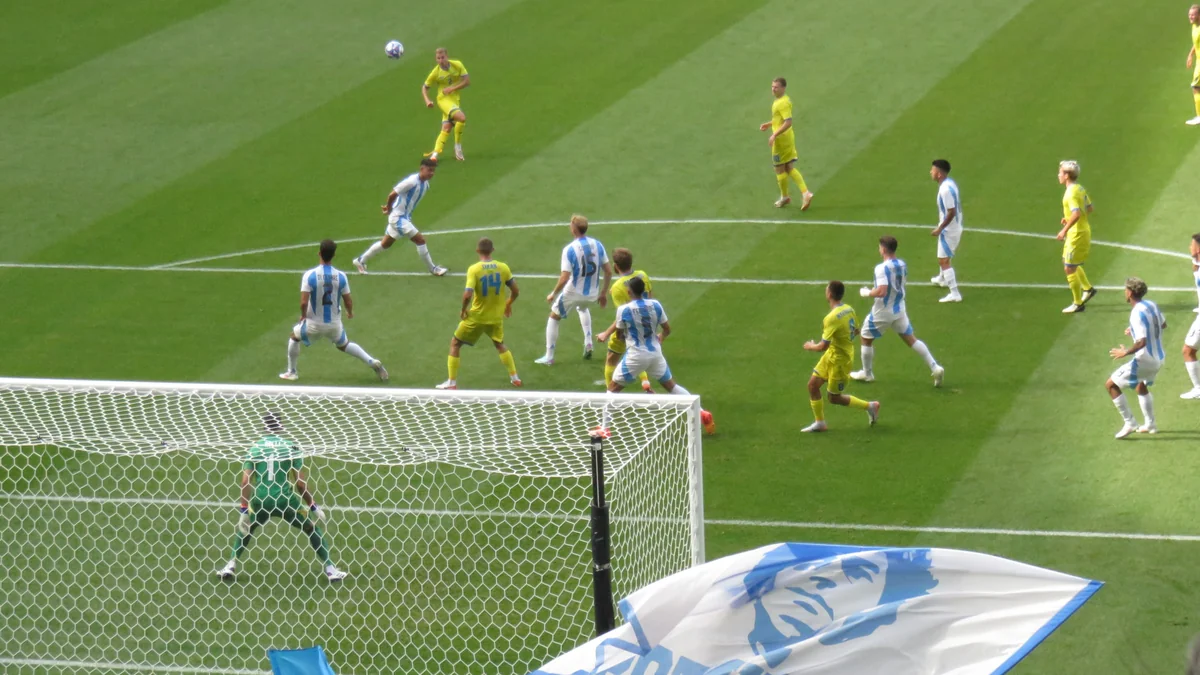
Match-context note: Yamal’s per-match completed take-ons, progressive carries and minutes load in La Liga, Champions League and senior international football sit at the upper end of the teenage-winger distribution (Match data: SofaScore), with the discriminator being the early-career exposure rate rather than peak per-match output.
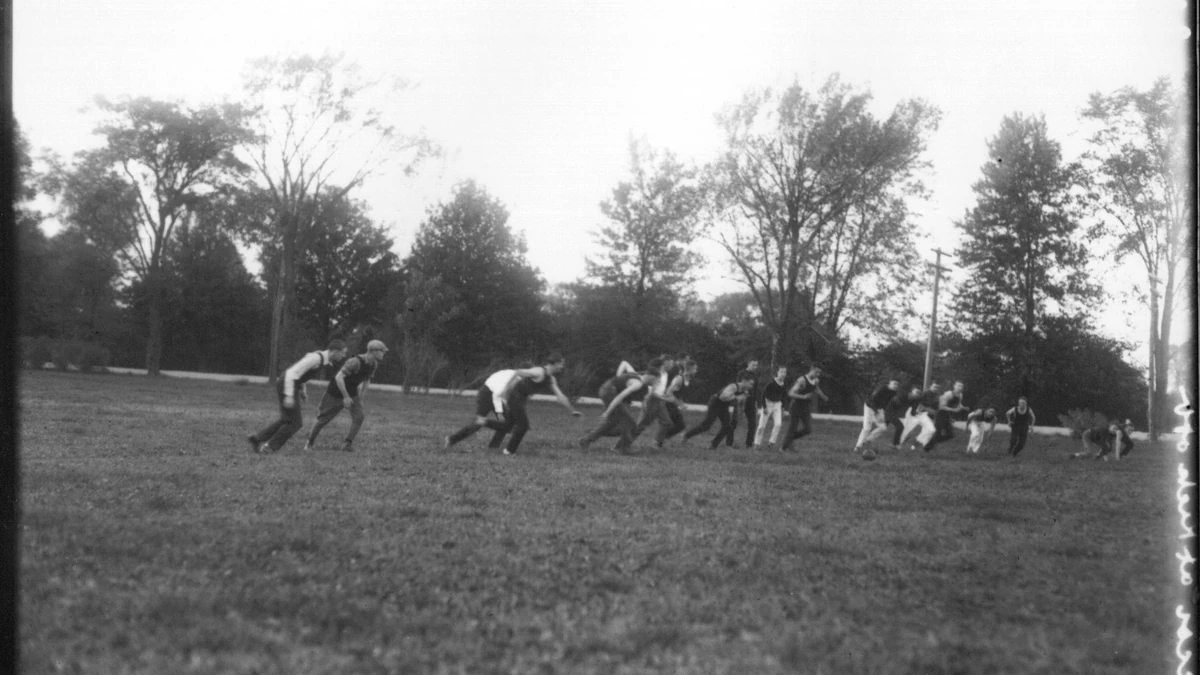
Flickr: Miami U. Libraries – Digital Collections.
What This Means for the Reader
For parents, coaches and developing wingers, the takeaway is that the Yamal case is not a template — it is an outlier governed by an elite medical infrastructure that an amateur context cannot replicate. The transferable lesson is the one Gabbett and the youth-development literature have been making consistently: chronic load builds tissue tolerance, acute spikes break it, and the developing skeleton has narrower spike tolerance than the adult skeleton [3, 5]. The amateur diagnostic uses three measurements: a weekly training-and-match-minute log, a weekly session-RPE × duration product to estimate internal load, and an ACWR computed across a four-week rolling window.
The training prescription targets the diagnostic finding. Teenagers in the post-PHV / pre-skeletal-closure window should be progressed in chronic load with bounded weekly spikes, with explicit attention to traction-apophysis warning signs (tibial tuberosity tenderness, posterior-heel pain, anterior-iliac-spine soreness) and a low threshold for de-loading when those signs appear [1, 3]. The error to avoid is mistaking acute capability — what the teenager can do this week — for chronic tolerance — what the teenager should do across a season.
The diagnostic question for the teenage winger and the coach: is this week’s load consistent with the four-week chronic load, and is the body showing any of the apophysis-traction warning signs? If the answer is no and no, the load is permissible. If either answer flips, the load is the variable to govern, not the body.
References
- Malina RM, Eisenmann JC, Cumming SP, Ribeiro B, Aroso J. (2004). Maturity-associated variation in the growth and functional capacities of youth football (soccer) players 13–15 years. European Journal of Applied Physiology, 91(5–6): 555–562. doi:10.1007/s00421-003-0995-z
- Mirwald RL, Baxter-Jones AD, Bailey DA, Beunen GP. (2002). An assessment of maturity from anthropometric measurements. Medicine and Science in Sports and Exercise, 34(4): 689–694. doi:10.1097/00005768-200204000-00020
- Lloyd RS, Oliver JL. (2012). The Youth Physical Development Model: a new approach to long-term athletic development. Strength and Conditioning Journal, 34(3): 61–72. doi:10.1519/SSC.0b013e31825760ea
- Stølen T, Chamari K, Castagna C, Wisløff U. (2005). Physiology of soccer: an update. Sports Medicine, 35(6): 501–536. doi:10.2165/00007256-200535060-00004
- Gabbett TJ. (2016). The training–injury prevention paradox: should athletes be training smarter and harder? British Journal of Sports Medicine, 50(5): 273–280. doi:10.1136/bjsports-2015-095788
Match-context data (descriptive only): SofaScore.
The Athlete in One Paragraph
Lamine Yamal Nasraoui Ebana (b. 2007-07-13, Esplugues de Llobregat, Spain) is, as of September 2026, a winger for FC Barcelona and the Spain national team — listed at 1.80 m and ~73 kg, and already a senior international and the youngest UEFA European Championship winner…
The Physiology — what skeletal-immaturity load actually means
Biological age is not chronological age, and skeletal age is not either; the two diverge across adolescence and the gap is the single most under-respected variable in youth-football medicine. Malina and colleagues, working with 13–15-year-old academy players, demonstrated that maturity-associated variation in stature, mass, lean…
The Case — Yamal as skeletal-immaturity-load archetype
For a 1.80 m, ~73 kg winger competing in La Liga, Champions League and senior international football before the typical close of skeletal maturation, the load profile is structurally unusual. Wingers operate at the high-intensity-distance end of the team-running distribution, with repeated max-velocity sprints and…
What This Means for the Reader
For parents, coaches and developing wingers, the takeaway is that the Yamal case is not a template — it is an outlier governed by an elite medical infrastructure that an amateur context cannot replicate. The transferable lesson is the one Gabbett and the youth-development literature…