Preview
Hüseyin Akbulut, MSc (2026). Tadej Pogačar and the Power-to-Weight Ratio of an Elite Climbing Cyclist. Sporeus. Retrieved, October 18, 2026. https://sporeus.com/en/science/tadej-pogacar-power-to-weight-uphill/
The Athlete in One Paragraph
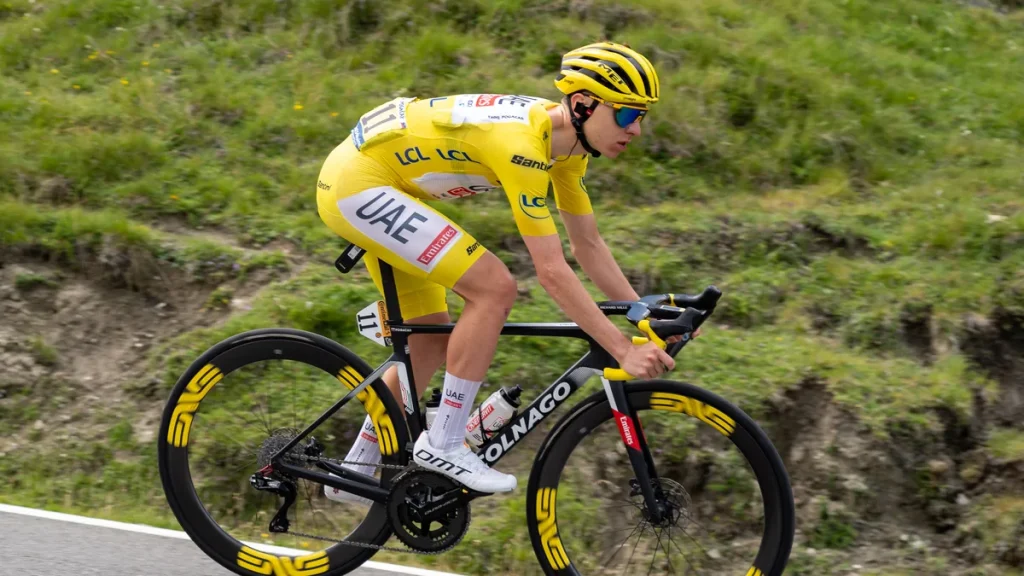
Tadej Pogačar (b. 21 September 1998, Komenda, Slovenia) is, as of September 2026, a road cyclist for UAE Team Emirates and the Slovenian national team. Listed at 1.76 m and ~66 kg, he is a pure stage-race general-classification rider whose competitive identity is built on multi-week grand tours decided in the high mountains; multiple Tour de France victories sit on a profile that is fundamentally about sustained climbing performance rather than peak sprint power. The interesting case for sport science is the discriminator that decides every long, sustained ascent in professional cycling: power-to-weight ratio — the watts an athlete can produce, normalised to body mass, at a sustainable fraction of VO₂max for the duration of a 30–50-minute climb. Below the topic phrase, every other variable a climber trains is essentially a route to the same destination.
Table of Contents
The Physiology — what power-to-weight actually is
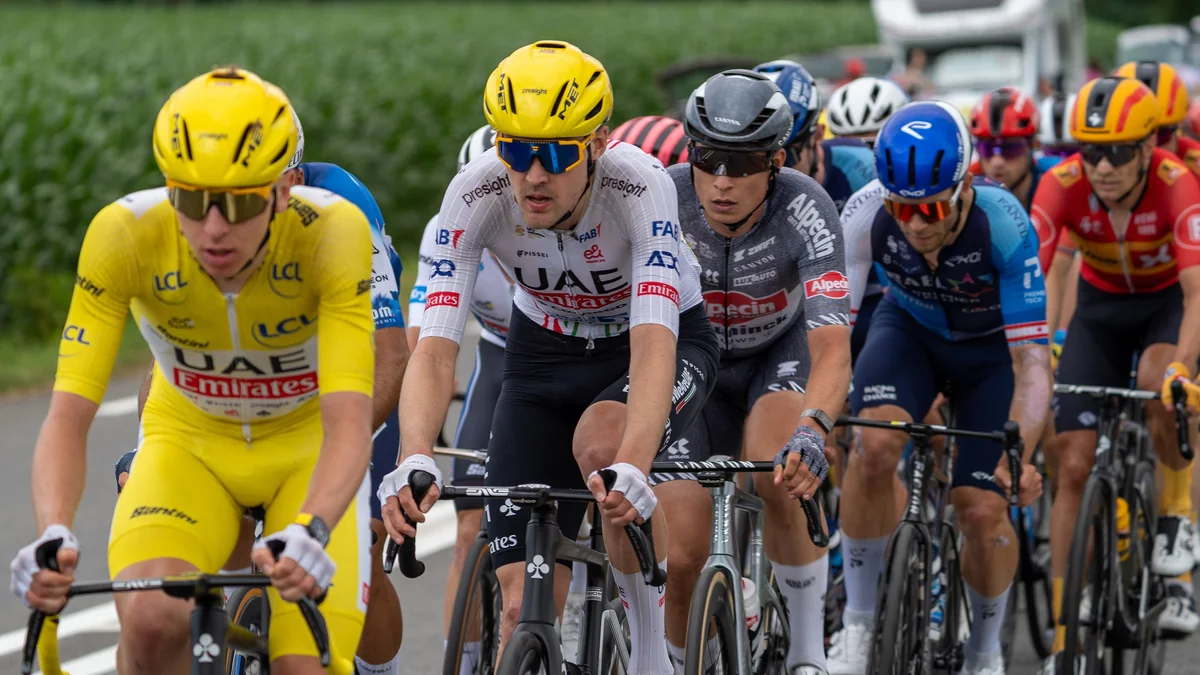
In endurance cycling, performance on flat ground is dominated by aerodynamics — the rider’s frontal area, drag coefficient and absolute power output [3]. On a sustained climb of 6–10% gradient, however, gravity dominates: the rate-limiting variable is no longer absolute watts but watts per kilogram of total system mass. The Joyner and Coyle framework for endurance performance — VO₂max, lactate threshold, and exercise economy — translates directly into cycling, with the additional twist that climbing performance is driven by VO₂max expressed relative to body mass [1].
Two riders with identical absolute VO₂max in litres per minute can perform very differently on a climb if one of them weighs 8–10 kg less; the lighter rider’s mass-specific oxygen uptake — millilitres per kilogram per minute — is higher, and therefore the sustainable wattage per kilogram is higher. This is why the elite climber’s anthropometric profile is consistent across decades: small frame, low fat mass, lean lower-body musculature carrying just enough cross-sectional area to produce the watts [3].
The second component is the threshold position. Faude and colleagues’ review of lactate-threshold concepts established that the highest sustainable steady-state intensity is the maximal lactate steady state (MLSS) — the point above which blood lactate accumulates uncontrollably [2]. A climber’s race-decisive ability is to ride at or just below MLSS for 30–50 minutes; the absolute watts at that intensity, divided by body mass, is the climbing currency.
The third component is economy. Saunders and colleagues identified the determinants of running economy in endurance athletes — stride mechanics, tendon stiffness, neuromuscular efficiency — and the cycling equivalent is pedalling economy: the oxygen cost of producing a given submaximal wattage [4]. Two climbers at the same MLSS-power-per-kilogram can still differ by several percent in oxygen cost, and over a 40-minute climb, several percent compounds. Helgerud and colleagues’ interval-training work showed that aerobic ceiling and economy are both trainable on the same stimulus — high-intensity intervals improve VO₂max while preserving the threshold’s positional fraction [5].
The Case — Pogačar as the modern climbing archetype
For a 66 kg rider, the climbing arithmetic is unforgiving and clean: every additional kilogram of body mass costs sustained wattage on the climb, and every additional watt at threshold-power-per-kilogram buys time on the rivals. Pogačar’s anthropometric profile — 1.76 m, lean, with a frontal area small enough that the aero penalty on rolling terrain is manageable — is consistent with the climbing archetype that has dominated grand-tour general classifications for the last decade.
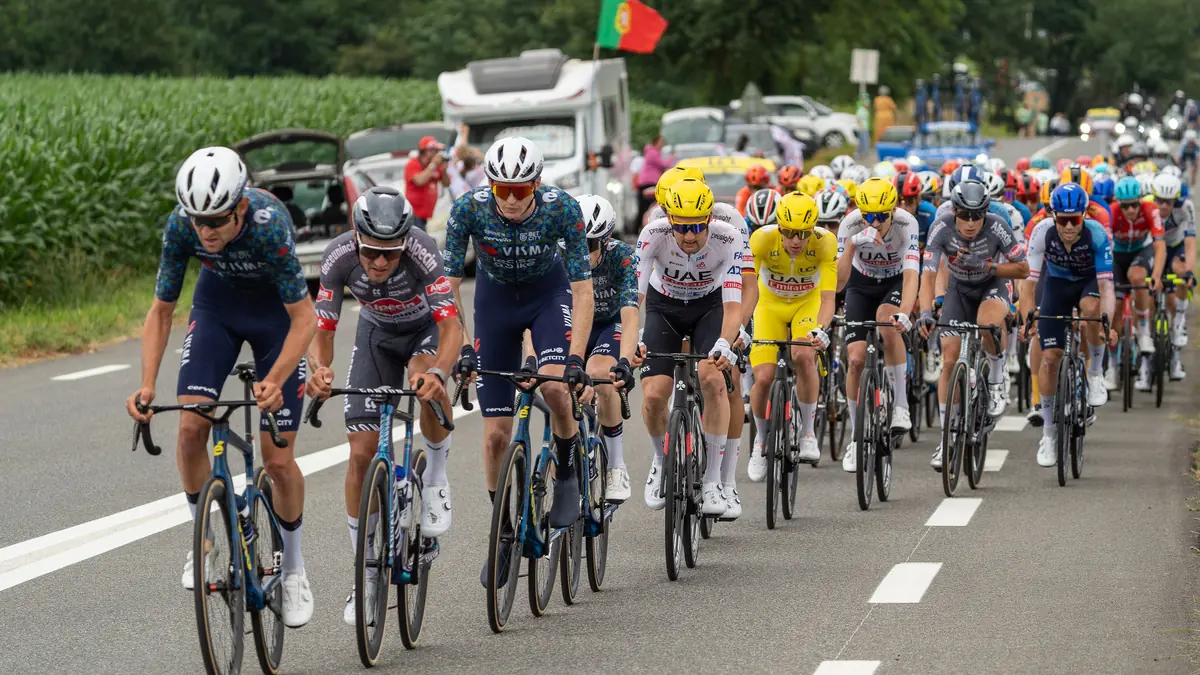
The interesting wrinkle in Pogačar’s case is range: he is not a pure climber in the historical sense, because he also competes in one-day classics where short, explosive efforts on cobbled ramps demand a different metabolic profile. Buchheit and Laursen’s HIIT review formalised the principle that aerobic and anaerobic capacities are not opposed in endurance sport — the well-trained aerobic system supports faster recovery between supra-threshold attacks, which means the climber who can attack repeatedly on the final ascent is also the climber whose threshold is highest [5]. Pogačar’s race repertoire — the ability to drop rivals on a 5-kilometre climb finish and to sustain a 40-minute solo on a longer ascent — is consistent with a rider whose threshold-power-per-kilogram sits at the upper bound of the contemporary peloton.
The body-mass discipline is the unspoken constraint underneath the wattage. The grand-tour climber’s race weight is not an aesthetic choice but a physiological one: every kilogram costs wattage on the gradient, and every kilogram below an athlete’s structural minimum costs durability and immune function. Pogačar’s stable race weight across multiple seasons is descriptively consistent with a rider whose physiological window is narrow and well-managed [1, 4].
(Performance data: UCI / ProCyclingStats)
What This Means for the Reader
For the amateur cyclist, the takeaway is that absolute wattage is a vanity metric on any course with significant climbing. The relevant number is your sustainable threshold wattage divided by your body mass; the rider who improves either numerator (training the threshold) or denominator (managing body composition without compromising structural mass) gains directly. Both at once compounds.
The training implication is that climbing-specific work is best built on a long aerobic base — Helgerud’s interval prescription on top of an already-developed aerobic ceiling, rather than as a substitute for it [5]. The amateur who chases interval sessions while neglecting the long, low-intensity aerobic stimulus typically plateaus at a threshold wattage that will not respond to more intervals; the ceiling has not been raised, and the threshold cannot move higher than the ceiling allows.
The diagnostic question for the developing climber: what is your sustainable wattage for 20 minutes, divided by your race-weight kilograms? The number — not the bike, not the kit — is the predictor of how the next climb ends.
References
- Joyner MJ, Coyle EF. (2008). Endurance exercise performance: the physiology of champions. The Journal of Physiology, 586(1): 35–44. doi:10.1113/jphysiol.2007.143834
- Faude O, Kindermann W, Meyer T. (2009). Lactate threshold concepts: how valid are they? Sports Medicine, 39(6): 469–490. doi:10.2165/00007256-200939060-00003
- Billat VL. (1996). Use of blood lactate measurements for prediction of exercise performance and for control of training. Sports Medicine, 22(3): 157–175. doi:10.2165/00007256-199622030-00003
- Saunders PU, Pyne DB, Telford RD, Hawley JA. (2004). Factors affecting running economy in trained distance runners. Sports Medicine, 34(7): 465–485. doi:10.2165/00007256-200434070-00005
- Helgerud J, Engen LC, Wisløff U, Hoff J. (2001). Aerobic endurance training improves soccer performance. Medicine and Science in Sports and Exercise, 33(11): 1925–1931. doi:10.1097/00005768-200111000-00019
Performance data (descriptive only): UCI / ProCyclingStats.
Discuss this in the forum: Climbing on the bike: seated or out of the saddle?
Hüseyin Akbulut is the founder of Sporeus and author of THRESHOLD (EŞİK), a 540-page Turkish-language book on endurance science.
- 540pp THRESHOLD Book
- MSc Sport Sciences
- Marmara University
The Athlete in One Paragraph
Tadej Pogačar (b. 21 September 1998, Komenda, Slovenia) is, as of September 2026, a road cyclist for UAE Team Emirates and the Slovenian national team. Listed at 1.76 m and ~66 kg, he is a pure stage-race general-classification rider whose competitive identity is built on…
The Physiology — what power-to-weight actually is
In endurance cycling, performance on flat ground is dominated by aerodynamics — the rider's frontal area, drag coefficient and absolute power output [3]. On a sustained climb of 6–10% gradient, however, gravity dominates: the rate-limiting variable is no longer absolute watts but watts per kilogram…
The Case — Pogačar as the modern climbing archetype
For a 66 kg rider, the climbing arithmetic is unforgiving and clean: every additional kilogram of body mass costs sustained wattage on the climb, and every additional watt at threshold-power-per-kilogram buys time on the rivals. Pogačar's anthropometric profile — 1.76 m, lean, with a frontal…
What This Means for the Reader
For the amateur cyclist, the takeaway is that absolute wattage is a vanity metric on any course with significant climbing. The relevant number is your sustainable threshold wattage divided by your body mass; the rider who improves either numerator (training the threshold) or denominator (managing…