Preview
Hüseyin Akbulut, MSc (2026). Achilles Tendinopathy: Causes, Treatment and Return to Training. Sporeus. Retrieved, November 19, 2026. https://sporeus.com/en/sport/achilles-tendinopathy-causes-treatment-return/
Achilles tendinopathy is a degenerative condition, usually caused by structural changes within the tendon.
Table of Contents
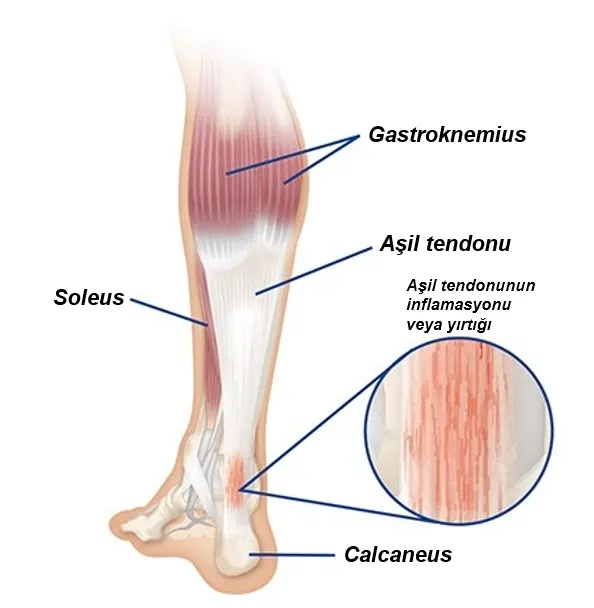
It is felt as pain along the tendon or at the heel bone (calcaneus).
The pain typically appears in the morning or at the start of a run, and it eases temporarily once you are warmed up. Treatment should start early and be appropriate; otherwise the problem can become chronic.
Achilles tendinopathy develops through overuse of the Achilles tendon, which attaches the calf muscles to the heel bone. A poor balance between loading and rest in the training programme is another common cause.
It also appears when people over middle age take up speed and agility training irregularly. These individuals first need a good preparation period; without one, the likelihood of this and similar injuries is high.
Elite athletes may feel Achilles pain in phases when training intensity rises. This pain can also be part of the tendon’s adaptation process. Athletes who recognise these limits can get through such phases without injury if they are careful.
Be aware of the pain, don’t panic, and plan and carry out your training intensities and your warm-ups and cool-downs carefully.
Achilles tendon ruptures can be managed either surgically or with functional (non-surgical) treatment that includes early loading; in recent studies the outcomes of the two approaches are largely similar, and the decision should be made together with a physician.
Common Causes
Achilles tendinopathy usually develops because of rapid increases in training load (distance, duration, intensity), an individual’s running biomechanics, choice of shoes or the running surface.
Prevention
The following steps can help prevent Achilles tendinopathy:
- Increase your activity level gradually.
- Learn to rest.
- Choose your shoes carefully.
- Replace worn-out shoes.
- Maintain calf flexibility (stretching alone has not been shown to prevent tendinopathy).
- Strengthen your calf muscles.
- Add variety to your exercise plan.
Treatment
Early treatment is essential for full recovery and usually includes:
- Load management rather than complete rest (continuing with activities that do not clearly increase the pain)
- Ice for short-term pain relief
- Short-term anti-inflammatory painkillers if needed (no long-term benefit has been shown in tendinopathy)
- A temporary reduction in exercise intensity
- Shoes with a slightly higher heel to offload the tendon
- The foundation of treatment: progressive loading exercises (eccentric or heavy slow resistance training), the approach with the strongest evidence in current clinical guidelines
Returning to Training
If the problem is caught early, training intensity is generally reduced, and Achilles tendinopathy usually settles within a few weeks to a few months with progressive loading exercises (the classic eccentric protocol lasts 12 weeks).
After that, training intensity should be increased slowly and gradually.
Remember that in tendon injuries pain perception can be misleading, and the tendon’s response to load may only show up 24 hours later. According to the pain-monitoring model widely used in rehabilitation, pain during exercise should not exceed 5 out of 10, and pain and stiffness the next morning should return to their previous level (Silbernagel et al., 2007).
Low-intensity exercise in the pool or on the bike helps maintain aerobic fitness without overloading the tendon.
Running at high speed or on hilly terrain places heavy stress on the tendon, so avoid these loads during recovery.
For elite runners: A heavy slow resistance programme (Beyer et al., 2015) has been shown to be as effective as the classic eccentric protocol, and athletes adhere to it better. At elite level, rehabilitation does not end when the pain goes away. Once calf and soleus strength is close to that of the healthy side, hopping and plyometric exercises are added gradually so that the tendon regains its capacity to store energy; only then do athletes return to high-speed running, hill sessions and racing shoes. Skipping these stages is thought to increase the risk of recurrence.
You may also be interested in: Patellofemoral Pain: The Most Common Knee Injury in Running (in Turkish)
References
- Alfredson H, Pietilä T, Jonsson P, Lorentzon R. (1998). Heavy-load eccentric calf muscle training for the treatment of chronic Achilles tendinosis. The American Journal of Sports Medicine, 26(3): 360-366. doi:10.1177/03635465980260030301
- Martin RL, Chimenti R, Cuddeford T, Houck J, Matheson JW, McDonough CM, Paulseth S, Wukich DK, Carcia CR. (2018). Achilles pain, stiffness, and muscle power deficits: midportion Achilles tendinopathy revision 2018 (clinical practice guidelines). Journal of Orthopaedic & Sports Physical Therapy, 48(5): A1-A38. doi:10.2519/jospt.2018.0302
- Li HY, Hua YH. (2016). Achilles tendinopathy: current concepts about the basic science and clinical treatments. BioMed Research International, 2016: 6492597. doi:10.1155/2016/6492597

Hüseyin Akbulut is the founder of Sporeus and author of THRESHOLD (EŞİK), a 540-page Turkish-language book on endurance science.
- 540pp THRESHOLD Book
- MSc Sport Sciences
- Marmara University
Common Causes
Achilles tendinopathy usually develops because of rapid increases in training load (distance, duration, intensity), an individual's running biomechanics, choice of shoes or the running surface.
Prevention
The following steps can help prevent Achilles tendinopathy:
Treatment
Early treatment is essential for full recovery and usually includes:
Returning to Training
If the problem is caught early, training intensity is generally reduced, and Achilles tendinopathy usually settles within a few weeks to a few months with progressive loading exercises (the classic eccentric protocol lasts 12 weeks).