
Preview
Hüseyin Akbulut, MSc (2026). Heart Rate in Exercise: Maximum, Resting and Reserve. Sporeus. Retrieved, November 19, 2026. https://sporeus.com/en/sport/exercise-heart-rate-max-resting-reserve/
When you start a training programme (in Turkish), you should first assess your current fitness. Then you should follow a programme and exercises that suit you in a planned way and track your progress. You can begin with two simple, basic parameters, heart rate and rating of perceived exertion, and use them to get more out of your training.
Table of Contents
Up to a point, heart rate rises linearly with exercise intensity. This means we have a physiological parameter we can use soundly across the whole process, from planning training programmes to carrying them out. Provided we use it correctly, of course!
Used over a given programme or period, heart rate is an important indicator of your form, that is, your current fitness.
For example, imagine you train at a certain running speed and track your heart rate. If in the following weeks of the programme your heart rate at that same speed is lower, you can conclude that the session no longer places enough stress on your body.
There are a few things to watch out for.
Heart rate can be affected by fatigue, heat, terrain and many other factors.
To allow for this, use your heart rate while paying attention to your training programme, how your day has gone and so on.
You can also use scales such as the rating of perceived exertion, which is often used to set an athlete’s training intensity.
With these scales you simply rate the intensity of the session on a scale from 0 to 10 after exercise. They are also useful for your rest intervals.

(0 is the lowest and 10 the highest intensity; it can be used alongside heart rate)
Heart Rate Values During Exercise
You can measure your heart rate during exercise with a wrist watch or a chest strap. A good chest strap measures heart rate accurately even when you are moving a lot.
One calculation you should use in training is your heart rate reserve.
Heart rate reserve is the difference between your resting heart rate and your maximum heart rate, and it represents the range you can use during exercise. If your heart rate is high even at rest, a given workout is relatively more intense for you, which suggests you may need longer rest intervals.
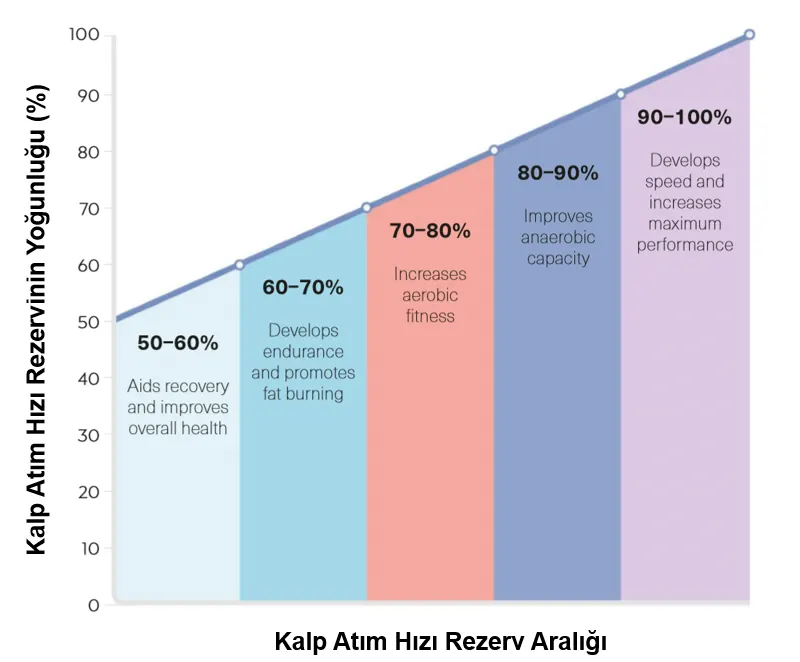
The figure below shows how to train using your heart rate reserve. It is taken from Dr Chris Napier’s book Science of Running and shows the relationship between heart rate reserve ranges and exercise intensity during running.
You can use it to calculate your own target heart rate with this formula (the Karvonen method): (heart rate reserve × intensity percentage) + resting heart rate = target heart rate.
For example, suppose your heart rate reserve is 110 beats/min, your resting heart rate is 70 beats/min and you want to train at 85% intensity.
(110 × 0.85) + 70 = 163.5, so your target heart rate is about 164 beats/min.
Heart Rate Calculations for Exercise
The heart is a muscle that gets stronger with exercise. The lower your resting heart rate, the more efficiently your heart is working. Your maximum heart rate tells you about your effort and intensity level during exercise. If you understand the heart a little and use that knowledge when planning and doing your workouts, your training will be much more effective and you will see healthy progress in your performance.
Resting Heart Rate
Your heart rate measured when you wake up in the morning, before getting out of bed, is your resting heart rate. For an accurate value, measure it every morning for several days. If you are not wearing a watch or chest strap, count your heartbeats for 10 seconds and multiply by 6. Now you know your resting heart rate.
Maximum Heart Rate
The simplest way to estimate your maximum heart rate is the formula 220 − age, but it can be off by as much as 10–12 beats/min between individuals. The formula of Tanaka and colleagues (2001), 208 − 0.7 × age, gives a more accurate estimate, especially at older ages. To determine maximum heart rate properly you should do an exercise test (see VO₂max testing). But if you are not at that level yet, you can estimate it with a simple formula and use it in training.
With these simple calculations you can set your training ranges and use them with confidence. A good athlete learns over time to read their body very well. But if you are new to sport, these calculations can be a lifesaver for setting your intensity ranges.
Related: Heart Rate Zones: The 5-Zone System for Endurance Training
References
- Tanaka H, Monahan KD, Seals DR. (2001). Age-predicted maximal heart rate revisited. Journal of the American College of Cardiology, 37(1): 153-156. doi:10.1016/S0735-1097(00)01054-8
- Karvonen MJ, Kentala E, Mustala O. (1957). The effects of training on heart rate; a longitudinal study. Annales Medicinae Experimentalis et Biologiae Fenniae, 35(3): 307-315
- Borg GA. (1982). Psychophysical bases of perceived exertion. Medicine & Science in Sports & Exercise, 14(5): 377-381. doi:10.1249/00005768-198205000-00012

Hüseyin Akbulut is the founder of Sporeus and author of THRESHOLD (EŞİK), a 540-page Turkish-language book on endurance science.
- 540pp THRESHOLD Book
- MSc Sport Sciences
- Marmara University
Heart Rate Values During Exercise
You can measure your heart rate during exercise with a wrist watch or a chest strap. A good chest strap measures heart rate accurately even when you are moving a lot.
Heart Rate Calculations for Exercise
The heart is a muscle that gets stronger with exercise. The lower your resting heart rate, the more efficiently your heart is working. Your maximum heart rate tells you about your effort and intensity level during exercise. If you understand the heart a little and…
Resting Heart Rate
Your heart rate measured when you wake up in the morning, before getting out of bed, is your resting heart rate. For an accurate value, measure it every morning for several days. If you are not wearing a watch or chest strap, count your heartbeats…
Maximum Heart Rate
The simplest way to estimate your maximum heart rate is the formula 220 − age, but it can be off by as much as 10–12 beats/min between individuals. The formula of Tanaka and colleagues (2001), 208 − 0.7 × age, gives a more accurate estimate,…