Preview
Hüseyin Akbulut, MSc (2026). Cortisol: How It Is Triggered, Released and Inhibited. Sporeus. Retrieved, November 18, 2026. https://sporeus.com/en/science/cortisol-release-and-inhibition/
In this article we look at how cortisol is synthesised and released, its feedback mechanisms and its effects on the body. In two earlier articles, to better understand their physiological mechanisms and feedback loops, we discussed how growth hormone and testosterone are secreted and how their release is stopped.
Table of Contents
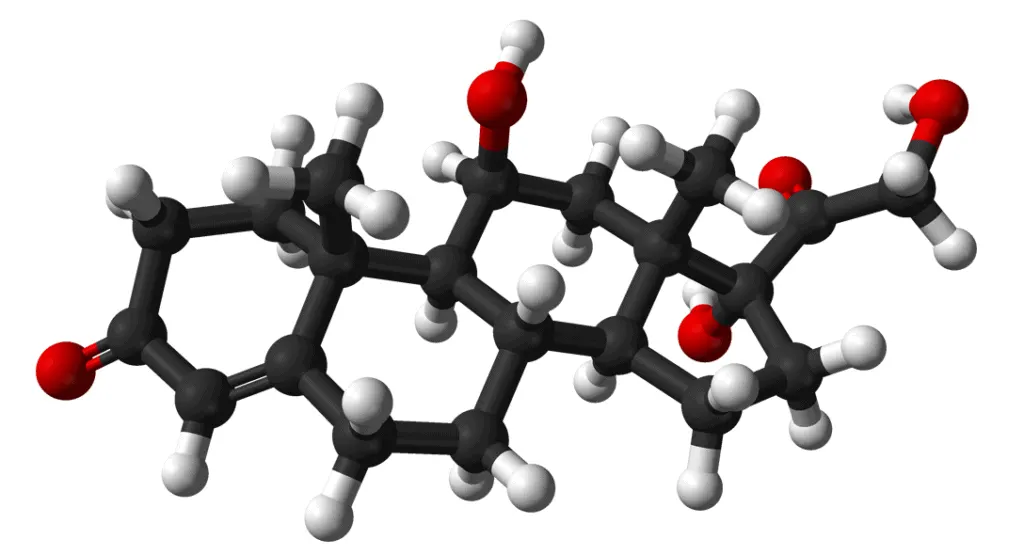
Like testosterone, cortisol is a steroid hormone.
Prolonged fasting, prolonged exercise, stress and circadian rhythms all play an important role in the synthesis and release of cortisol.
Cortisol is also known as the stress hormone.
Cortisol is secreted on a circadian rhythm: its lowest level is around midnight, it begins to rise in the early hours of the morning and it peaks shortly after waking.
How Cortisol Is Released
To understand its cycle, we need to start with the hypothalamus, as we did with the other hormones. Neurosecretory cells in the hypothalamus play an active role in triggering the synthesis and release of hormones.
For cortisol to be released, these neurosecretory cells first synthesise and secrete corticotropin-releasing hormone (CRH).
When neurosecretory neurons synthesise CRH, the hormone travels along the axon to the axon terminal, where it is released.
Once secreted, CRH reaches the hypophyseal portal system, which links the hypothalamus to the anterior pituitary gland. There, CRH binds to endocrine cells. When it binds, the anterior pituitary synthesises and releases another hormone: adrenocorticotropic hormone (ACTH).
ACTH enters the systemic circulation and spreads throughout the body. It specifically targets the adrenal glands, which sit on top of the kidneys. Each adrenal gland has two parts: the medulla at its centre, and the adrenal cortex, which surrounds the medulla and forms the outer layer.
When ACTH reaches the adrenal glands, it targets the zona fasciculata of the adrenal cortex. This binding stimulates the zona fasciculata to synthesise and release cortisol. In other words, producing and secreting cortisol is the zona fasciculata’s most important job.
Cortisol’s Targets in the Circulation
Once cortisol enters the circulation, it has several different targets.
First, it targets adipose tissue. Whether in visceral fat or peripheral fat, cortisol promotes lipolysis, the breakdown of fat. When lipolysis occurs, triglycerides are split into glycerol and fatty acids.
Glycerol can be converted into glucose in the liver, which raises plasma glucose.
Fatty acids also enter the circulation, so the amount of fatty acids in the plasma rises. Fatty acids also reach the liver, where they are converted into acetyl coenzyme A (acetyl-CoA). These molecules are then turned into ketone bodies (a process called ketogenesis) and released into the bloodstream, so plasma ketone levels rise.
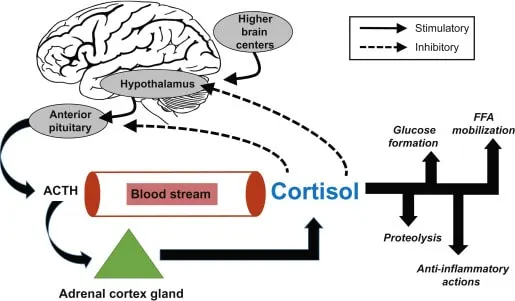
Cortisol also affects skeletal muscle, where it causes proteolysis: proteins are broken down and amino acids are released.
These amino acids enter the circulation and their plasma concentration rises. They also travel to the liver, where they are converted into pyruvate, which opens the way for their conversion into glucose. As a result, plasma glucose levels rise further.
So when cortisol levels in the bloodstream rise, plasma glucose, amino acids, ketone bodies and fatty acids all increase. If this continues for a long time, the resulting energy surplus tends to be stored as triglyceride, or fat, especially in visceral tissue. In the long run this becomes another source of stress.
Chronic Effects of Cortisol
When we expose the body to prolonged stress, and therefore secrete cortisol for long periods, chronic stress develops. We know that small doses of stress are good for the body, but chronic stress is not one of them.
Now imagine your visceral and peripheral fat: a layer of fat inside your abdominal wall surrounding your organs, and an outer layer of fat beneath your skin.
Under chronic stress, glucose, fatty acids, amino acids and the other substances we listed are released into the bloodstream. With prolonged and marked cortisol excess (Cushing’s syndrome is the extreme example), this process leads to visceral fat gain, especially around the waist. The effect of everyday stress in this direction is smaller and varies from person to person.
Effects of Cortisol on the Brain
Chronic stress-related cortisol release also affects the brain. The hippocampus, a region in the medial temporal lobe mainly involved in memory, which also helps regulate the endocrine system and influences many other systems, can lose volume under chronic, severe stress. This has been shown in animal studies and in patients exposed to high glucocorticoid levels for long periods.
The hippocampus normally plays a key role in converting short-term memories into long-term ones. If it atrophies, these abilities can suffer, and this is associated with memory problems.
Chronic cortisol release also damages the prefrontal cortex, which is linked to concentration, decision-making and creativity. Impairment in these systems is associated with depression.
The amygdala, another brain structure, is also affected by chronic cortisol release. The amygdala has many functions but is generally known as the centre of fear and worry. Under prolonged stress, unlike the hippocampus, the amygdala shows overactivity and growth of nerve cell branches; these changes are associated with anxiety.
Chronic stress-related cortisol release also causes the thymus, which sits behind the breastbone, to atrophy. The thymus is very important because it is involved in immune responses. If its cells begin to shrink and die, its role in the immune system diminishes and immune responses are suppressed, leaving the body more vulnerable to disease.
How Cortisol Release Is Stopped
Once cortisol has been synthesised and released, the body’s systems need to restrain or stop it.
While cortisol is in the systemic circulation, it inhibits the endocrine cells of the anterior pituitary, reducing their sensitivity to CRH. This in turn reduces the release of ACTH.
Cortisol also has an inhibitory effect on the hypothalamus, where it suppresses the synthesis and secretion of CRH. As a result, the hypothalamus and the endocrine cells of the anterior pituitary can no longer communicate to release ACTH. Without that communication, ACTH cannot bind to receptors in the zona fasciculata, and cortisol cannot be released.
This is how cortisol release is stopped.
What it means for athletes: Exercise raises cortisol depending on intensity and duration; a marked rise is usually seen at intensities above about 60% of VO2max and in long sessions. This acute rise is not harmful; it is needed for energy mobilisation and adaptation. What elite athletes really need to watch are the conditions that raise cortisol chronically: low energy availability, sleep loss and accumulated load without recovery. Carbohydrate intake during long sessions has also been shown to reduce the cortisol response. A single cortisol measurement, however, is not enough to diagnose overtraining; the daily rhythm and individual variability are too large.
You may also like: Testosterone: How It Is Triggered, Released and Inhibited (in Turkish)
References
- Herman, J.P., McKlveen, J.M., Ghosal, S., Kopp, B., Wulsin, A., Makinson, R., Scheimann, J. & Myers, B. (2016). Regulation of the Hypothalamic-Pituitary-Adrenocortical Stress Response. Comprehensive Physiology, 6(2), 603–621. https://doi.org/10.1002/cphy.c150015
- Sapolsky, R.M. (2000). Glucocorticoids and hippocampal atrophy in neuropsychiatric disorders. Archives of General Psychiatry, 57(10), 925–935.
- Arnsten, A.F.T. (2009). Stress signalling pathways that impair prefrontal cortex structure and function. Nature Reviews Neuroscience, 10(6), 410–422. https://doi.org/10.1038/nrn2648

Hüseyin Akbulut is the founder of Sporeus and author of THRESHOLD (EŞİK), a 540-page Turkish-language book on endurance science.
- 540pp THRESHOLD Book
- MSc Sport Sciences
- Marmara University
How Cortisol Is Released
To understand its cycle, we need to start with the hypothalamus, as we did with the other hormones. Neurosecretory cells in the hypothalamus play an active role in triggering the synthesis and release of hormones.
Cortisol's Targets in the Circulation
Once cortisol enters the circulation, it has several different targets.
Chronic Effects of Cortisol
When we expose the body to prolonged stress, and therefore secrete cortisol for long periods, chronic stress develops. We know that small doses of stress are good for the body, but chronic stress is not one of them.
Effects of Cortisol on the Brain
Chronic stress-related cortisol release also affects the brain. The hippocampus, a region in the medial temporal lobe mainly involved in memory, which also helps regulate the endocrine system and influences many other systems, can lose volume under chronic, severe stress. This has been shown in…
How Cortisol Release Is Stopped
Once cortisol has been synthesised and released, the body's systems need to restrain or stop it.