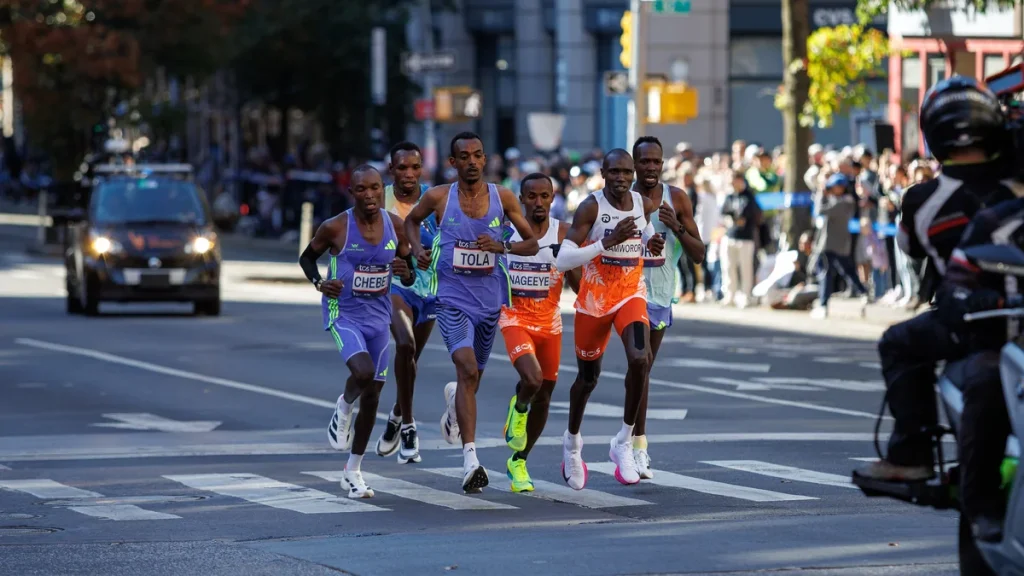
Preview
Hüseyin Akbulut, MSc (2026). The Heart Muscle: From Structure to Training Effects. Sporeus. Retrieved, November 19, 2026. https://sporeus.com/en/sport/heart-muscle-structure-function-training-effects/
What is cardiac muscle, and what makes it special? We are talking about a muscle that beats differently in athletes than in sedentary people, whose rhythm changes with training and which keeps contracting for our entire life. But how does it work?
Table of Contents
Cardiac muscle, also known as the myocardium in vertebrates, is one of the three main types of muscle.
Like skeletal muscle, cardiac muscle is built from contractile units called sarcomeres. This sets both of them apart from the third type, smooth muscle.
Cardiac muscle differs from striated skeletal muscle in that it works through rhythmic contractions and is controlled involuntarily. Its rhythmic contractions are initiated by the sinoatrial node, while the autonomic nervous system speeds that rhythm up or slows it down.
Its one job is to pump blood. The heart does this with its own electrical system, without waiting for an outside command (automaticity); the fact that a transplanted heart, whose nerve connections have been cut, keeps beating is the most striking proof. The nervous system and hormones only adjust the rate and the force of contraction.
When we look closely at cardiac muscle, what stands out is contraction, the basis of every heartbeat, and the rhythm of those contractions.
The amount of blood the heart pumps per minute, cardiac output, changes to meet the needs of peripheral tissues, skeletal muscles, the kidneys, the brain and other metabolic processes.
Cardiac output depends on the force and frequency of contraction generated by the cardiac muscle cells. Together these determine how efficiently the heart pumps blood.
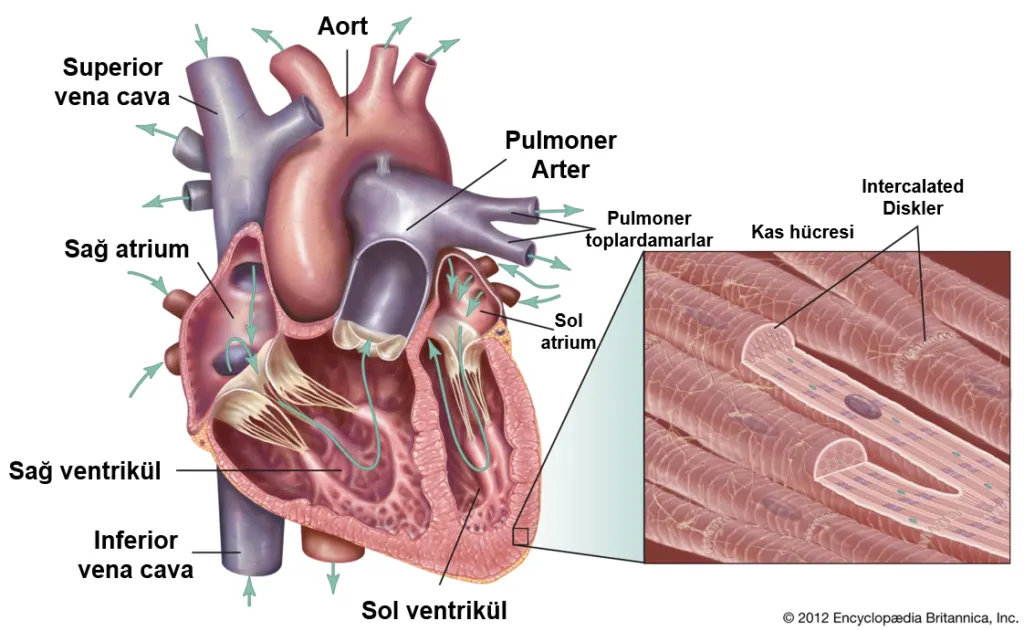
Cardiac muscle cells form a highly branched cellular network in the heart. They are joined to one another by intercalated discs and form the layered structure of the myocardium.
When the cardiac muscle cells begin to contract, they generate force, and with each contraction blood is sent into the pulmonary and systemic circulations.
Function
Cardiac muscle keeps working involuntarily to carry out the heart’s function: sending blood around the body. This is what distinguishes it from skeletal muscle, which is under voluntary control.
The rhythm starts at the sinoatrial node. The nervous system sends signals to the sinoatrial node cells to make them speed up or slow down.
The sinoatrial node cells are also connected to the other cardiac muscle cells and pass the signal on to them. This creates a wave of excitation that spreads through the heart, and the heart beats.
The Effects of Exercise on Cardiac Muscle
As with many other muscles in your body, exercise strengthens cardiac muscle and makes it work more efficiently.
The term “cardio” refers to exercise that improves the efficiency of the heart. Regular cardio exercise helps to regulate blood pressure and lowers resting heart rate.
Physical training changes the structure and appearance of skeletal muscle and alters its performance. The tissue of the heart muscle is also affected by training and adapts to it. If it is not challenged, its efficiency and volume decline.
Although muscle cells change in size, essentially no new cells are formed. Instead, proteins are added to the existing fibres, producing hypertrophy.
The cellular make-up of muscle depends on how it is used, and the changes depend on the type of training performed. In skeletal muscle, endurance training increases mitochondria, myoglobin and capillaries in the slow-twitch oxidative fibres. Endurance athletes usually have a higher proportion of slow-twitch fibres in their muscles; genetics, and the tendency of athletes to gravitate to sports that suit their gifts, play a part in this as well as training.
Resistance exercise, by contrast, produces hypertrophy, and strength and sprint athletes usually have a higher proportion of fast-twitch glycolytic fibres (see Physiopedia: Muscle).
There are many forms of training you can use for cardio (see Aerobic Exercise: What It Is, What It Does and How to Train). In recent years it has also become clear that high-intensity interval training has positive effects on the heart and circulation (see What Is HIIT?).
The Heart of the Elite Athlete
In athletes who do years of high-volume endurance training, the left ventricular cavity and stroke volume become markedly larger. This adaptation, known as the “athlete’s heart”, is one of the main determinants of maximal cardiac output and therefore of VO₂max (Pluim et al., 2000). Wall thickness can increase too, but in the study of elite athletes by Pelliccia and colleagues (1991), a left ventricular wall thickness above 13 mm was seen in only a small minority. Marked thickening, a family history of sudden death, or fainting during exercise should therefore never be dismissed as “athlete’s heart”; they need assessment by a sports cardiologist.
References
- Pluim, B.M., Zwinderman, A.H., van der Laarse, A., & van der Wall, E.E. (2000). The Athlete’s Heart: A Meta-Analysis of Cardiac Structure and Function. Circulation, 101(3), 336-344. https://doi.org/10.1161/01.CIR.101.3.336
- Fagard, R. (2003). Athlete’s heart. Heart, 89(12), 1455-1461. https://doi.org/10.1136/heart.89.12.1455
- Pelliccia, A., Maron, B.J., Spataro, A., Proschan, M.A., & Spirito, P. (1991). The upper limit of physiologic cardiac hypertrophy in highly trained elite athletes. New England Journal of Medicine, 324(5), 295-301. https://doi.org/10.1056/NEJM199101313240504

Hüseyin Akbulut is the founder of Sporeus and author of THRESHOLD (EŞİK), a 540-page Turkish-language book on endurance science.
- 540pp THRESHOLD Book
- MSc Sport Sciences
- Marmara University
The Effects of Exercise on Cardiac Muscle
As with many other muscles in your body, exercise strengthens cardiac muscle and makes it work more efficiently.
The Heart of the Elite Athlete
In athletes who do years of high-volume endurance training, the left ventricular cavity and stroke volume become markedly larger. This adaptation, known as the "athlete's heart", is one of the main determinants of maximal cardiac output and therefore of VO₂max (Pluim et al., 2000). Wall…