Preview
Hüseyin Akbulut, MSc (2026). HIIT Essentials, Part VIII: Loads and Stresses. Sporeus. Retrieved, November 18, 2026. https://sporeus.com/en/sport/hiit-essentials-loads-and-stresses/
When we look at HIIT formats, we have to consider the body’s energy production mechanisms, and therefore oxygen uptake and anaerobic glycolytic metabolism. We keep these processes in mind when we set the intensity and duration of the work bouts and the rest intervals in a session, and we try to plan them for the individual athlete.
One of the variables we watch is the time the body spends at intensities where it is consuming oxygen at or near its maximum, and how that time is distributed across the different formats. In repeated-sprint and sprint interval training this time window is very limited, yet these formats still make a considerable contribution to the athlete’s oxygen uptake. Long and short intervals, meanwhile, keep us under load at high levels of oxygen uptake for longer, which has a very positive effect on maximal oxygen uptake.
In long and short intervals, an important way to increase this time is to keep the work-to-rest ratio generally above 1 (for example, 30 seconds of work and 15 seconds of rest).
If the work bouts in a session are performed at the same intensity, each athlete’s physiological responses can still differ, even with a work-to-rest ratio of 1.
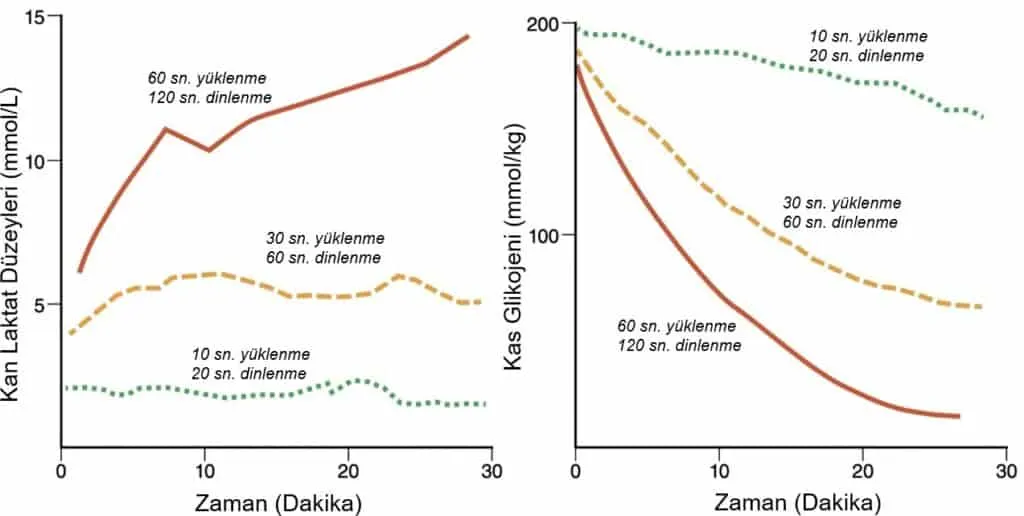
If a work level (expressed, for example, as running speed, weight lifted or power in watts) lies above the level that elicits maximal oxygen uptake, blood lactate tends to rise quickly. As the figure shows, the body’s physiological responses change with different durations and work levels, and when analysed they can be used to set athlete-specific work levels.
Game-based HIIT differs from other HIIT formats because it is so open to variation. It has to be adapted to the specific sport and group of athletes, and it can include technical and tactical elements. This can make physiological measurement difficult, because many variables, from in-game tactics to the playing surface, affect physiological responses such as heart rate, lactate levels and rating of perceived exertion.
External Loads, Internal Stresses2
The work and rest periods in a session represent the total stress we place on the body. Assessing the intensity and duration of a session, its passive or active rest intervals and its interaction with the sessions before and after it is very hard to quantify. Still, because we cannot ignore these factors altogether, assessing them with physiological and psychological measurements takes us a step forward.
It is not easy to think of training load as an output we can calculate. We need to find a reference point, but because these calculations vary so much between individuals, it is hard to rely on any single value.
Variables we can use to quantify training load, such as distance, running speed, work done in joules or the number of repetitions of a functional movement, can be called external loads.
The effort the body makes to overcome these calculated external loads comes through physiological responses. We can call these responses internal stresses.
We can measure internal stress through physiological data such as heart rate, maximal oxygen uptake, lactate values and muscle oxygen saturation, and use it to set training loads.
Training load, viewed as a combination of practical measurements and calculable values covering internal stresses and external loads, is a hard term to assess accurately: even when the measurable external loads are identical, each individual responds differently and the resulting internal stresses vary widely. What we need to do is choose simple, practical measures and use them regularly to monitor the training programme.
When this monitoring is done and the internal stress created by external loads is measured for the individual athlete, assessing the body’s physiological responses to exercise becomes an effective way to improve exercise performance.
For example, in training that is progressively increased over days, weeks and months (which, as we mentioned earlier, is the foundation of training science), an increase in running speed simply leads to changes in heart rate, oxygen uptake and many other physiological values.
When the body is repeatedly exposed to external loads it can overcome, it uses the anatomical and physiological adaptations it has made to respond to the same external load with lower internal stress. If the body’s adaptation is treated as one of the most important indicators, and external loads are increased at a set rate, the athlete’s development can be sustained over long periods.
If we take two athletes doing the same HIIT sessions, it is almost inevitable that their physiological responses will differ.
For example, imagine an athlete running at 17 km/h for 4 minutes, or rowing at 300 watts for 5 minutes on a rowing ergometer. We know that these two bouts of different durations are created by different external loads. For simplicity, let us take heart rate, blood lactate and maximal oxygen uptake as the internal stresses they produce. If all these measurements are taken repeatedly and accurately within the training programme, the athlete’s physiological responses can be assessed effectively and a relationship can be established between the external loads and the internal stresses. By using external loads and internal stresses to set work intensity and rest intervals, we can also create variations within a session more easily.2
The key point for any session is how well the external loads we set match the internal stresses, and how closely they deliver the intensity we want. When we set a maximal load for the athlete, can we measure a maximal value through a physiological response? And does that physiological measurement reflect maximal loading for the muscular system? These questions highlight an important point about how we use the data we collect regularly for assessment.
The next step is optimising training loads. How internal stress adapts to external loads that need to rise progressively is an important detail. Understanding the athlete’s physiological responses to the external loads they face matters, because it tells us at what intensity they sustained and completed the exercise.
Applying it at elite level: Professional teams monitor external load (distance, high-speed running and accelerations from GPS; power in cycling) together with internal load (heart rate, session rating of perceived exertion × duration); the real information lies in the ratio between the two. For example, a falling heart-rate response in the same standard submaximal run measured every week may show that the same external load is creating less internal stress, in other words that fitness is improving; a rise in perceived exertion and heart rate at the same external load may be an early sign of accumulated fatigue. Such assessments are interpreted not from a single measurement but against the athlete’s own historical data.
References
- Akbulut, H. & Güney, S. (2022). HIIT: Yüksek Yoğunluklu Egzersizler ve Etkileri Üzerine [HIIT: On High-Intensity Exercise and Its Effects]. eKitap Projesi & Cheapest Books.
- Laursen, P. & Buchheit, M. (2019). Science and Application of High-Intensity Interval Training. Human Kinetics.
- Nugent, F., Comyns, T., Kearney, P. & Warrington, G. (2019). Ultra-short race-pace training (USRPT) in swimming: current perspectives. Open Access Journal of Sports Medicine, 10, 133.
- Åstrand, P.O. and Rodahl, K. (1977). Textbook of Work Physiology: Physiological Bases of Exercise (2nd ed.). New York: McGraw-Hill.

Hüseyin AKBULUT
Coach. He graduated from the Faculty of Sport Sciences at Marmara University in 2017, wrote his master’s thesis in the university’s Information Technologies in Sport programme on the neural dynamics of performing and observing movement, and has worked on many research projects examining high-level exercise performance.

Hüseyin Akbulut is the founder of Sporeus and author of THRESHOLD (EŞİK), a 540-page Turkish-language book on endurance science.
- 540pp THRESHOLD Book
- MSc Sport Sciences
- Marmara University