Preview
Hüseyin Akbulut, MSc (2026). Muscle Fatigue: Causes, Effects and Training. Sporeus. Retrieved, November 18, 2026. https://sporeus.com/en/sport/muscle-fatigue-causes-effects-training/
Muscle fatigue can have a serious effect on both daily life and sport. Like other forms of fatigue, it can set off a chain of physiological reactions, and many aspects of the mechanisms behind fatigue are still not understood. We are living organisms, and we know we have to listen to our bodies if we want to keep going. Even if we cannot eliminate fatigue altogether, being aware of the factors that affect us lets us delay it and train more effectively.
Table of Contents
The Turkish Language Association’s dictionary defines yorgunluk (fatigue) as a fall in a person’s mental and physical efficiency caused by work or similar demands; in other words, exhaustion.
The Cambridge English Dictionary lists tiredness as “the state of wanting to rest or sleep”.
The two definitions feel rather different, don’t they? From the point of view of exercise and sport science, the picture becomes different again.
Getting Started
When we begin a training session or any task that demands physical effort, our muscles feel strong and supple (setting aside the effects of warming up for a moment).
When we are exposed to training or load repeatedly, however, our muscles can become unable to meet the demand. Put simply, we can call this muscle fatigue. But just as with performance, fatigue is affected by a range of factors and cannot be explained by looking at muscle alone.
Training loads are tolerated through wide-ranging cooperation between our body systems. Or they are not, and we start to feel fatigue.
Of course, we do not stop mechanically the moment we get tired. The differences between athletes depend largely on their ability to withstand these loads for longer, which means that when we talk about fatigue we are also talking about endurance.
And whenever we talk about endurance, we should remember that we are also bringing in the important effects of mental processes. Understanding this cooperation is not as easy as it might seem, and this is where the differences begin.
Muscle fatigue can be seen as a symptom that reduces your muscles’ ability to perform over time or, more simply, their ability to resist load.
It is usually thought of as a state of tiredness after strenuous activity or exercise. But if this cycle of loading and rest continues for days at intervals that do not allow the body to recover, you will face the serious consequences of chronic under-recovery and tissues that cannot regenerate, and you may have to abandon your programme.
We should not forget that a considerable number of factors can cause muscle fatigue, and we need to be aware of them.
Causes of Muscle Fatigue
Many factors can cause muscle fatigue, including:
- Age
- Anaemia (a reduction in red blood cells)
- Stress and anxiety
- Chronic fatigue syndrome
- Addison’s disease
- Dehydration (fluid loss)
- Depression
- Lack of exercise
- Mineral deficiency
- Muscular dystrophy (muscle wasting)
- Lack of sleep
This list does not, of course, cover every mechanism that affects the human body; muscle fatigue can also result from many other illnesses and conditions.
How Can Muscle Fatigue Be Prevented?
Prevention depends on the underlying causes of your muscle fatigue, the symptoms that accompany it and how aware you are of them. If you feel muscle fatigue and do not think it is linked to exercise, see a doctor.
In most cases, however, muscle fatigue can be overcome through rest and recovery.
For elite athletes, these recovery periods can create a paradox: not training can itself become a source of stress. Remember that rest will contribute positively to your performance, and that carrying on training without going through such a period can seriously harm your sporting career.
By paying attention to fluid intake and eating a healthy diet, you can shorten your recovery time and protect yourself against muscle fatigue and weakness.
Warm up dynamically before strenuous activity. A good warm-up raises muscle temperature and blood flow and supports performance, and structured warm-up programmes have been shown to reduce injury risk in some sports. The evidence that static stretching on its own prevents injury, however, is weak.
Other muscle fatigue disorders may require medical treatment. Depending on your diagnosis, your doctor may prescribe anti-inflammatory or antidepressant medication. If your muscle fatigue is more severe, your doctor may recommend physiotherapy to improve your mobility and speed up your recovery.
Simple Tips to Prevent Muscle Fatigue and Related Problems
- Eat 2 to 3 hours before training (this gap helps make sure your muscles are fuelled, digestion is complete, and blood glucose and insulin have returned to baseline).
- Make sure you drink about half a litre of water in the 2 to 3 hours before training.
- Do your warm-up and cool-down properly.
- Switch between different exercises. Avoid doing the same exercise every day!
- Be aware of the air temperature when you train! Do not underestimate the effects of heat!
- Pay attention to how the type of exercise or sport you do makes you feel.
- If you are a beginner, do not exceed 2 high-intensity sessions a week. Add active recovery sessions to your programme for the days after hard sessions!
- Do not neglect to take at least 1 full rest day a week!

What You Need to Know About Exercise and Muscle Fatigue
From the point of view of sport and exercise science, fatigue simply describes the inability to continue exercising at a given intensity or to meet a given load, but physiologically it is highly complex.
In every sport and form of exercise, the onset of fatigue varies with the individual’s fitness level, the intensity and duration of the exercise and environmental conditions (such as heat and humidity).
Let us take a closer look at how different types of muscle fatigue relate to exercise.
The Relationship Between Muscle Fatigue and Exercise
Let us look at some examples.
Fatigue is a process that develops over time (accumulates might be a better word), largely depending on the duration and intensity of the exercise. We will examine three exercise scenarios that cause fatigue: high-intensity exercise, repeated sprints and prolonged submaximal exercise (Girard et al., 2011).
With these conditions in mind, let us move on to the metabolic processes and systems involved.
High-Intensity Exercise
In sprints and high-intensity exercise, the use and resynthesis of adenosine triphosphate (ATP) to supply the energy needed for continuously repeated muscle contractions becomes critical. This is the basis of our energy production, and the body never stops renewing ATP.
Under these conditions, creatine phosphate (CP) and the breakdown of glucose (called glycolysis) are primarily responsible for resynthesising ATP.
The role of CP in skeletal muscle contraction is quite limited, because once we start exercising, CP stores fall substantially (by roughly half to two-thirds) within the first 10 seconds of a maximal sprint, and full recovery takes several minutes.
To make up for a potential ATP shortfall, the glycolytic pathway steps in, which then leads to the accumulation of lactate and hydrogen ions (H+).
For many years lactate was thought to be a useless waste product and the main cause of muscle soreness and fatigue. Current research, however, shows that lactate production is actually beneficial for sustained high-intensity performance. The link between this mechanism and fatigue remains debated.

Metabolites That Accumulate in Muscle
The accumulation of metabolites thought to cause fatigue lowers pH (increases acidity), and it is believed to affect the mechanisms of muscle contraction in the following ways (none of them good news):
1) The activity of the enzyme myosin ATPase is impaired. In skeletal muscle, this enzyme breaks down ATP and releases the energy the muscle needs to contract.
2) The roles of sodium and potassium in regulating the cell during muscle contraction are disrupted.
3) Hydrogen ions, and especially the inorganic phosphate released by the breakdown of CP, reduce the sensitivity of the contractile proteins to calcium and the release of calcium from the sarcoplasmic reticulum, which lowers the muscle’s ability to produce force. According to current thinking, the build-up of inorganic phosphate may be a more decisive cause of fatigue than acidity.
Suggested Training Intervals
Exercise itself can reduce these uncomfortable muscular responses to high-intensity work. Consider the following:
The function and buffering capacity of our muscles at cellular level can be developed carefully through exercise. Fatigue can be delayed with short, intense exercise of this kind, which improves the capacity to tolerate rising acidosis. For this, interval training needs a regular place in the programme. An example session:
6 to 10 repetitions of 2-minute bouts clearly above the lactate threshold, with 1-minute rest intervals. In a study by Edge and colleagues (2006) with active women, high-intensity intervals of this kind increased muscle buffer capacity; the group that did the same work below threshold showed no such increase. In practice, this intensity corresponds to 90% of maximum heart rate or more for most athletes.
To get the benefit, pay attention to the right intensity. Heart rate rises with a delay during 2-minute bouts, so a speed or power target is more reliable. Training at a markedly lower intensity, or completing the session at different intervals, may stop you getting the effect you want.
These sessions are one way of delaying fatigue, but they do not solve the problem completely. As your muscles adapt, you can escape the negative effects, and if you train regularly (paying attention to intensity) you can avoid the chronic consequences of muscle fatigue.

Repeated-Sprint Training
Repeated-sprint exercise has a place in the training programmes of many individual, team and racket sports, and for some reason it is one of the most neglected.
Repeated-sprint sessions consist of many short sprints (usually 10 seconds or less) with shorter rest periods (usually under 60 seconds).
The fatigue that applies to repeated sprints is similar to that of high-intensity exercise, including metabolite accumulation in the muscle and a limited CP supply. But the intervals in the programme become even more important for CP recovery, because the intensity of the exercise depends on it. Getting this wrong hurts sprint performance.
Neural fatigue is also a major factor in repeated-sprint training. Each motor nerve (which provides voluntary control of skeletal muscle) activates a group of muscle fibres, and we call this a motor unit.
As repeated sprints progress, the drive from the central nervous system to the muscles decreases; muscle electrical activity (EMG) falls and fewer motor units are fully recruited (Girard et al., 2011). Work-to-rest ratios are crucial here. The end result is lower muscle efficiency and a reduced ability to contract. This is very hard to see from the outside, but if you are a sprint coach or a sprinter you may notice it in your training times, your performance or your muscle tension.
Suggested Training Intervals
Research shows that athletes with a higher maximal oxygen uptake (VO₂max) are better able to resist fatigue during repeated sprints, and VO₂max is one of the key markers of endurance.
This is most likely because athletes with a high VO₂max can restore their CP stores faster, even when rest periods are very short. It is generally thought that a high level of cardiovascular fitness can be reached through continuous moderate-intensity exercise (you may have heard it called LISS). That is true up to a point, but working with a variety of exercise always gives better results.

Interval training is also very useful for raising VO₂max. For example, you could use the following session:
A 3 to 5-minute bout at about 90% of maximum heart rate, followed by 5 minutes of active recovery at 60 to 70%. Treated as one set, this can be repeated for 2 to 3 sets without a break by a well-trained athlete. Gormley and colleagues (2008) showed that, when total work was matched, the gain in VO2max grew as training intensity increased.
Prolonged Submaximal Exercise
In prolonged exercise such as cycling, cross-country skiing and middle and long-distance running, muscle contraction also depends on the ability to continuously renew ATP through metabolic processes (to release energy).
Mitochondrial respiration (producing energy using oxygen in the cell’s mitochondria, that is, aerobic metabolism) becomes the source of ATP production.
In fact, many of the fuels our body uses for energy (fat, carbohydrate and protein) feed into mitochondrial respiration.
The fuels we most closely associate with fatigue, however, are blood glucose and muscle glycogen. Fats in the form of triglycerides are a very economical source of ATP (and therefore of energy) for the body, and because of the muscle fibres that use them they are associated with less fatigue. But they are broken down much more slowly than glucose and glycogen.
Falling blood glucose and low muscle glycogen have been more closely linked to fatigue limits in continuous, prolonged exercise.
If we talk about optimal exercise performance, glycolysis can be seen as a limiting factor, and muscle glycogen as one of the factors that determine maximal ATP synthesis. Research shows that at moderate to high intensities, around 65 to 75% of VO2max, muscle glycogen stores fall to critical levels within 90 to 120 minutes; carbohydrate intake during the event extends this time.

Prolonged aerobic work and resistance exercise (especially exercise involving eccentric contractions) can damage skeletal muscle: the sarcolemma (the cell membrane of the muscle fibre), the structure of the contractile proteins and the connective tissue.
As a result, the transfer of blood glucose into skeletal muscle tissue can be impaired, which reduces the capacity to restore glycogen stores. In this way muscle fatigue can turn into a long-lasting problem.
Events such as mountain hiking, cross-country running and endurance races often take place in hot, humid conditions. This brings heat stress and dehydration.
With inadequate fluid intake and sweating (the body cools itself by releasing water, which we call sweating), body temperature can reach intolerable levels. At this point the body’s sensory and control systems are disrupted (loss of balance, for example), and cardiovascular function may become inefficient, with blood pressure moving outside its normal range.
During prolonged exercise, repeated muscle contractions keep producing heat while the body tries to maintain thermoregulation, so body temperature can rise further and core temperature can increase significantly, a condition known as hyperthermia.
This rise in core temperature can show up as fatigue in both the muscles and the nervous system.
As you can see, the effects keep widening. In prolonged exercise, poorly managed fluid intake harms both the muscles and the circulation.
If it continues, it leads to cardiovascular strain and, at some point, an autonomic intervention by the body’s systems, which in a person shows up as fainting or collapse.
How to Avoid These Effects
Here are the points to watch if we want to avoid these effects.
The problems linked to rising body temperature can be addressed through an increase in plasma volume, earlier onset of sweating during exercise, more sweating and smaller electrolyte losses.
Paradoxically, achieving this requires training in the heat.
According to the scientific literature, though, the training you do in the heat does not have to be high-intensity.

For example, in a study by Lorenzo and colleagues (2010) with trained cyclists, 10 days of low-intensity riding (2 × 45 minutes at about 50% of VO2max in a 40 °C environment) increased maximal oxygen uptake (VO2max) by about 8% in the heat and about 5% in cool conditions, and time-trial performance improved in both environments.
In other words, you can adapt to heat in a fairly short time and carry on training more safely.
Final Thoughts
As most coaches know, if competitions and events will take place in hot weather, training should be done in similar conditions, or at least close to them, so that the athlete can adapt.
This is especially critical for performance athletes. Heat adaptation does not happen in a few sessions: international consensus recommendations call for 60 to 90 minutes of training in the heat on most days for 1 to 2 weeks before competition, with most of the gains appearing in the first week. Elite athletes without access to a hot environment can create a similar stimulus with passive heat methods such as a hot bath or sauna after training, and by training in extra clothing. Because adaptation starts to fade within a few weeks once heat exposure stops, timing should be planned around the race.
You will have noticed that, just as good performance depends on many factors coming together, many factors also come together to cause or prevent muscle fatigue. In fact, what happens in the muscle is only the output.
The cooperation between our muscles and the body’s other systems is even more complex than we think. Research on this continues, and there is no consensus yet.
Before we finish, let us recall a memorable moment in the story of muscle fatigue.
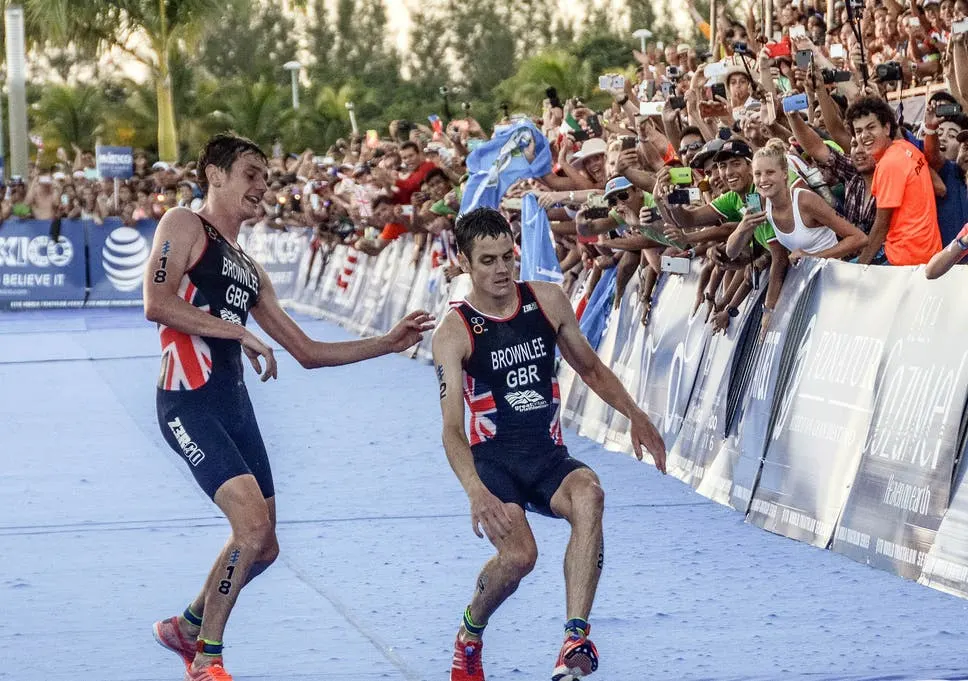
In 2016, 26-year-old triathlete Jonny Brownlee was leading a race in very hot and humid conditions when, about 700 metres from the finish, he lost his balance. Helped along by his brother Alistair Brownlee, he finished second, a scene that lays bare both our limits and how far we can push beyond them.
It was an event that changed how we look at fatigue.
For readers who want to look more closely at the training protocols in this article, or who want more detail, the scientific sources are listed below.
References
- Girard, O., Mendez-Villanueva, A. and Bishop, D. (2011). Repeated-sprint ability, part I: Factors contributing to fatigue. Sports Medicine, 41(8), 673–694.
- Robergs, R.A. and Roberts, S. (1997). Exercise Physiology: Exercise, Performance, and Clinical Applications. St. Louis, MO: Mosby.
- Edge, J., Bishop, D. and Goodman, C. (2006). The effects of training intensity on muscle buffer capacity in females. European Journal of Applied Physiology, 96, 97–105.
- Gormley, S.E. et al. (2008). Effect of intensity of aerobic training on VO2max. Medicine and Science in Sports and Exercise, 40(7), 1336–1343.
- Powers, S.K. and Howley, E.T. (2012). Exercise Physiology: Theory and Application to Fitness and Performance (8th ed.). New York: McGraw-Hill.
- Lorenzo, S. et al. (2010). Heat acclimation improves exercise performance. Journal of Applied Physiology, 109, 1140–1147.
Related: Enzymes and Exercise: How Cellular Processes Affect Performance

Hüseyin Akbulut is the founder of Sporeus and author of THRESHOLD (EŞİK), a 540-page Turkish-language book on endurance science.
- 540pp THRESHOLD Book
- MSc Sport Sciences
- Marmara University
Getting Started
When we begin a training session or any task that demands physical effort, our muscles feel strong and supple (setting aside the effects of warming up for a moment).
Causes of Muscle Fatigue
Many factors can cause muscle fatigue, including:
How Can Muscle Fatigue Be Prevented?
Prevention depends on the underlying causes of your muscle fatigue, the symptoms that accompany it and how aware you are of them. If you feel muscle fatigue and do not think it is linked to exercise, see a doctor.
Simple Tips to Prevent Muscle Fatigue and Related Problems Eat 2 to 3 hours before training (this gap helps make sure your muscles are fuelled, digestion is complete, and blood glucose and insulin have returned to baseline).Make sure you drink about half a litre of water in the 2 to 3 hours before training.Do your warm-up and cool-down properly.Switch between different exercises. Avoid doing the same exercise every day!Be aware of the air temperature when you train! Do not underestimate the effects of heat!Pay attention to how the type of exercise or sport you do makes you feel.If you are a beginner, do not exceed 2 high-intensity sessions a week. Add active recovery sessions to your programme for the days after hard sessions!Do not neglect to take at least 1 full rest day a week! What You Need to Know About Exercise and Muscle Fatigue
From the point of view of sport and exercise science, fatigue simply describes the inability to continue exercising at a given intensity or to meet a given load, but physiologically it is highly complex.
The Relationship Between Muscle Fatigue and Exercise
Let us look at some examples.