Preview
Hüseyin Akbulut, MSc (2026). Motor Control: Signals From the Nervous System to the Muscles. Sporeus. Retrieved, November 18, 2026. https://sporeus.com/en/science/motor-control-nervous-system-to-muscles/
While you run, the brain and nervous system work to control movement through both the voluntary and the autonomic systems. They also work with the endocrine system to make adjustments and keep neural processes running.
At the same time, they must keep the body’s systems working in balance.
As we know, the brain is the body’s control centre. It can exert this control consciously, that is voluntarily, and also below the level of awareness, autonomically.
The definitions may sound simple, but whether we look at autonomic control or conscious control, the organisation and hierarchy within neural networks behind even the simplest muscle movement, or the perception of that movement, are highly complex.
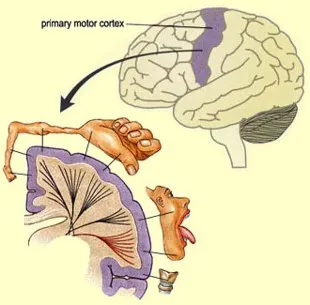
The brain sends and receives signals through the spinal cord and the peripheral nervous system. In other words, it connects and communicates with almost every system in the body. The peripheral nervous system is further divided into the autonomic nervous system and the somatic nervous system.
The somatic nervous system plays an active role in the motor and sensory mechanisms behind voluntary control of skeletal muscle.
The autonomic nervous system, by contrast, governs involuntary physiological processes in the body, such as regulating temperature, breathing and heart rate.
The Cerebral Cortex and Motor Control
The cerebral cortex is the wrinkled outer layer that makes up most of the brain. The motor and sensory areas are located mainly in the frontal and parietal lobes, but they have connections distributed throughout the cortex.
While you run, movement is controlled through cooperation between the motor cortex, the areas connected to it and the spinal cord. The basic rhythm of rhythmic movements such as walking and running is generated largely by neural networks in the spinal cord (central pattern generators); the evidence for this in humans is indirect, but the cortex, brainstem and cerebellum continuously adjust this rhythm to speed, terrain and goal.
Signals from almost every system in the body are carried to the brain through peripheral nerves, and in this way the nervous system sends new commands back to the body’s systems. Signals and feedback flow continuously, and information keeps moving between the nervous system and the body’s systems.
During this communication, extensive and continuous cooperation between the endocrine and nervous systems is very important for correcting changes in the body’s systems, which nerve cells keep monitoring, and for maintaining balance.
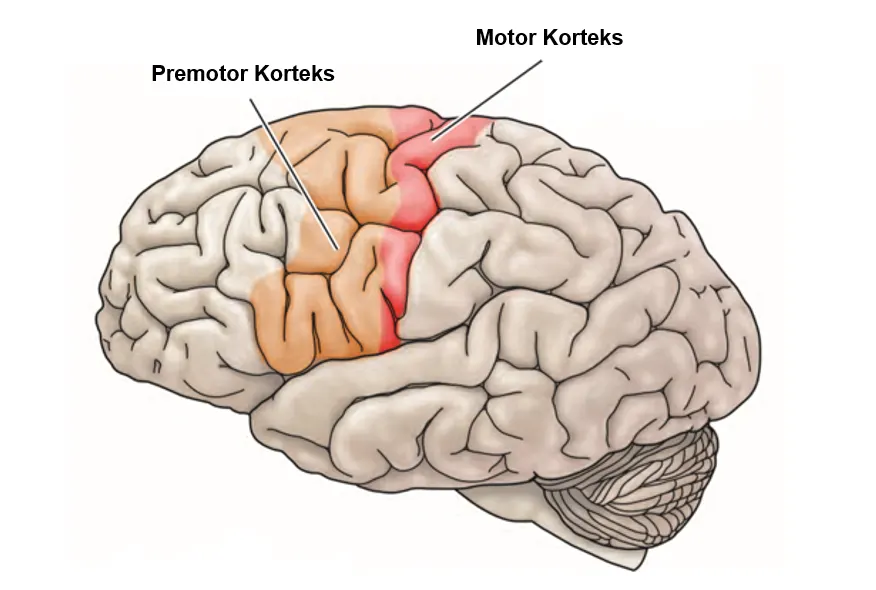
The motor cortex (located at the back of the frontal lobe) is responsible for executing muscle movements, particularly voluntary ones.
It plays a very active role in organising the neuromuscular cooperation needed to carry out a movement.
Signals sent from the spinal cord and peripheral nerves through motor neurons give the muscles their commands to contract and relax when needed.
Put as simply as possible, that is how motor control can be summarised.
What it means for elite athletes: The nervous system adapts to training too. Heavy and explosive strength training raises the rate of force development by increasing neural drive to the muscles (motor unit firing rate and recruitment) (Aagaard et al., 2002); a large part of the gains in the first weeks of strength training comes from these neural adaptations before the muscles grow. The automation of technical skill works on the same logic: the more automatic a movement is, the less load the cortex carries under fatigue and pressure. That is why elite programmes place technical and sprint quality work before fatiguing sessions, while the nervous system is fresh.
You may also like: Types of Muscle: How Skeletal, Smooth and Cardiac Muscle Differ
References
- Sanes JN, Donoghue JP. (2000). Plasticity and primary motor cortex. Annual Review of Neuroscience, 23: 393–415. doi:10.1146/annurev.neuro.23.1.393
- Scott SH. (2004). Optimal feedback control and the neural basis of volitional motor control. Nature Reviews Neuroscience, 5(7): 532–546. doi:10.1038/nrn1427
- Kandel ER, Schwartz JH, Jessell TM, Siegelbaum SA, Hudspeth AJ. (2013). Principles of Neural Science (5th ed.). McGraw-Hill. ISBN 978-0071390118

Hüseyin Akbulut is the founder of Sporeus and author of THRESHOLD (EŞİK), a 540-page Turkish-language book on endurance science.
- 540pp THRESHOLD Book
- MSc Sport Sciences
- Marmara University