
Preview
Hüseyin Akbulut, MSc (2026). Muscle Development: Stress, Limits and Recovery. Sporeus. Retrieved, November 19, 2026. https://sporeus.com/en/sport/muscle-development-stress-limits-recovery/
By now we all know that to build muscle we have to expose the body to a load or resistance so that stress is placed on the tissue. If you perform a movement with good technique and the weight suits you, your body will overcome the stress of the movement without struggling.
But what happens under a very heavy load? At that point the processes start to change. Your nervous system brings more muscle into play to produce more force. Meanwhile, cytokines are released to repair the metabolic breakdown in the muscle fibres, triggering an immune response. The muscle then regenerates, and once it has, it becomes more capable.
Muscle Development
Muscle development depends on many factors. The kind of load the muscle is exposed to, or the resistance it has to overcome, creates limits depending on the quality you want to develop.
If we know these limits, we can first plan our training programme more precisely and then get healthier, more appropriate progress from each session.
Let’s look at the factors that affect muscle development.
Timing of muscle tension
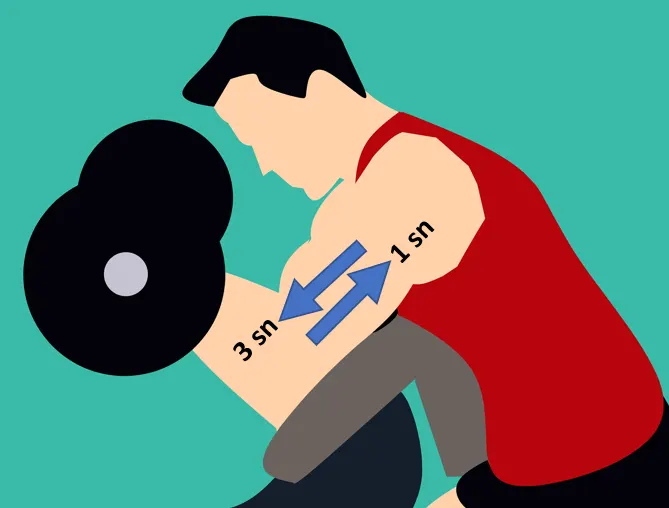
The figure shows the kind of tension the muscle should be under during the movement. The key point is time.
In this example, as the arm is lowered (eccentric contraction), the biceps lengthens in a controlled way while resisting (in Turkish) the weight of the dumbbell, which gravity pulls downwards. When the full range of motion is reached (full extension), the biceps shortens and lifts the weight (concentric contraction).
A common recommendation is to perform the eccentric phase (where gravity helps) more slowly than the concentric phase. The eccentric phase can be lengthened further when the concentric phase is performed fast or “explosively”, but there should always be a ratio between them (the 1:3 ratio is just an example to make this easier to understand). However, a meta-analysis showed that repetition durations between 0.5 and 8 seconds produce similar muscle growth (Schoenfeld et al., 2015), so tempo is best seen as a tool for keeping control.
Resistance training also includes many movements in which you work against gravity with your own body weight, such as push-ups or pull-ups.
The Body’s Limits in Muscle Development
If the weight you use in training is appropriate (let’s simply assume it is not relatively too heavy), there is a number of repetitions your body can sustain in each set.
Our physiological and psychological capacities and limits are kept in a delicate balance in which each affects the other. Put simply, it looks like this:
| Time frame | Skill | ↔ | Limit |
|---|---|---|---|
| Movement | Repetitions | ↔ | Weight (resistance) |
| Session | Rest periods | ↔ | Intensity |
| Day | Training duration | ↔ | Physiological capacity |
| Week | Training frequency | ↔ | Recovery time |
“Resistance exercise” is the umbrella term for hypertrophy, strength and weightlifting programmes. Repetition ranges are very effective when athletes use the right weights. Three sessions a week can be devoted to resistance training (this of course depends on many factors: your fitness level, your sport, your training programme, the number of sessions per week and so on).
| Type of training | Repetitions | Goal |
|---|---|---|
| Strength | 1-5 | Maximal strength |
| Hypertrophy | 6-15 | Muscle mass and strength |
| Muscular endurance | 16+ | Muscular endurance |
Why Do Muscles Need Rest to Grow?
We said that training means putting your body under stress. After training, the body needs food and rest to recover, so that cells damaged by the stress can be repaired.
When the need for adequate rest and nutrition is not met, muscle development goes into reverse and the body comes under even greater stress. The muscle needs to escape this state and regenerate. That is why rest, and giving the muscle the time it needs to recover, is essential.
The rate at which muscle recovers varies with sex, age and genetics. This is also part of the body’s limits and should be assessed thoroughly.

And Fat Loss
Diet is the most important factor in fat loss, but exercise can speed the process up considerably. Here is how exercise helps:
A single high-intensity session increases energy expenditure.
Metabolism stays elevated for a while after training; after heavy resistance training this increase can last up to 48 hours, although the total extra expenditure is modest.
When muscle is exposed to heavy stress (high-intensity training), it needs energy (calories) for repair and regeneration.
As muscle mass increases, so does the energy needed to maintain it.
So when exercise is combined with diet, controlling your body weight becomes much easier.
You may also be interested in: Muscle Fatigue: Causes, Effects and Training
References
- Schoenfeld BJ. (2010). The mechanisms of muscle hypertrophy and their application to resistance training. Journal of Strength and Conditioning Research, 24(10): 2857-2872. doi:10.1519/JSC.0b013e3181e840f3
- Ratamess NA, Alvar BA, Evetoch TK, Housh TJ, Kibler WB, Kraemer WJ, Triplett NT. (2009). American College of Sports Medicine position stand. Progression models in resistance training for healthy adults. Medicine & Science in Sports & Exercise, 41(3): 687-708. doi:10.1249/MSS.0b013e3181915670
- Schoenfeld BJ, Ogborn DI, Krieger JW. (2015). Effect of repetition duration during resistance training on muscle hypertrophy: a systematic review and meta-analysis. Sports Medicine, 45(4): 577-585. doi:10.1007/s40279-015-0304-0
- Peake JM, Neubauer O, Della Gatta PA, Nosaka K. (2017). Muscle damage and inflammation during recovery from exercise. Journal of Applied Physiology, 122(3): 559-570. doi:10.1152/japplphysiol.00971.2016

Hüseyin Akbulut is the founder of Sporeus and author of THRESHOLD (EŞİK), a 540-page Turkish-language book on endurance science.
- 540pp THRESHOLD Book
- MSc Sport Sciences
- Marmara University
Muscle Development
Muscle development depends on many factors. The kind of load the muscle is exposed to, or the resistance it has to overcome, creates limits depending on the quality you want to develop.
Timing of muscle tension An example tempo for a biceps curl: about 3 s to lower the weight and 1 s to lift it ("sn" = seconds). The figure shows the kind of tension the muscle should be under during the movement. The key point is time. In this example, as the arm is lowered (eccentric contraction), the biceps lengthens in a controlled way while resisting (in Turkish) the weight of the dumbbell, which gravity pulls downwards. When the full range of motion is reached (full extension), the biceps shortens and lifts the weight (concentric contraction). A common recommendation is to perform the eccentric phase (where gravity helps) more slowly than the concentric phase. The eccentric phase can be lengthened further when the concentric phase is performed fast or "explosively", but there should always be a ratio between them (the 1:3 ratio is just an example to make this easier to understand). However, a meta-analysis showed that repetition durations between 0.5 and 8 seconds produce similar muscle growth (Schoenfeld et al., 2015), so tempo is best seen as a tool for keeping control. Resistance training also includes many movements in which you work against gravity with your own body weight, such as push-ups or pull-ups. The Body's Limits in Muscle Development
If the weight you use in training is appropriate (let's simply assume it is not relatively too heavy), there is a number of repetitions your body can sustain in each set.
Why Do Muscles Need Rest to Grow?
We said that training means putting your body under stress. After training, the body needs food and rest to recover, so that cells damaged by the stress can be repaired.
And Fat Loss
Diet is the most important factor in fat loss, but exercise can speed the process up considerably. Here is how exercise helps: