Preview
Hüseyin Akbulut, MSc (2026). Hamish Bond and the Rowing Aerobic Power and 2-Kilometre Pace of an Elite Rower. Sporeus. Retrieved, October 27, 2026. https://sporeus.com/en/science/hamish-bond-rowing-aerobic-power-2km-pace/
The Athlete in One Paragraph
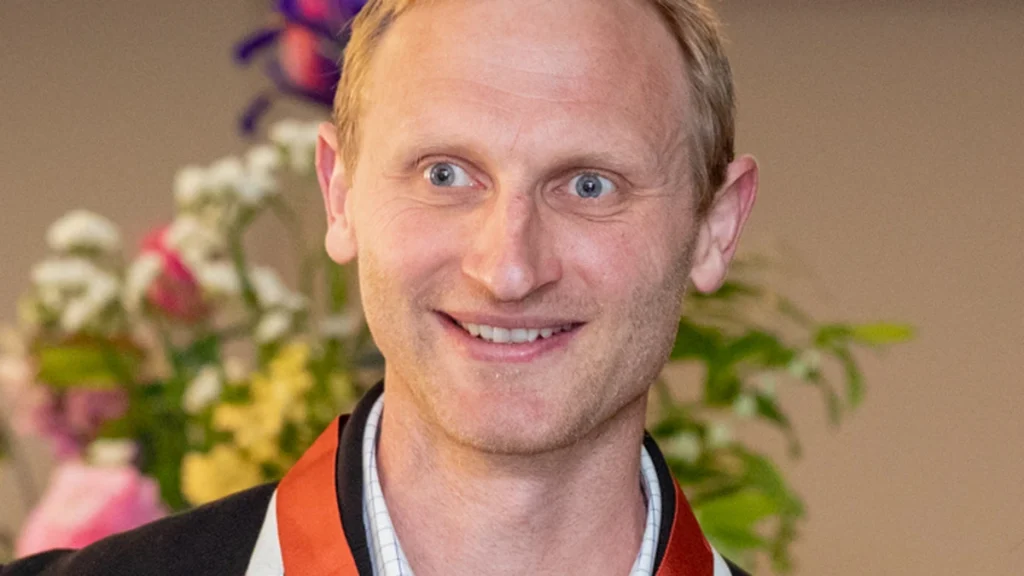
Hamish Bond (b. 1986-02-13, Dunedin, New Zealand) is a former rower of the New Zealand national programme (retired from rowing after Tokyo 2020) and a three-time Olympic champion (the men’s pair at London 2012 and Rio 2016, the men’s eight at Tokyo 2020), with a long competitive partnership alongside Eric Murray that produced an extended unbeaten run in the discipline. Listed at 1.92 m and roughly 95 kg, he carries the canonical heavyweight-rowing frame, long levers, large absolute aerobic capacity, lean musculature distributed for the leg-drive and back-swing of the stroke, into a discipline where the race lasts barely six minutes and yet is decided almost entirely by aerobic mechanisms. The interesting case for sport science is not the rower’s peak wattage in a single stroke; it is how high a sustained mechanical power output, normalised to body mass, can be held for the duration of a 2000-metre race. The variable underneath that pattern is rowing aerobic power and 2-kilometre pace, the watts per kilogram an athlete can produce, at a fraction of VO₂max that does not collapse before the finish line.
Table of Contents
The Physiology: what rowing aerobic power actually is
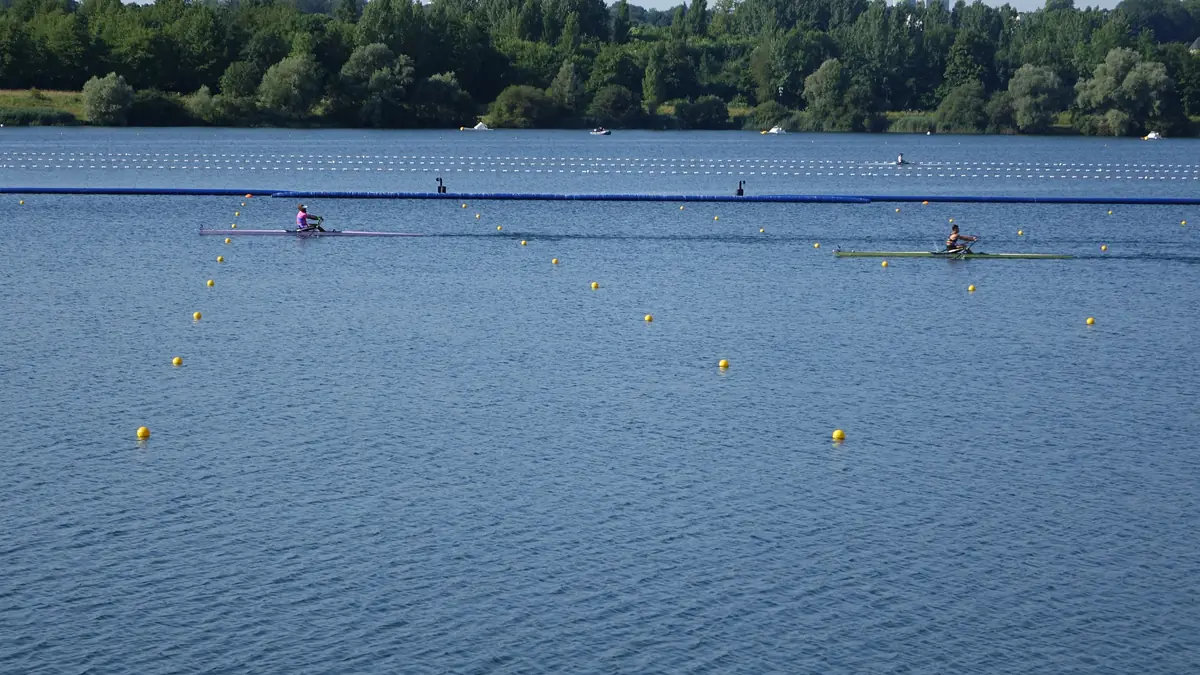
Rowing’s 2000-metre race is a peculiar duration in endurance physiology: long enough that the aerobic system supplies the majority of total ATP turnover, short enough that a non-trivial anaerobic contribution sits on top. The Joyner and Coyle framework, VO₂max, the sustainable fraction of that ceiling, and exercise economy, translates onto the water with the additional twist that the rower’s mechanical output must be applied through an oar in repeated, discrete strokes [1]. Absolute VO₂max values reported in elite heavyweight rowers sit at the upper end of any endurance population; expressed per kilogram of body mass, the numbers compete with cyclists and runners despite the rower’s much larger absolute frame.
The second component is the threshold position. Faude and colleagues’ review of lactate-threshold concepts established that the highest sustainable steady-state intensity is the maximal lactate steady state, the velocity above which blood lactate accumulates uncontrollably; in rowing terms, this is the wattage above which the second half of the race becomes a survival exercise rather than a continuation of the first half [2]. A 6-minute race is short enough that elite rowers actually spend most of it above their threshold, with blood lactate climbing throughout, but the higher the threshold, the smaller the supra-threshold gap that has to be bridged anaerobically.
The third component is the high-intensity interval framework. Buchheit and Laursen’s HIIT review formalised the principle that aerobic ceiling and threshold position are both trainable on intermittent stimuli at or above VO₂max-eliciting intensity; for rowing, this maps directly onto the long-standing practice of repeated 4–6-minute pieces at race pace or just below [3]. The aerobic ceiling rises with sustained training; the threshold migrates upward toward the ceiling as the years accumulate; and the gap between the two becomes the race-specific reservoir.
Stølen and colleagues’ broader endurance review reinforced that rowing’s energy distribution, roughly 75–85% aerobic in a 2000-metre race, sits much closer to a long-distance event than the duration alone suggests, which is why heavy aerobic-base volume sits underneath every elite rowing programme [4]. Helgerud and colleagues’ interval-training work showed that VO₂max and threshold velocity in trained athletes both respond to high-intensity aerobic intervals, the same training logic that organises the rower’s racing season [5].
The Case: Bond as a heavyweight aerobic-power lens
For a heavyweight rower at 1.92 m and ~95 kg, the arithmetic of 2000-metre pace is unforgiving. Sustained mechanical power outputs in the 5–6 W/kg range at race intensity are consistent with elite heavyweight performance reported in the rowing literature; the absolute number, the total wattage applied to the oar, is enormous, but it is the per-kilogram value that determines whether the boat moves at world-best velocity. Bond’s competitive record in the men’s pair across more than a decade is the cleanest applied demonstration of this principle: long-form dominance in a discipline where the second-half pace cannot be faked by tactical surge [1].
His anthropometry is consistent with the heavyweight-rowing archetype. Long levers convert into a longer effective stroke at a given rating, which means more impulse per stroke and lower stroke-rate demand for the same boat speed; large skeletal muscle mass supports a high absolute VO₂ value that, when normalised to a 95 kg frame, still expresses a per-kilogram capacity competitive with smaller endurance athletes [4]. The economy variable, the oxygen cost of producing a given submaximal wattage on the rowing ergometer or in the boat, refines itself across years of consistent training, and is a non-trivial differentiator at the elite level [3].
The pacing implication is structural. Faude’s threshold work makes clear that the 2000-metre race cannot be paced purely aerobically; the start and the final-quarter sprint are above-threshold by design [2]. The athlete who arrives at the 1500-metre mark with a higher remaining aerobic share, because the threshold sits closer to the ceiling, is the athlete who can hold race-pace wattage when the boat is hurting. Bond’s career consistency in the pair, where the second half is decided more by aerobic durability than by initial-burst power, is descriptively consistent with a threshold–ceiling profile pushed to the upper bound of contemporary heavyweight rowing [1, 5].
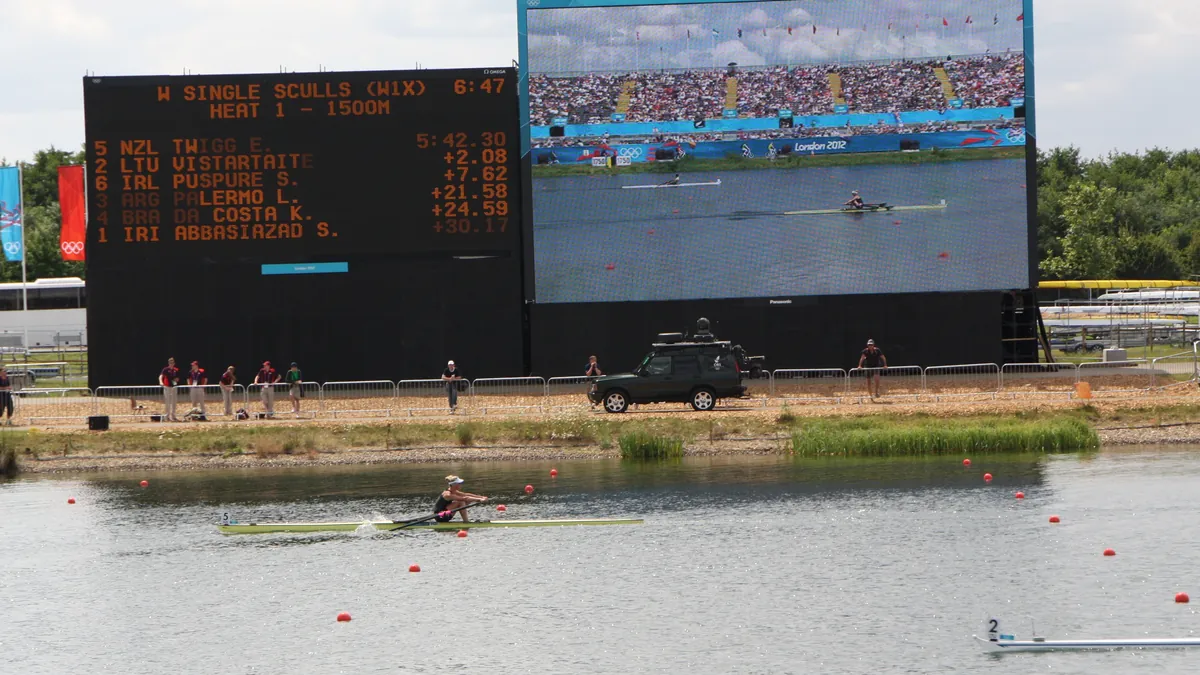
(Performance data: World Rowing)
What This Means for the Reader
For the developing rower or the cross-trained endurance athlete, the takeaway is that the 2000-metre race is an aerobic-power event with an anaerobic top layer, not the reverse. Many amateurs train as if the race were a 6-minute anaerobic time-trial and chase short, supra-threshold pieces while neglecting the long aerobic-base work that raises the ceiling itself; the threshold cannot move higher than the ceiling allows, and the per-kilogram race-pace wattage is determined by the product of both [1, 4].
The training implication is the classical polarised approach, a substantial volume at low intensity to develop the ceiling, layered with focused threshold and VO₂max-eliciting intervals to migrate the threshold upward [3, 5]. Foster’s broader load-monitoring logic applies: the chronic aerobic load is the ceiling-builder, and the acute high-intensity sessions are the precision tool laid on top.
The diagnostic question for the developing rower: at race-pace wattage on the ergometer, what is your sustainable output per kilogram of body mass for a full 2000 metres and how much of that wattage is supplied by an aerobic system whose ceiling has actually been built?
References
- Joyner MJ, Coyle EF. (2008). Endurance exercise performance: the physiology of champions. The Journal of Physiology, 586(1): 35–44. doi:10.1113/jphysiol.2007.143834
- Faude O, Kindermann W, Meyer T. (2009). Lactate threshold concepts: how valid are they? Sports Medicine, 39(6): 469–490. doi:10.2165/00007256-200939060-00003
- Buchheit M, Laursen PB. (2013). High-intensity interval training, solutions to the programming puzzle. Sports Medicine, 43(5): 313–338. doi:10.1007/s40279-013-0029-x
- Stølen T, Chamari K, Castagna C, Wisløff U. (2005). Physiology of soccer: an update. Sports Medicine, 35(6): 501–536. doi:10.2165/00007256-200535060-00004
- Helgerud J, Engen LC, Wisløff U, Hoff J. (2001). Aerobic endurance training improves soccer performance. Medicine & Science in Sports & Exercise, 33(11): 1925–1931. doi:10.1097/00005768-200111000-00019
Performance data (descriptive only): World Rowing.
Hüseyin Akbulut is the founder of Sporeus and author of THRESHOLD (EŞİK), a 540-page Turkish-language book on endurance science.
- 540pp THRESHOLD Book
- MSc Sport Sciences
- Marmara University
The Athlete in One Paragraph
Hamish Bond (b. 1986-02-13, Dunedin, New Zealand) is a former rower of the New Zealand national programme (retired from rowing after Tokyo 2020) and a three-time Olympic champion (the men's pair at London 2012 and Rio 2016, the men's eight at Tokyo 2020), with a…
The Physiology: what rowing aerobic power actually is
Rowing's 2000-metre race is a peculiar duration in endurance physiology: long enough that the aerobic system supplies the majority of total ATP turnover, short enough that a non-trivial anaerobic contribution sits on top. The Joyner and Coyle framework, VO₂max, the sustainable fraction of that ceiling,…
The Case: Bond as a heavyweight aerobic-power lens
For a heavyweight rower at 1.92 m and ~95 kg, the arithmetic of 2000-metre pace is unforgiving. Sustained mechanical power outputs in the 5–6 W/kg range at race intensity are consistent with elite heavyweight performance reported in the rowing literature; the absolute number, the total…
What This Means for the Reader
For the developing rower or the cross-trained endurance athlete, the takeaway is that the 2000-metre race is an aerobic-power event with an anaerobic top layer, not the reverse. Many amateurs train as if the race were a 6-minute anaerobic time-trial and chase short, supra-threshold pieces…